
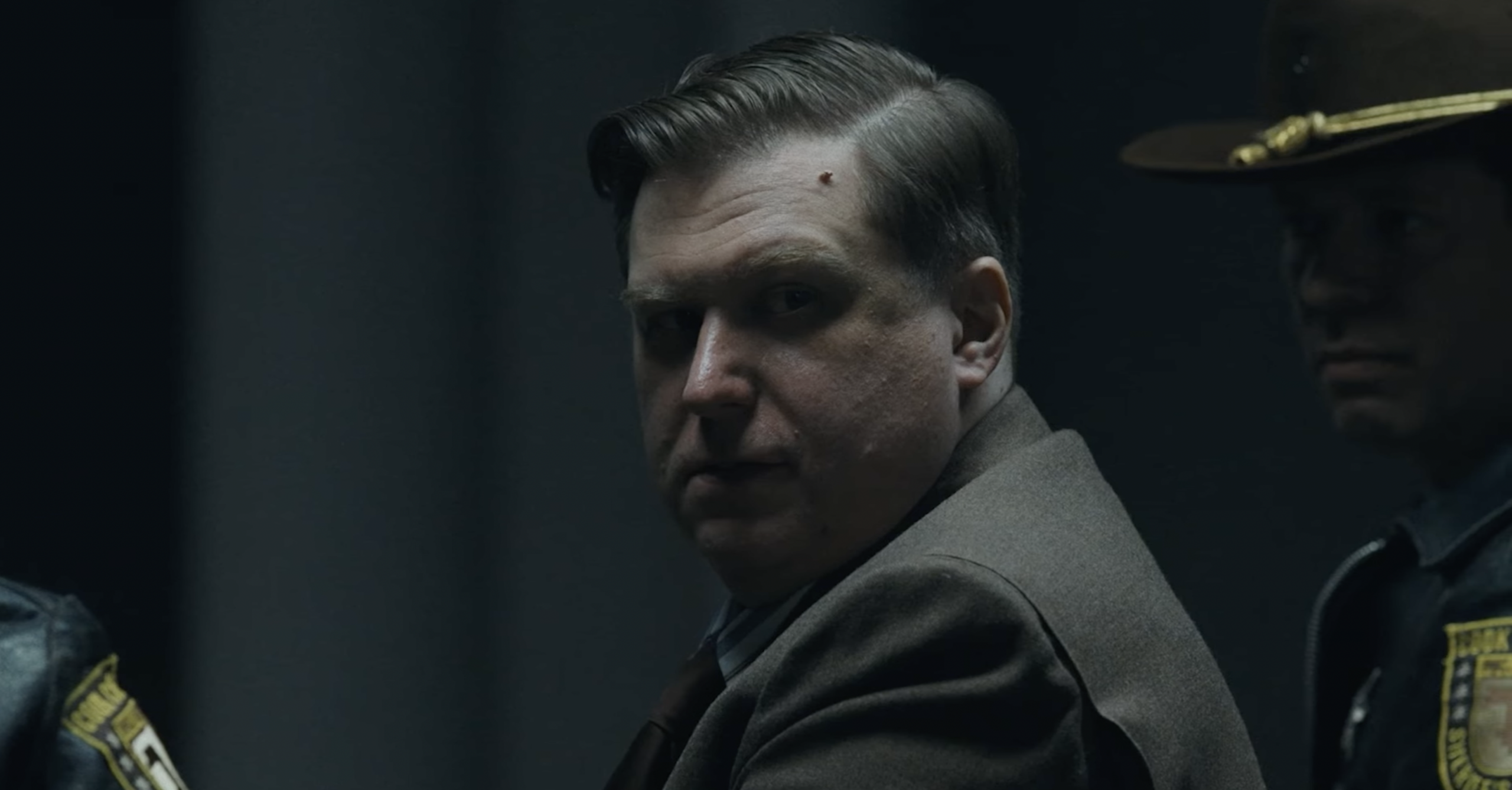
When I meet with an actor to talk about their work playing a real-life person who did horrible things, there’s always a sense of sobriety that comes over me before we begin the conversation. Never was that more true than when I met with Michael Chernus, who plays the lead character in Peacock’s limited series, Devil in Disguise: John Wayne Gacy. We live in a time where the public fascination with serial killers, with infamy itself, is at an all-time high. Every film or series that walks into the world of true crime has a responsibility to take its subject and the consequences of their actions seriously. Far too few pass that test. The genre has been polluted with exploitative and irresponsible projects that are made too quickly and with too little care.
I was skeptical of Devil in Disguise: John Wayne Gacy before I sat down to view it. That skepticism soon was replaced with respect, astonishment, and even admiration for what this series accomplishes. Show creator Patrick Macmanus teamed with a talented group of writers to put the focus on Gacy’s victims. Sure, Gacy is the linchpin upon which the story is based, this gregarious, ingratiating fellow who murdered at least 33 young men and boys in the greater Chicago area during the 1970s. But the heart of the show is the loss of whoever these boys and young men might have become, and, quite often, the deep pain their loved ones suffer due to the acts of one man: John Wayne Gacy.
Devil in Disguise: John Wayne Gacy is masterfully told, and authentic to the core. There were times, especially while viewing the interactions between law enforcement officers, that I could have almost sworn I was watching a lost Sidney Lumet film. Even though the series was shot in Toronto, I could practically feel the Chicago chill come through my television. At the core of any film or series focusing on the possessor of the darkest of hearts is the actor playing that person. Michael Chernus has been delivering excellent performances on film and TV for over twenty years. He’s mostly been seen in supporting roles in recent productions like Severance, A Complete Unknown, and Dead Ringers. In Devil in Disguise, Chernus is both at the center and the periphery of the show. The series takes great pains to show us who John Wayne Gacy was, and there is plenty of screen time for Chernus to do just that. But even when off-screen, his version of John Wayne Gacy casts a looming sense of dread over the entirety of the show’s eight episodes.
Chernus gives a staggering performance in Devil in Disguise: John Wayne Gacy. His ability to flip the switch from folksy and unthreatening to sinister and terrifying is extraordinary to watch. Chernus has earned outstanding notices for his work playing John Wayne Gacy, but that work did come with a cost. In our conversation, Chernus and I discuss what made the series more than just another run-of-the-mill grindhouse take on a real-life serial killer, the importance of telling these kinds of stories with rigor and respect, and the challenge of not just looking into the abyss but becoming it.
The Contending: When you were first considering taking part in the series, was there something on the page that made you recognize this wasn’t going to be the kind of project you’d feel uncomfortable doing? That it would be, as much as a rendering of this story can be, tasteful? The “true crime” genre has so many pitfalls, and there’s so much of it out there. Some of it is outstanding, but there are so many series and films on both the documentary and narrative side of the genre that feel cheap and exploitative.
Michael Chernus: Absolutely. I was drawn in right away by the writing. Patrick McManus, our head writer, executive producer, and showrunner, assembled this incredible writing staff that really understood the level of care needed to tell a story like this, especially one that’s been told ad nauseam since Gacy’s arrest. One thing that immediately struck me was that the Gacy character doesn’t even appear until 20 minutes into the pilot. Every episode is named after a different victim, and throughout the series, there are these little vignettes, which we called “short stories” on set, that showed parts of the victims’ lives before they ever crossed paths with John Gacy. That was the moment I really understood how we were going to approach the show. To be honest, I was hesitant at first when my agent told me about the meeting for the role, for all the reasons you can probably imagine. Chief among them was the question: what could I add to this story that hasn’t already been said? What could this show add? But once I started doing the research, reading the scripts, and talking at length with Patrick, I realized this could be a really unique, potentially groundbreaking way to tell these stories. I think there’s room enough for all kinds of content. But I do think that for a long time, the more salacious, exploitative versions of these stories have taken up all the space. And I think audiences now have a real appetite for something more holistic and human in the way these stories are told.
The Contending: The victim-centered nature of the show starts from the beginning, with Rob Piest, the last boy who was murdered, and then works its way from there. I remember thinking: Rob Piest was “the boy who mattered.” It broke my heart to think that, because all of these boys mattered. But in a sense, Gacy just eventually chose the wrong victim.
Michael Chernus: He did. And not to generalize, but so often these serial murderers do get sloppy, for lack of a better word, towards the end. Or maybe “cocky” is more accurate in the case of John Gacy. After all those years and all those victims, he probably really believed he was never going to get caught. The sad truth is that his last victim, Rob Piest, in many ways became the only name and face people really knew from the news coverage. That tied into the unfortunate way the case was framed at the time: that he came from a “good home.” It’s often been said that his parents were relentless in searching for him, which is very true, and that’s depicted in our show. Marin Ireland plays Elizabeth Piest so beautifully. She’s so good. But the truth is, the Piests weren’t the only parents who were out there looking. We know now that a lot of the other victims — maybe all of them — also had family members looking for them.
But this was the ’70s, and Rob was a good-looking, athletic, white boy from a middle-class family. A straight boy, by all accounts. He fit the mold of the kind of victim the public really cared about at the time. I’ll also say that the Des Plaines Police Department handled the Piest case, and they were a small enough department to actually devote some real attention to it. I think a lot of the other boys got lost within the sheer volume of cases the Chicago PD was dealing with. There was just an immense number of what they called “runaways” in the ’70s, who were, of course, actually missing children but were dismissed under that label. It was all these factors together: the systemic failures of the time, the biases at play that allowed these boys to go missing for so long without anyone truly mobilizing on their behalf. The more we started to unpack this story, we realized it wasn’t just the story of a serial killer. There was so much more there. It was so complicated, so layered, so involved.
The Contending: You mentioned that there’s so much out there about Gacy before this show—podcasts, books, the Peacock documentary with a very similar title—and some of them are very well done. When you were doing your research, and you had a trove, I don’t want to call it a treasure trove, but certainly a trove of information to work from. How did you hone in on what parts you needed most to portray this character correctly?
Michael Chernus: That is a great question, and honestly, one I probably struggled with right up until the end. There was just so much information. How do you sift through all of it? There are so many books — some good, some not so good — along with films, podcasts, documentaries, you name it. At the beginning, I just consumed everything I could. I basically did this massive download of information into my brain. I felt like I needed to know every nook and cranny of the case before I could even begin deciding what was useful and what wasn’t. I eventually started heading down the road of oversaturation. I had about four or five months between getting the role and starting production, and during that time, I became kind of obsessed. I was completely down the rabbit hole. Eventually, Patrick McManus said to me, “Stop it.” I remember being on a call with him, and he asked, “Are you still reading books about John Gacy? You actually have to put them down now.” Very wisely, he said, “There are eight scripts that you need to turn your focus to, because we are not making a documentary.” He was right. The documentaries have been made. What we were making was a fictionalized account based on a true story. Something searching for a version of the truth, yes, but still ultimately cinema, still television. So I had to put everything down and trust that I had done the work and that it was all there subconsciously and subliminally.
The Contending: What was essential from your research that helped you embody Gacy?
Michael Chernus: I think it was this sort of endless process of listening to recordings of him. I would watch interviews with him, trying to pick up his different facial tics and those little tells you notice when you know he’s lying. On set, I was constantly going back to certain quotes of Gacy’s that I’d heard or read, and I would say them to myself before we started shooting. I remember Gabriel Luna, who plays Detective Tovar so brilliantly, mentioning it after we were done shooting. He said something like, “I was amazed by how you just had these phrases of Gacy’s that you would say to yourself right before action.” I did that not only for technical reasons, to get his voice, dialect, and rhythms into my head, but also to try to embody him in a way that felt useful and… I don’t know why this word is coming to mind, but “safe” is coming to mind. Not “safe” in the sense of playing it safe, because I absolutely didn’t want to do that. I mean safe in a way that felt respectful to the larger thing we were trying to do.
I kept going back to these phrases of Gacy’s because I came to think of him as this blabbermouth. A blowhard. An egomaniac and a narcissist who desperately wanted everyone to like him. But he did have that skill of being able to talk to anyone and tell them exactly what they wanted to hear. For years, that ability kept him hidden. He was a chameleon. If you were a guy at the Moose Lodge, he knew how to speak your language. If you were the little old lady who needed her driveway shoveled, he knew how to talk to you, too. I kept thinking: if I could find this guy’s voice, then maybe that was my way in, because he used his voice so often to manipulate people. Eventually, it was that very aspect of his personality, that wanting to be liked, that made him confess. That became his downfall because it made him overtalk to the police. But at the end of the day, it was this tricky exercise. I cared so much about the stories of these young men and boys who were lost. It may sound corny or weird, but I felt a strong connection to them and an obligation to tell their story. But I also had the strange task of playing the man who hunted them down, tortured them, and killed them. On one hand, I was carrying the memory of these victims with me. But, in order to tell the story well and honestly, I had to fully embody the person who ended their lives. That was such a strange assignment.
The Contending: He had such a particular affect. There’s the Chicago accent, the Polish roots. I lived about two hours from Chicago most of my life, so I know that world and that cadence. The way he’d use words like “geez,” “hooey,” and “hankerin’,” the dropping of the g’s at the ends of words. There was this overt affability he was projecting. One thing you just said that struck me — and one of the officers in the show says it too — I’m paraphrasing here: this guy wants to be liked. You can see that so clearly in the scene where he invites the two detectives into his house. He cooks for them, has beers with them, and then goes into his “Pogo the Clown” bit. That transformation into Pogo could have come across as ridiculous, but it was so unnerving. Did it feel dangerous stepping into that kind of goofiness?
Michael Chernus: That was actually in the first week or two of shooting, if you can believe it. It was a real rip-off-the-Band-Aid, leap-and-hope-the-net-appears kind of moment. I’m very grateful for it now, though. I think it was just the way that things had to be scheduled, but a lot of my big scenes were right in the first couple of weeks of shooting. So I got thrown into the deep end and had to discover the character very quickly. That scene actually happened, by the way. He really did invite these cops who were trailing him into his house. One of the officers in the Peacock documentary, Ron Robinson, talks about how they were hanging out in his house when one of the detectives went into the bathroom. Then he says, in this thick Chicago accent, “The heat kicked on.” And when the heat kicked on, they smelled the bodies. That scene was difficult because Gacy had to seem folksy enough, approachable enough, nonthreatening enough that you could believe these officers would actually agree to come inside, sit down, have dinner, have a beer with him. While the detectives must have recognized the opportunity to poke around, they also had to feel safe enough to go against best practices and just waltz into this guy’s house for a drink. So I had to come off as non-threatening, but then be able to flip that switch immediately. There’s just something so unsettling about a grown man putting on the artifice of a clown and trying to appear childlike when we, as the audience, know the horrific things he’s done. We shot that scene a number of different ways, but I knew it had to feel authentic. I’ve done a lot of theater, and I’ve watched a lot of videos of clowns — everything from hokey birthday party clowns to great clowns like Bill Irwin — just studying the different physical approaches and the way people move when they’re trying to be a clown.
I wanted it to feel like this was a guy who had actually done this for years. He really had gone to hospitals, birthday parties, and parades as a clown. So you didn’t want it to feel like he didn’t know what he was doing, or that he was bad at it. At the same time, though, he was still a self-taught amateur. That scene became a real defining moment for me. There was such a fine line to walk. And then there’s that final moment where he tells the detectives that clowns can get away with anything. That clowns can get away with murder. We talked a lot about that moment. Like, how conscious or unconscious is that statement? Is he deliberately manipulating them, or does something slip out unconsciously? Not to invoke politics, but it feels like when Donald Trump said he could shoot someone on Fifth Avenue and get away with it. It’s that same kind of blind narcissism. This absolute belief that you’re untouchable. So in Gacy’s case, maybe the line is just a brag. Just a statement of fact, in his mind. That scene really captures a lot of the different layers I had to confront while playing him. It wasn’t as simple as “bad guy.” And I don’t think real life ever is. Only horror movies and fairy tales paint villains in broad strokes. I have a three-year-old, so we watch a lot of Disney movies. In those movies, the bad guy, or the evil witch, or whatever, is always painted in broad strokes. In real life, it’s much more complicated.
The Contending: Personally, I always try to be very careful with the word “monster.” I understand why people use it, of course, but I’m uncomfortable with the way we as a society sometimes describe people who commit horrible acts as monsters. They did something monstrous, absolutely. But they are still human beings. To me, that’s actually more frightening. With Gacy, one thing I noticed, especially on a second viewing, is how the anger is always just behind the façade. I could feel it simmering underneath so many scenes. I talked a little about this with Evan Peters when he played Dahmer. There’s not a huge amount those two men have in common…
Michael Chernus: There’s some.
The Contending: But there is one aspect they shared, in particular, that stuck with me. Both of these men were essentially gay men living in a period when it was simply unacceptable, completely unacceptable, to be gay. Back then, it was just an entirely different reality. With Gacy, especially, there’s this intense repression of those feelings. He’s constantly denying that he is gay. How much did repression factor into the way you built the character?
Michael Chernus: Man, we talked about this a lot, and I think it’s central to the discussion of John Gacy and these crimes. I think whenever someone represses an essential part of themselves, those feelings have to go somewhere. I think that goes for anyone. We’ve all dissociated from something we’d rather not deal with, or kept a secret from ourselves. It’s a lie that we tell ourselves to think that those feelings can just go away. They don’t simply disappear. They come out in different ways. They come out sideways. The good news is that for the vast majority of people, gay, straight, or however they identify, those repressed feelings usually don’t manifest in harming or murdering others. There’s a phrase in modern psychology that gets repeated a lot: “hurt people hurt people.” While I think there’s a lot of truth in that, the thing I kept coming back to with Gacy is that in the 1960s and 1970s, there were millions of other people who grew up feeling unsafe to come out, who repressed their identities, and who never murdered 33 boys and young men.
Unfortunately, millions of people grew up with abusive alcoholic fathers throughout this country’s history, and did not go on to murder anyone, let alone 33 people. But yes, he undoubtedly and absolutely experienced abuse himself. He was sexually abused as a child by a friend of his father’s. His father physically beat him for years, almost nightly at times. His father was also a severe alcoholic who reportedly said that if he ever discovered his son was gay, he would kill him. John Gacy was clearly struggling with enormous trauma and repression. I think you’re hitting on something central to the discussion of why John Gacy did what he did. We spoke with GLAAD a bunch when we were making the show, and they were advisors on the show, and they rightfully cautioned us to steer away from a narrative that he did what he did because he was gay.
The Contending: Right. The question is not whether being gay made him a serial killer. I think the question is whether not being allowed to be himself, and how that created his self-loathing, contributed to making him a killer.
Michael Chernus: I think he had a huge amount of self-hatred, whether he would’ve been born attracted to women or men. I think the abuse that he suffered really severed a part of his humanity. If I’m able to offer any kind of compassion and empathy towards him, I think what he suffered as a child really cut off his own ability to have empathy for others. But I do believe that he was a psychopath, and that his particular version of psychopathy manifested in a kind of bloodlust. For him, sex and lust led to murder. I do believe that, whether his sexual preference was men or women, he was probably destined to be a serial murderer. You’re hitting on something that I struggled with a lot, and that I think is addressed in the show. There’s a whole episode where Gacy’s speaking to a psychiatrist in prison, and this idea comes up of the early abuse from his father when he was young. This shame that developed from being drawn to his mother’s panties, and you brought up earlier, that many people have said that he just wanted to be liked.
I think often what happened with his victims, not in every case, but what happened, the ones that he ended up killing were often people who said they would “out” him. That, or even sometimes changed the price on him, or tried to run away, or said something like they weren’t attracted to him and would only have had sex with him for money. It was any time that he felt rejected, compromised, or threatened. By all accounts, he was cruising constantly and brought home probably hundreds of young men. There are many accounts of young men who got into the car, felt something was wrong, and then got out. We know of accounts of young men who were brought back to his house and unfortunately tortured, but thankfully did survive and escape, or Gacy let them go. For whatever reason, the 33 that we know of that he killed, there was something that happened those nights that triggered him. I believe it’s rooted in a feeling of being judged or rejected, or scolded or criticized, in a way that felt historically familiar to him.
The Contending: It’s critical what you said there, because I struggled with how to ask that question, because I don’t believe he killed these boys because he was gay. But what if he had not lived under that judgment? That rejection of who he is from his parents and peers? When you have this immense denial of who you are as a person, it rarely manifests itself into becoming a serial killer. But there is something about the unfairness that creates anger and frustration that pour out in an unhealthy manner, usually in far less demonstrably horrible ways than this. I didn’t feel sorry for Gacy exactly, but I kept looking at him thinking, Was there some other way this could have turned out? But you can’t reduce this sort of psychopathy down to a single aspect.
Michael Chernus: We’ll never know, right? I wrestled with that for months and still wrestle with it. It’s impossible to know. I think a lot of people would argue that if he had been raised in a loving home, a stable home with two parents who weren’t bringing their own baggage and their own addictions to their parenting, it’s possible that he would’ve turned out completely different. It’s this age-old question of nature versus nurture. I agree with you. I fall on the side that I don’t believe that there are monsters, that people are born inherently evil. At the same time, it’s still a bit of a mystery. What percentage of your upbringing, your childhood, and your parents and the people around you, were you bullied at school? How much does that impact who you become, and how much of it is already just preloaded in your DNA, and we just don’t know. One of the things I really struggled with, and you mentioned that you didn’t exactly sympathize with him in watching it, it’s a tough thing. People always say to young actors, “Well, you’ve got to find a way to connect with your character,” right? I remember in drama school they used to say, “Even if you’re playing Hitler, you’ve got to find a way in.” You’ve got to find a way to, at least for you as an actor, to justify why they did what they did and to understand it and to empathize with your character—to embrace whatever that wound was that they had.
I went to Juilliard, which is mostly classical theater, and I remember doing scenes from the Scottish play Macbeth and playing Macbeth, this murderous person who’s driven by ego and totally obsessed with his own advancement and career, to the point of going so far as to kill the king. You’ve got to find a way to justify that in the character’s mind. After playing this role, I don’t know how much belief I put in that anymore. I think that to embody someone, you absolutely have to find the humanity in them. That was the exercise for me. Yeah. I don’t believe that John Gacy was a monster. He did monstrous things. I think it’s scarier that he was a human being who was capable of doing these monstrous things. That became very important because I think these guys, these serial killers—we put them on this pop culture pedestal. Some people end up, if you can believe it, looking up to them. Writing songs about them or getting tattoos of them or, with Gacy, buying his paintings for thousands of dollars. Because we turn them into something larger-than-life, everybody knows the names of Ted Bundy, Jeffrey Dahmer, and John Gacy. Or we give them these almost-Marvel-villain nicknames like The Night Stalker, BTK, or The Killer Clown, in this case.
I think we do ourselves a disservice because when someone becomes The Killer Clown. It’s like they’re The Joker or The Penguin in a Batman comic, and they cease to be real. We can then metabolize them. We can understand them as a society. They’re evil. They’re a monster. It’s those broad strokes from the Disney movie villains. He was The Killer Clown. But when he’s just this schlubby contractor from the suburbs of Chicago who had Polish immigrant parents, and he’s got a drinking problem, and he’s lonely and repressed, and he maybe kills his first victim and realizes he likes how it feels. Many accounts say that he said he had an orgasm when he killed his first victim, Timothy McCoy, whom he called the Greyhound bus boy. All of a sudden, you’re humanizing this person. You’re not justifying it. You’re not explaining it away. You’re not asking the audience to empathize with them. I did want the audience to realize this is a human being, who could be someone in your community. I don’t say that as a scary thing. I mean it in the way that it’s not fantasy. It’s not a comic book. That was the slippery slope. That was the question: How do I make John Gacy seem fully human without making people walk away thinking, “Ah, I kinda like him.”
The Contending: He was integrated into his community, not only as a businessman, but in politics. He was a member of organizations. In some respects, he was looked up to, maybe not as much as he thought he should be, but he was. That’s what’s so fascinating and troubling: he was hiding in plain sight. The idea of being cautious with who we let into our lives really came to me while watching the series.
Michael Chernus: I struggled with that in the very beginning. In rehearsals and during the first couple of days of shooting, we would do a scene, and sometimes the crew would laugh, or the other actors would say, “Oh man, that was hilarious and weird.” Especially with the clown scene you mentioned. I remember saying to Patrick, “I’m worried he’s coming off as too likable. Everyone thinks it’s funny.” And Patrick said: “He was funny.” That’s what all the books say. He was charming. He was like the most charming guy in the neighborhood. He presented to some, if you didn’t know all the horrible things he did, as a Chris Farley or a John Candy type. These lovable, kinda chubby Midwestern guys that we see in pop culture and think, “Oh, he’s so goofy and funny.” Or, “I’d love to have a couple beers with that guy.”
At first, I felt that making him likable would somehow be a disservice to the victims and their memory. Patrick eventually convinced me that fully embodying him was actually the only way to give service to the victims and their stories. Because if the audience gets pulled into thinking this guy is likable, then we begin to understand how those boys got into his car. Or took that job at PDM Contractors to work for him. Or wanted to share that joint with him. Because he seemed safe, he seemed fun. He seemed disarming and jolly. He didn’t present as threatening. Some of the guys who worked with him even expressed how amazed they were that John could dig all those graves under the house. “He was so out of shape, he could barely do anything.” He had to hire all these young guys to do his work for him.
The Contending: I remember years ago reading an interview with Christian Bale in which he said that when he played Patrick Bateman in American Psycho, he slept like a baby, but when he played Jesus in a television miniseries, he had nightmares every night. What was it like for you to live in this character during shooting, and then afterward try to let him go?
Michael Chernus: That’s amazing. I’d never heard that anecdote. I love that film. I think serial killers have occupied this strange place in the acting zeitgeist for a long time, since The Silence of the Lambs. People look at it as a very complex thing. How do you play someone who can appear intelligent, charming, even warm, while hiding something horrific underneath? These people are, as the title of our show says, “devils in disguise.” They’re hiding in plain sight. So the challenge becomes: how do you play all those different versions of a person at once? But I will say that, emotionally, someone like Marin Ireland (as Rob Piest’s mother) probably carried a much heavier burden than I did. She had to show up every day and experience, moment by moment: “Where is my son? My son is missing. They still haven’t found him. Oh my God, maybe he’s dead. Oh my God, he is dead.” The sheer number of devastating revelations she had to process onscreen was overwhelming, and she did such an incredible job.
For me, stepping into the skin of this horrible man, I actually understand what Christian Bale meant. In some ways, it was almost too… “easy” is the wrong word, because I don’t mean easy emotionally. But this was a man doing exactly what he wanted to do until the moment he got caught. By the time of Rob Piest, he had done this dozens of times. He was comfortable. He wasn’t afraid of being caught. He knew the routine. Like an addict, he knew exactly how to get his fix. There was a strange detachment I felt while playing him. A coldness that would sort of take over. It was almost freeing as an actor to play him. A character who didn’t have any guilt. Any shame. Most of us, or at least I’ll speak for myself, walk around with a great deal of guilt and shame and neurosis. This man had none of that.
The Contending: Not an ounce.
Michael Chernus: But I did not sleep like a baby. When I got home, I felt like I would shower and try to shed the day, and then it would all come crashing down on me. One of the hardest days was this night shoot in Hamilton, Ontario. We shot mostly in Toronto, but Hamilton was our version of Chicago streets because it’s a little bit more blue collar and kind of looks like Chicago in the ’70s. We were filming part of a montage in episode six where Gacy is picking up sex worker after sex worker, victim after victim. He’s pulling over beside young men on the street and saying things like, “Get in,” or “How much?” or “You wanna get high? Get in the car.” And it was so anonymous. These were background actors, and they were all fantastic, but I didn’t know them. They weren’t regulars on the show that I was familiar with, so they were anonymous to me. Most of them, I didn’t even know the actors’ names when they were getting in the car with me. The actors’ names, I mean…
And because we were shooting so many of these moments in succession, late at night, in the rain, everyone exhausted, they became almost non-human. There was this awful sense of repetition and anonymity to it. And when I got home from, I realized that I’d just told about 20, 25 young background artists to get in this car with me for a terrible purpose. The sheer volume was palpable to me as an actor in that moment. So while there were these moments where I thought, “Oh, God, it’s strangely easy to play this guy,” there would also be moments like that night shoot where it all came crashing down. The last thing I’ll say, especially because we’re talking during awards season and in a “For Your Consideration” context, is that one of the tricky things about this show was that we had this incredible group of people. The showrunner, the cast, the crew, the writers, the directors — truly, everyone was on the same page. We all had the same mission: to honor these 33 young men and boys and tell their story in a way it hadn’t been told before. Usually, if people know the names of these victims, it’s only because they were killed by Dahmer, Bundy, or Gacy.
The Contending: They were collateral to infamy.
Michael Chernus: Right. We wanted to show them before they ever met John Gacy. We wanted to show joy and hope and potential. They were so young. We wanted to show the futures that were ripped away from them. In a lot of cases, we wanted to show queer joy being embodied—first love, first kiss. So in a strange way, even though that was the heart and purpose of the show, I was still, for better or worse, the lead character. I had never really confronted that paradox as an actor before. How do you be the lead when the story isn’t ultimately about your character? Usually, if you’re the lead, it’s your story. You’re the protagonist. Rarely is the antagonist the central figure. Shakespeare didn’t call the play Iago. He called it Othello.
So trying to fully embody this man, this person who committed monstrous acts against other human beings, while never tipping into glorification or idolization, was a delicate balance. We never wanted audiences to walk away feeling like the show was really about him, or God forbid, want to glorify him. I still find it difficult to talk about because I’m deeply proud of the work everyone did. It was incredibly hard, and people poured themselves into making this show. But all we ever wanted was for the focus to remain on those 33 boys and their memory. At the same time, I knew I still had to show up every day and fully inhabit this man. I was number one on the call sheet. The show is called Devil in Disguise: John Wayne Gacy. I’ve had to say this man’s name thousands of times while promoting it, and know that this guy’s name might be in my obituary when I die. It could be the thing I’m most known for. How do you, as an artist, make peace with that? I honestly don’t know. It’s something I’m still wrestling with. What are the long-term ramifications of playing a serial killer?
The Contending: Years ago, I interviewed Ethan Hawke for The Good Lord Bird, in which he played John Brown, the abolitionist, a huge personality who existed somewhere between righteousness and insanity. But the story itself is told through the eyes of a young slave boy named Onion. I asked Ethan about that. I said, “You’re the guy, but it’s really Onion’s story, right?” He brought up his experience on Training Day. What he took away from Training Day was this: Denzel was the event. But the story was about my character’s experience of that event. I think it’s similar. Your character is the event, to use Ethan’s words. But the story is really about these kids who had largely been left in anonymity until now.
Michael Chernus: I love what Ethan said. I think that’s exactly right. Unfortunately, John Wayne Gacy was and is the main event. That’s probably why most people tune in. They recognize the name. Patrick and I talked about this a lot. We viewed our show as an experiment, and we didn’t know how it would go. We would talk about the Gacy character as being like the Trojan horse. They’re going to come for the killer clown. They want to see how well I embody Gacy. They want to hear me do the voice. They want to see the clown makeup. They want to see the leather jacket. But, will they stick around for the characters they don’t know when John Gacy’s not on screen? We were always trying to strike that delicate balance, dancing with giving the audience just enough of the thing that they want, the serial killer, that they stick around long enough to become invested in the victims and their stories instead. Hopefully, by the end, maybe they leave wanting more of that kind of show in the future.
Michael Chernus is an Emmy contender in the category of Outstanding Lead Actor in a Limited or Anthology Series or Movie. All episodes of Devil in Disguise: John Wayne Gacy, season one, are now streaming on Peacock.