The opening montage of Jake Borelli’s affecting, emotionally complex film, IGNIS, shows the construction of a batch of medication. Shot from above as if we are watching a tutorial on TikTok, the caps are shaken about and assembled as a bouncy, bubbly song, by Alexis Floyd, floods our ears. The environment is clean, bright, and pristine as if there is an inherent hopefulness baked into the medicine itself and there is a comfortable familiarity in Floyd’s sugary tune. Are the makers of this drug thinking about the complications that may come along with its usage? We have all seen those commercials and chuckled at the mention of nausea, migraines, or, in some cases, even death…but would the list of emotional side effects be met with the same consideration? Borelli has made a film with remarkable balance, allowing the narrative to flow from breezy comedy to grounded drama while asking us all the same question: what would you do to hang on to a love that felt so real that you cannot deny its effects on your entire being?
What makes a relationship “authentic”? Maybe a lot of us have never pondered this before since we have been conditioned to imagine courtship leading to romance which leads to commitment and then all the milestones along the way. By the time that you move in together or get engaged, you consider yourself on a certain path as a relationship becomes more serious. For Britt Baron’s Camille, that journey comes to a screeching halt when she discovers that her fiancé, Allen Leech’s Jason, participated in a drug trial where a new pill, IGNIS, allowed him to fall in love with her more easily. ‘What does it say about me that he needs a pill to love me,’ she exclaims to her friend and sounding board, Karan Soni’s Sam, who insists that there might be nothing wrong with being nudged towards assured, unconditional love. ‘You’re the Barack and Michelle of our friend group,’ Sam declares, in an attempt to mellow the situation.
Borelli slyly lays the dramatic groundwork while earlier beats hint that IGNIS, from a script by Julie Cohn, will keep things light and airy. When Sam is in the apartment and weighing ‘what-ifs’ with Camille, even the editing and camerawork allow us to assume that we are in for some playful bickering, but Borelli takes his actors deeper by sinking into knotty territory that this scenario proposes. Can love be counterfeit? Have Jason and Camille even fought like this before? Perhaps the idea of a confrontation is wholly new to such a happy, aspirational couple and their first real fight has the biggest stakes they’ve ever faced together.
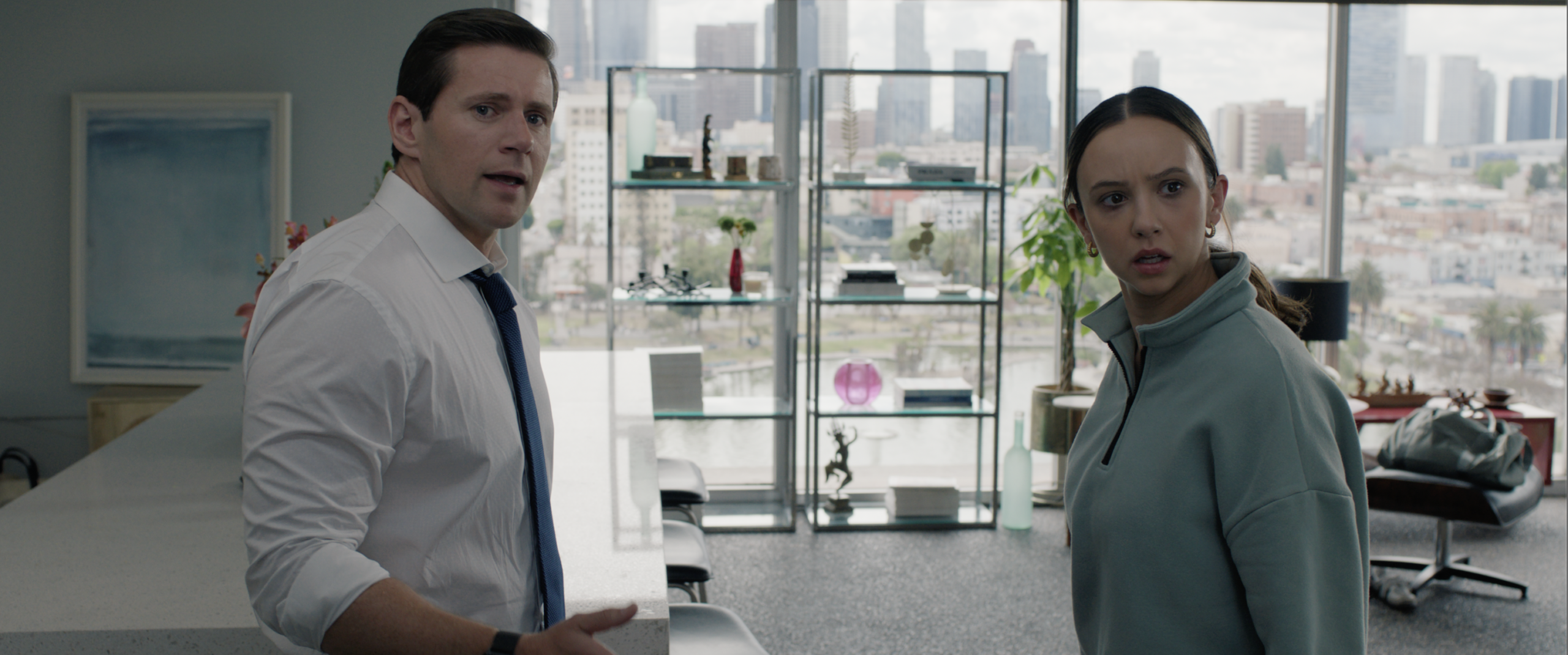
 Once their characters are alone, Baron and Leech really sink their teeth into the script as Borelli’s direction brings their dispute towards crescendoing before softening again. Their connection is always tangible even as we witness their respective arguments growing more intense. ‘I’ve never dated you–just this drugged-up version,’ she accuses him as his defenses then go on the affront. When I saw the film on the last day of Indy Shorts, my audience reacted loudly to a moment when Jason pivots his case towards the broader subject of how medicine is used to aid with one’s mental health.
Both actors bring such solid chops to their character’s perspectives that we can find ourselves siding with one argument and then, on a rewatch or after reflection, seeing the other’s viewpoint. Borelli smartly places the actors on equal footing and never winks at the audience in terms of giving us easy answers. The apartment’s large windows look out onto the city as if to remind us (and both Jason and Camille) that there is a lot on the line.
The act of taking a pill or seeking assistance is step one in the journey to betterment. That could apply to the medicine we seek to make our bodies feel better or to ease our anxieties, but what about the mind and the heart? That connective tissue? IGNIS embraces these prickly, uncomfortable conversations, because we are not simple beings. We are wired in ways that we don’t even realize, and we have to be prepared to articulate what we need and what we want. Rarely do we get a film like IGNIS that is driven by heartbreak, confusion and those emotions that bubble up without us being prepared for them.
Can you handle it?
IGNIS will next play LA Shorts International Film Festival on August 6th.
![Theo Rossi Trifecta: In-Depth Chat About His 3 Fab New Films: ‘Bruton,’ ‘Come With Me,’ & ‘The Saviors’ [VIDEO]](https://thecontending.com/wp-content/uploads/2026/07/Bruton-75x75.jpg)