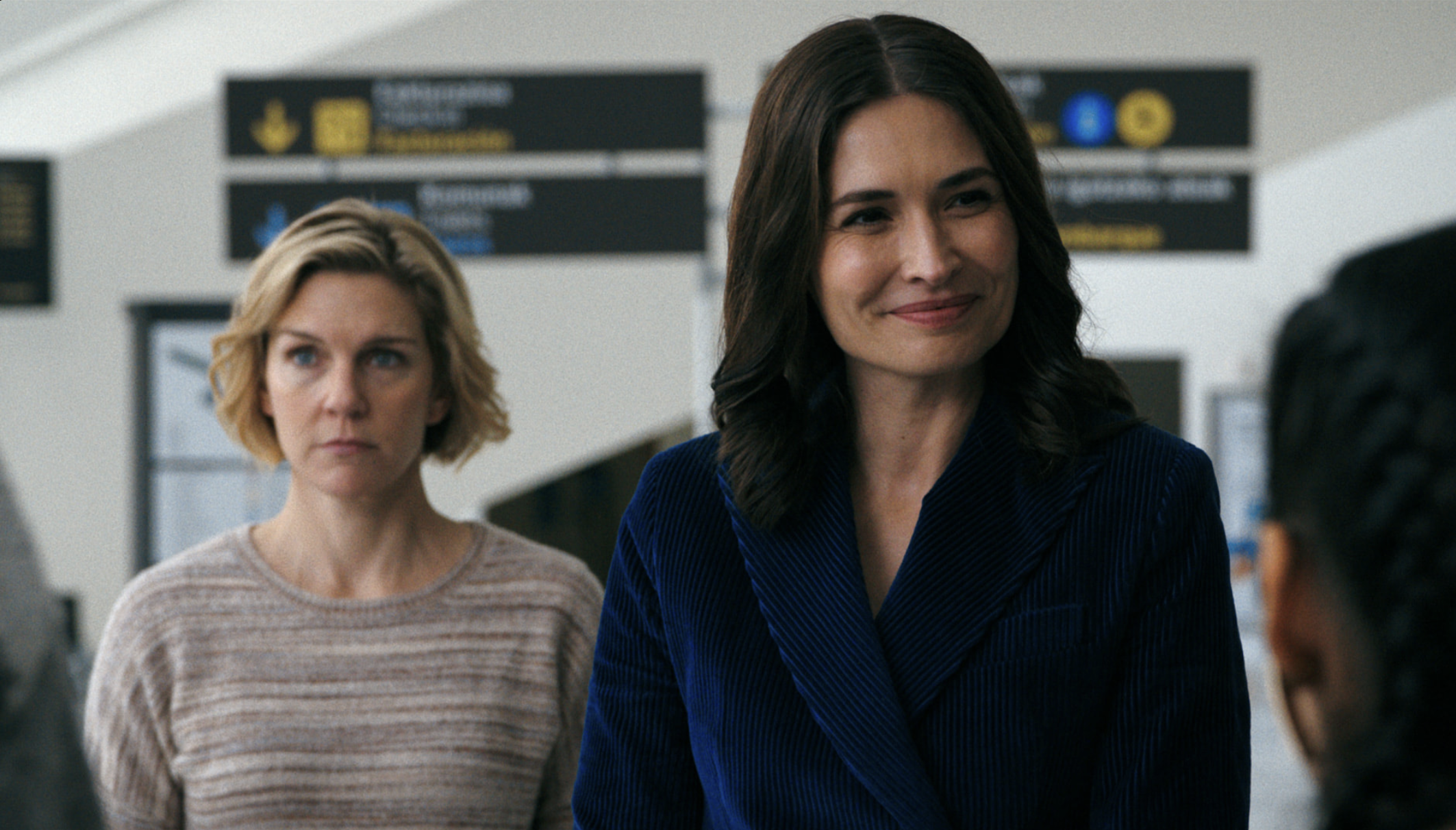
Polish actress Karolina Wydra had been away from acting for nearly six years when she received the offer to join Pluribus and play the pivotal role of Zosia, across from Rhea Seehorn’s Carol. Vince Gilligan’s follow-up to the Breaking Bad universe is a decidedly different type of show. Gilligan takes his style, dry wit, and much of his Breaking Bad/Better Call Saul crew into the world of science fiction. In the near future, the world meets with an engineered virus that creates a collective consciousness in nearly all of the world’s population. Seehorn’s Carol, a sci-fi novelist, is one of the few exceptions. The virus doesn’t take with Carol, and in this strange new world, where there is no guilt, shame, crime, or cruelty, Carol pushes back on this new utopia. The trade-off, individuality vs. the safety of the hive-mind that the “others” offer, is at the crux of the show’s moral dilemma.
Can Carol hold up this very personal rebellion? To challenge her perspective, enter Karolina Wydra as Zosia, who intends to gently lead Carol to a place of acceptance. As an “other,” Zosia carries all the thoughts and experiences of collective humanity. She is an expert on everything. She knows everything that’s ever happened, and she aims to use that knowledge and collected experience to bring this reluctant novelist into the fold.
In playing Zosia, Wydra gives one of the most remarkable performances in recent memory. How does one play an all-knowing character who is everyone and herself all at once? How does one avoid playing Zosia robotically? How does Wydra make her character appealing, empathetic, and warm without pushing forward what we would consider normal human emotion? There’s a certain alchemy in Wydra’s performance. It’s hard to describe just how good she is without telling someone to “just watch the show.”
Variety’s Chief Awards Editor, Clayton Davis, has shared his early predictions for this year’s Emmys. Wydra is among his chosen few in the Best Supporting Actress (Drama) category. Looking over his other selections, it’s not hard to realize that if the Emmy nominations in this category hold to his predictions, this will be one loaded field. Still, to my mind, the path to the podium should begin and end with Karolina Wydra.
The Contending: There was a roughly six-year gap between onscreen performances. And that came with a professional cost to you: you lost your agent. Six years is an eon in this industry. And then you had to re-enter this world after all that time away.
Karolina Wydra: I grew up in communism, and my parents used to go abroad when I was little to provide a better life for us, and what I mean by that is bringing things back that we didn’t have in the country, which was very limited. And so they would travel a lot. I missed them as a child. It was incredibly important to me when I became a mother that I would be a stay-at-home mom for the first two years of their lives. When the pandemic happened, and we were in a lockdown, obviously, people were dying; it’s a disaster, and I said, “We have to procreate.” That’s a good time. It’s a great time. My husband and I were like I think this is a really good time to make some babies. (Laughs). But we did, we made that decision. I was 39, and I had to make that choice. So I had Atticus, and I told my team I’m going to be a stay-at-home mom. It was important to me. I forget at which point, if it was when I got pregnant again or right after Atticus, that my team said they wanted to part ways. And it was terrifying. It was terrifying to choose to walk away for the time being. And it was scary to walk away at the age of 39. I remember during that time my friends who were actors getting these roles and acting, and I was so happy for them, and at the same time going, “Oh God, I hope my dream is not over.” Because I love this craft so much, it makes me feel alive. The idea of losing it at that time just felt quite scary.
The Contending: How did you end up on Pluribus?
Karolina Wydra: I got this email from the agency requesting a tape from me. I wrote back, okay, what is it? And she says, I don’t know. ” I said, “Do you mind checking and letting me know what it is?” She came back, and she said it’s a Vince Gilligan show for Apple TV. My whole career, I’ve been asking my team if there’s ever anything for Vince Gilligan, send me in, I’ll play anything on his show. I’ll be a chair. I don’t care. (Laughs). I just want to be in his universe, because I find him so incredibly talented and such a profound storyteller. And I never auditioned for anything for him. He’s the reason why I got into TV. I was such a cinephile in New York, I watched films only, and obviously, when you’re 19 and in your early twenties, you’re just cocky, “I just watch films. I don’t watch TV.” And especially living in New York, I just do indie films. Angelica and Sunshine, that’s all I do. I remember my friend said, “Hey, you have to check out this show, Breaking Bad.” It just blew my mind. I was utterly taken aback by having an opportunity, after all this time, to work with Vince Gilligan. I didn’t know what the show was. I didn’t know the character’s significance. Nothing. I just knew that it was Vince Gilligan—Apple TV.
I read the sides, and my first reaction was, “Oh, there’s no way.” No, don’t do it. That’s ridiculous. If you do it and you don’t get it, that’s it. It’s over. Your dream with Vince Gilligan is done. So let’s not even try. Then there’s the other part of me that went Karolina, you have nothing to lose. Just go for it. You never know. I met with a friend, I put myself on tape, and when I read it, I felt something. She even said it when we taped. She said it’s so weird, I have a good feeling about this for you. She said, “There’s something that’s happening to you when you’re playing this role. And I felt it too. There was just a level of subconscious connection happening. I love to do dream work for my characters. You have to really trust the process of the dreams. The dreams will reveal to you subconsciously what you need for roles. Two days later, I got an email asking for my reel. Then, around Christmas time, I asked if I could contact the casting people directly. I did that, and they emailed me back to say that in the new year, we will know more about this role.
The Contending: Where were you when you got the news?
Karolina Wydra: I happened to be on vacation with my best friend, Caitriona Balfe, who is a phenomenal actress. I remember it was January 3rd, and I got an email that said, “Can we please talk to you?” Then you have an out-of-body experience. Why do you want to talk to me? It must be good news. I got on the phone with them, and they said we want to test you for this role. I just couldn’t believe it. I truly felt like somebody was punking me. I felt like it was some practical joke that someone was playing on me. I ran out of the room screaming and all excited, and Caitriona said, “Oh my God, what happened?” They want to test me. I don’t know what to do. She said okay, calm down, I’m going to talk to my manager. He’s going to call casting, I’m going to help you out. So Brian dePersia, who’s her manager, called casting and came back and said, “Yes, you are being tested on the show.” He said you need a lawyer. So I got a lawyer, and then we made the deal.
The Contending: Vince Gilligan did not give you a simple character to play. Did it hit you what you’d gotten into once you started to receive pages?
Karolina Wydra: When I learned the significance of the character, I couldn’t believe it. Then I got the first two scripts, and the originality of the story blew me away, the bigness of the world that he created, who the others are, and who Zosia is. I was also terrified. How am I going to play Zosia? How would you tackle that? Before the test, I got the opportunity to meet Vince. I was very excited to meet him. He couldn’t have been kinder and more supportive. He was such a gentleman as he took me through the process. We talked about his idea of who he feels Zosia is and what he envisioned Zosia and the others to be.
The Contending: When did you meet with Rhea?
Karolina Wydra: I met Rhea at the test, and she was so giving. She literally said, “What do you need?” I’ll give you whatever you need. I want you to do your best. She was so supportive, and I just couldn’t believe her kindness and her generosity. The test was fun. I walked out of it thinking I was terrible. I think that’s just how my mind works. I was like oh yeah, that’s it. It’s over. It was Friday, and I had to wait. Monday was a holiday, and on Tuesday, they said I was going to find out if I passed with the studio. I had to wait till Friday to receive the call from Apple. They had to watch my tape and approve me. When I got the call, it was the greatest moment I could possibly ask for.
The Contending: Now you just have to do it. (Laughs).
Karolina Wydra: Then it was about working on the character and talking to Vince and understanding who he expected—I don’t like that word expected because it’s not about expecting, it’s a creative process. The conversations that we would have were about who Zosia is, how she behaves, and how she operates in the world. Vince’s idea is that the others are not just happy. They are happy, joyous, and unflappable. But who they are is so incredibly complex. They’re joyous, but there’s more that they don’t have. They have a memory of anger, sadness, and grief, but they don’t experience it in their body. They don’t experience nerves in their body. They’re not afraid to die. They are in this blissful state of being, of joy, and then they have every muscle memory of whatever they’re performing.
They’re the best of the best of whatever they do. So if you’re going to fly a plane, you’re the best pilot that’s ever flown that plane. If you’re going to perform open-heart surgery, you are the greatest surgeon who ever lived. In episode two, I taxi a plane. It took a lot of rehearsals, conversations, and understanding how the plane works. These are the conversations we had. Even in rehearsals, when originally Vince wanted me to taxi the plane, the C-130, the pilot said I’m sorry, we cannot let her do that for insurance purposes. And then I spent a day with them, and they went okay, yeah, she’s getting it, so we’re going to let her taxi the C-130. It was insane.
The Contending: That’s how we meet Zosia, wearing sackcloth and flying a plane. But we don’t hear her speak for several minutes. When we do, we meet this beatific person. It would seem like a real balancing act to play a character like Zosia, who is very present but also somewhat distant.
Karolina Wydra: I had to do a lot of body work to stay calm and present and be relaxed so that things could just bounce off of me so I could be in this state of being where I’m very peaceful and serene and content. Script analysis was big. Understanding the psychology of the highest emotional level of intelligence. If you study highly emotionally intelligent people, you will find they are very observant. They take in the world, and they’re very present. They don’t need to speak; they don’t need to sound a certain way. They just are, and they take in the world in a very different way than somebody who’s insecure or traumatized.
They come from a place of needing to please. It was an incredible thing to study. Or spiritual leaders, how there’s an essence to them, there’s an energy to them. They vibrate a certain energy, spiritual leaders and Buddhist monks. Years prior, I went to India, and—you know, the religion Jainism—I was able to visit their temple and feel the energy there. So all these things I would put together, it was like a big pot of soup that I would just throw in all these different ingredients to create Zosia. I meditated a ton to get into a certain state of vibration that happens when you do it. New studies are showing that when you meditate a lot, it reduces ego. The ego gets quiet, and that’s why you’re more present, and a certain energy arises within you. Then, on the day, it was fine-tuning with Vince and trusting him completely with what he saw on the screen, and what was needed for the scenes.
The Contending: What was the hardest part about playing Zosia?
Karolina Wydra: The challenge that came up for me as an actress was that I had to suppress a lot of my instincts. So it’s like right now we’re having a conversation, if you were getting mad, I would have a reaction. How am I going to get through this? You calculate. With Pluribus, I had to embody Zosia in a way where I had to suppress my instincts. So when Rhea, playing Carol, has these beautiful, rich, emotional scenes—whether she’s angry or grieving—naturally, I want to go on this emotional journey —me, as Karolina. I want to save her, I want to make her feel better. I want to nurture her.
Sometimes I would get lost in the scene and go there, and Vince would remind me, “That’s not who Zosia is.” Trusting that I didn’t look like some weird zombie or a robot, because they (the others) are not, they’re fully fledged human beings that just don’t have the same emotions. They don’t have the same emotional spectrum as someone without the virus. So suppressing that, building the virus for the joining, and not judging it. She believed in the virus so much, she believed in the goodness of the virus so much, that for Zosia, it’s not manipulative. This is good for you. This is something you are really going to be grateful for once you experience it, because we know what it’s like to be you; you don’t know what it’s like to be us. And if you experience it, you’ll be thankful we shared this with you. It’s like if a child is deathly sick and you have the medicine, and the child’s rejecting the medicine, but you’re like, take this medicine, it’ll save you. We wouldn’t think of it as, “Oh my God, that’s being manipulative.” No, save that child. That’s what the others believe in.
The Contending: There are several dynamic characters in Pluribus, but the heart of the season is Zosia and Carol. What was it like working with Rhea?
Karolina Wydra: I love that woman. I am forever grateful to Vince for introducing us. She’s the most magical, incredible woman that I know and the most generous actress that I’ve worked with. She’s supportive in all the ways, and it’s really nice when you meet someone like that in this industry, to have another female in your corner rooting for you. Obviously, she’s been with Vince forever, and they know each other and have such a beautiful, rich, creative relationship. I was the newbie, coming in feeling nervous, and working with someone I had admired for years and dreamed of working with. Your whole being is like I don’t deserve to be here. It’s just nerves or things you get in your head. Rhea just held my hand, and Vince is such an incredible human being as well. To have that feeling where you really know somebody has your back through and through, it only breeds the best work.
When you have a team of people, and you’re nervous, and you know they’ve got you. You’re not alone, and we’re going to do this together. I had that with Brian Cranston when I met him on Sneaky Pete. They all come from the same school. He and Rhea and Vince—it’s that whole world of them, of these artists that say you are good. I’m good. The scene is good. The show is good. Instead of actors I’ve worked with, who want to outshine you, I want to make sure that when it’s on my take, I’m going to do things that don’t match what you do. So then they are going to stay on me.
The Contending: You’re essentially playing a person and a combined conscience of millions of people at the same time. I interviewed Rhea for Pluribus last year, and she spoke so highly of your work. Speaking to the challenge of playing Zosia, she said:
“What’s a smile that looks peaceful but not creepy? What’s a gaze that looks attentive but not reciprocal of my emotions? She has to be sentient. You can’t look like a robot. You can’t look like you’re high on Valium. You’re absolutely attentive in listening. There is compassion for Carol’s pain, but she won’t meet it. Not only is that usually an actor’s greatest tool, listening and reacting, but it’s human nature for us to mirror facial reactions and to mirror the tone of where a conversation is going. She’s not allowed to do any of that. Karolina has to invite the audience to care about her.”
Karolina Wydra: Can you please send that to me?
The Contending: Absolutely.
Karolina Wydra: I really appreciate that so much. When we were beginning this process, Vince said, “You’re going to learn to trust me.” At first, I was like, of course I trust you, you’re Vince Gilligan. But now I understand what he meant. Because this particular role had to do with a lot of trust when he saw things that were working or not working, and for him to guide me in those moments. If my natural instincts came out a little bit, where I would go on emotional journeys, he would say, “You can’t.” Go deeper into that state of being or that place of what the virus means to you. Go deeper into that. Go into the intelligence of these people, the emotional intelligence of this world. So trusting that and fine-tuning it on set until there’s an evolution that happens to Zosia later in episode eight.
I always had to watch what Carol was doing and know when to push and when to pull back. It was a constant dance about how far I could physically come closer to her, or whether I should stay away. The intention was always to make her happy, to be of service to Carol and her needs and wants, and to make sure she felt safe and taken care of. It was an incredible and exciting challenge to play that. Also, there were moments when this felt really foreign in my body because of the suppression of the feelings I wanted to bring forward, but you can’t, and you have to trust that. It’s not that I’m smiling, but it’s the contentment and bliss of that smile, how it lives in your body, and its authenticity and reality. There was a lot of collaboration from all of us, coming together to figure it out, make sure it came off a certain way, and that it served the story and who the others were. It was truly a fun challenge.
The Contending: There is a lot of surprising humor in the show. When you first meet Carol at her house, she’s literally trying to bury her significant other. You lean over, and you say, “We’d feel so much better if you’d hydrate.” It’s this tragic moment, but it’s also very funny.
Karolina Wydra: That’s what makes Vince Gilligan’s special. I ask him how he does it, adding so much humor, even when something is so heavy and dark. I can’t believe I’m laughing. That’s Vince’s writing. You see someone digging, almost dying from dehydration and exhaustion. Then you have someone come up and be like, “No, have water.” Jarmell Gurky says it’s okay. And you’re like, who the fuck is Jarmell Gurky? What the fuck are you talking about? What do you mean? That’s Vince’s genius. He’s a master of storytelling. I don’t know how he does it. I keep asking him, how did you do it? And he’s like I just do it.
The Contending: There’s this argument in the show of freedom versus security. Carol is trying to find a place somewhere in between, but there’s no in between. You either get to be this (yourself), or you get to be that (an other). Zosia is her guide, trying to get her to that. It’s fascinating. As Rhea said to me, becoming an other means you’ll never hear any new jokes again, because you’ll have already heard them all.
Karolina Wydra: You can’t get surprised again. But then you see that in episode eight, when we find out that Carol likes the sound of a train whistle. We (the others) get to experience something. When we learn that Carol is writing a new book, it’s exciting and genuine because we get to experience someone’s creation for the first time, and we won’t be able to have that again once everyone has joined. Those are the moments that Rhea and I would talk about: how individuality is so important, that we get to be surprised, that we get to have these moments of seeing art for the first time, reading a book for the first time, and what it does to us watching a movie that touches us for the first time, and how magical that is.
If we were living in a world where you know everything, and you’re part of the conformity, you lose so much of the beauty that makes us who we are as humans. The whole show is about humanity, what it means to be human, and what is worth fighting for. The others live in tolerance, peace, and unconditional love. There’s no crime, no racism, all that. We care about the planet. We live by a certain code. We’re selfless. We live in communities to preserve electricity, and we don’t kill animals. That’s incredible, but it comes at a cost.
The Contending: Near the end of the season, when Ray and Zosia are effectively dating, there’s this domestic bliss that’s kicking in, and then there’s this talk of Carol joining. So many times Zosia says we would like you, we would want you to do this. But there’s this moment when you say, “I love you,” to Carol. There’s a hint that you are on a journey too, and you’re not as locked into “otherness” as maybe we think.
Karolina Wydra: That’s a great interpretation. I have my own opinion of it, and I want to leave it at that. I want people to have their own interpretation of what that means. Because when we shot episodes eight and nine, we all had different ideas, and Jonny Gomez, Melissa Bernstein, Vince, Rhea, and I had different interpretations of what the scenes meant or what the journey meant. Is Zosia evolving within the hive mind? Is she detaching and evolving, and are you seeing more of her personality and individuality? Is it a performance of using Helen’s memories and knowing everything about Carol’s likes, dislikes, and preferences? Is it just to perform to make her happy so she would join us? Then I’m talking about the kiss. The kiss is a whole other thing. But what really is it? Is she really falling in love? Is she really falling in love with Carol, or is it just a performance?
The Contending: What’s so great about the show is you don’t actually know. It could be any of a number of things. Mystery is so rare in storytelling, and there’s so much of it in the show. Pluribus is also the most-watched show in the history of Apple TV, and we’re getting a season two, so we get to find out what’s next.
Karolina Wydra: I know nothing about season two. I genuinely have no idea where Vince is going to take this story. I’m very excited to find out, and I cannot wait to be reunited and be on set together, because we are very lucky with the kind of crew we have and the kind of love, respect, and adoration we have for one another. It’s a very special set to be on. The whole cast is texting each other. We are truly so incredibly supportive, and we want nothing but the best for one another. It’s such a joy to go to work having that kind of experience.