Nothing on this year’s Animated Short Film shortlist looks like Florence Miailhe’s Butterfly, and it is a prime example of how animation can transform how we see true life events and the world around us.
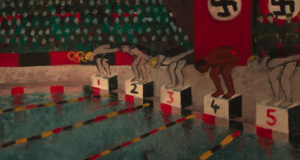
Butterfly is the perfect example of history colliding with art as Miailhe’s film explores the racism experienced by swimmer Alfred Nakache faced during the 1936 Berlin Olympics. One medium informs the other as the memories spill into one another. One of the most impressive aspect of Miailhe’s film is how the images transition from one another and how she uses depth of color when painting water. The water in a pool is different than water in an ocean, and she captures movement in a stunningly beautiful way. When we fully understand the history we are witnessing, Miailhe uses straight lines to represent oppression. The dividers in a pool become bars on a prison cell or the stripes of an Auschwitz camp uniform. In one chilling image, we see a crowd of people giving a Nazi salute: their faces are blank, but we never misunderstand the danger in their movement.
We always come back to the water. Once below the surface, we find peace, tranquility, and a true sense of self.
**We have linked Butterfly below. Consider watching it before reading our conversation.
The Contending: I loved seeing how the paint moved and seeing the actual paint lines. Early in the film, we see the white lines from the water splashing when he is being called a ‘mama’s boy’ or when he watches the girls in the pool. How did you want the audience to embrace the technique used in Butterfly?
Florence Miailhe: The technique I use and have practiced for a long time—painting animated directly under the camera—is not very well known to the general public. It is mostly reserved for short films because it is relatively time-consuming and difficult to rationalize and share the work. It is demanding, but it offers great fluidity of movement.
When audiences are given the opportunity to see these films, they are generally very receptive to this way of representing movement and discovering its graphic and narrative possibilities. I think they are sensitive to the emotions conveyed by the materiality of the paint itself. For Butterfly, everything happened quite quickly, because from the very beginning I had a very clear vision of the script and the narrative. It was obvious to me that the character would plunge into the water and that each immersion would trigger a memory linked to water. Animated painting imposed itself as an obvious choice, especially for the transitions, which I am particularly fond of. It allows for a smooth visual continuity between memories, eras, and emotions.
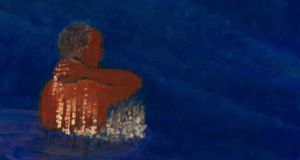
The film was made using oil paint on canvas, and the grain and brushstrokes bring a richness, warmth, and density that are essential to the film.
I explored the different symbolic meanings of water: the clear water of childhood, the swimming pool water of adulthood, the sea, but also the water of the basins at Auschwitz. Each type of water was animated differently, using several layers—painting on canvas, animation on glass, layers of oil paint—in order to play with transparency, distortion, and abstraction. In water, bodies fragment and dissolve into the material; at the surface, they become more realistic. Movement, more than precise drawing, always remains at the heart of the staging.
The writing, storyboarding, and production followed one another naturally. The film required about one hundred days of animation, with a team of three people, and was completed in one year, which is relatively fast for an animated film.
 TC: What is the most difficult aspect of movement when it comes to this style of animation?
FM: The most difficult movements are repetitive ones, such as walking.
We have to create animation loops, but they must not be noticeable. There can be “accidents” in the animation of the materials—paint that is a bit too present in certain frames—a flaw that goes unnoticed if it appears on only one frame (one twelfth of a second). But if the accident, the flaw, or the overly present material repeats in a loop, it becomes an unacceptable defect.
Similarly, very slow animations are difficult to achieve. Painted brushstrokes are better suited to conveying fast movement. The working time on a single shot is long, and one can quickly become discouraged by an animation that drags on.
TC: How did you want to express the different types of water? I loved the variety of blues and greens, especially when we got a sense of depth.
FM: Color played a fundamental role. I really enjoy working with color, and for this film, each period of the main character’s life was associated with a specific palette. With the production designer, Margaux Duseigneur, we established a sort of chart of blues: sky blue for childhood, turquoise blue for adolescence and competitive swimming pools, navy blue for the sea and adulthood, and a bluish-purple tone for the end, when he dives one last time. The Auschwitz basins, on the other hand, had dull, muddy, slightly greenish, almost dirty colors.
The idea was to associate each moment of his life, each memory, with a specific color palette. All of this produces an unconscious effect on the viewer, but it was the result of very meticulous reflection.
TC: I didn’t know anything about this story before I turned into the film, and I was surprised by so much of Alfred’s story. How do you think animation serves his history better than telling this story through a live action format?
FM: I don’t know if animation serves it better. The story is quite extraordinary and could also be the subject of a live-action feature film. But animation gives this story a fairy-tale dimension that may be more universal. That is also why I only reveal at the end that it is a true story. Beyond telling the specific story of Nakache, the film also tells the story of a man who maintained a singular relationship with water throughout his life, to the point where water almost becomes a character in the film.
 This film is not a documentary, but a poetic and metaphorical work, where not everything is said, but the essence of his existence is evoked. It is a story of memories, without voice-over or heavy explanations: only images and sounds, like reminiscences, pass through his memory and recount the key moments of his life, from childhood to death.
Painted animation allowed me to explore the metamorphosis of matter and form in order to express the unspeakable. It is very difficult to represent the camps, to maintain the right distance.
Like many former deportees, Nakache never wanted to talk about the camps or the death of his wife and daughter. To his nieces and nephews, he explained that the number tattooed on his arm was his phone number, for fear of forgetting it. They remembered a funny, generous man. After the film, meeting them confirmed the accuracy of this dreamlike and poetic approach, which allows images to convey a man marked by his history. I am glad that my film helps to pass on this memory.
TC: So much of Butterfly relies on memory. Tell me the most difficult aspect of structuring this story while using animation.
FM: When I discovered his story, I immediately chose to tell the story of Alfred Nakache’s final swim, and very quickly imagined the film as it ultimately became. Although he knew he had heart problems, he swam one or two kilometers every day. He died in the Mediterranean Sea, on the border between France and Spain, during this daily exercise. Water therefore imposed itself as an obvious choice: a space of memory, transmission, resilience, and transformation.
I imagined this final crossing as a suspended moment, during which memories of his life rise to the surface. All of them are linked to water, which becomes a passage between the different ages of his existence. These back-and-forth movements through time are made possible by animation, through the metamorphosis of forms and matter. Nakache plunges his head into the water as an old man, and in just a few images, he becomes young again, discovering the woman who will become his wife.
This project is also drawn from my own memories. As a child, I used to go on vacation very close to the place where Nakache died. It was Alfred Nakache’s younger brother who taught me to swim the famous “butterfly stroke.” One day, Alfred—whom my father knew and admired greatly—came down to the seaside, and I swam the butterfly stroke in front of him, feeling very impressed. I recently discovered his story, and telling it seemed obvious to me. Everything resonated with me: the story of this young Jewish man, born in Algeria, who became a swimming champion only to end up in the Nazi camps; the transmission of the butterfly stroke that I practiced; and the pleasure and sensuality of bodies in water.