Capturing the action, tension, and ridiculousness of AppleTV’s Slow Horses has been the pleasure of cinematographer Danny Cohen for several seasons. As he describes here in a chat with The Contending, Cohen needed to capture several distinct season five scenes, including the simple pleasure of just watching Gary Oldman telling a story. It’s a dialogue heavy moment, but it’s masterfully rendered. But those quiet moments aren’t the only challenges presented in lensing the series. There are shockingly violent moments that pose challenges unique to Slow Horses. And, of course, Cohen dives into the now-famous paint can falling and how complex it was to capture.
The Contending: When all the cars in London start acting up we get that huge plume of smoke overhead. What went into capturing that shot?
Danny Cohen: In a weird way that was pretty straightforward. Just trying to find an interesting vista within London. We used the 840, a road that leaves town, which gives the shot a bit of a spine so visually it directs your eye. We did need to film it from a helicopter, which has its own challenges, but the smoke and explosions were done in post with CGI. The fun of Slow Horses is that it isn’t big action moments, it’s a dialed down version of that where you’re just having pockets of smoke and explosions, and making those choices and designing the CG to fit in narratively I think is interesting.
The Contending: I think that works really well because then when the big moments do come it has that much more of an impact.
Danny Cohen: I think it’s all about balance, because the stories and writing are so good you want to just keep faithful to that style, and the style isn’t the slick Transformers backlit metal with shiny bits. Slow Horses is the down at heel rubbish version of that. For me it was important not to do backlight, because it traditionally is used to make things like metal shine and have highlights and give it an edge. That isn’t this world.
The Contending: One part that brought up a lot of tension for me was watching Tara as she’s being tracked by MI5 when she’s walking into the subway terminal, and we find out that she is actually working with the terrorists. Which we thought was a possibility, but we were never quite certain what her role was. That unknowing about her helped create tension in that scene. What went into creating that mood?
Danny Cohen: To me it’s all about again balance. That was a real location, the Piccadilly underground station, so we had to shoot there late one night because that’s at the center of London so you have to pick your window quite precisely. While we bring a lot of extras to help fill it out you don’t want to constrain yourself by having too few people. So there’s a balance where you need to control people because you want people to ignore what she’s doing, but you want to dress them in an interesting way so that they feel believable. Lighting-wise I was going with the practicals with any underground station, so not bringing in too much film lighting, which I think would have changed the essence of how the station looks. So you’re trying to find ways as much as possible to exploit what is there and get across the fabric of the location.
There are a couple of really good shots like her entrance into the underground and then her exit, which leads to this amazing drone shot which is the last shot in the episode where she jumps into the car with the other terrorists and drives off. And we just have the drone keep rising and rising and you get a value of one of the streets right off of Piccadilly station and see the city beyond. I think that’s the key to Slow Horses but also anything about how you achieve scale. Getting a real sense that there is this crazy story, and people are running around and people are getting up to all sorts of naughtiness, but it is within this city. So it is about picking these interesting locations and then when you’re prepping it in pre-production it is about working out story-wise how to visually tell the story best.
The Contending: I think the scene that everyone was talking about this season was the Rube Goldberg-like way of the paint coming down and hitting the mayoral candidate in the head. What went into capturing that shot?
Danny Cohen: Our director Saul Metzstein said in his head it was like the board game Mouse Trap about how you translate the consequences of the ball starting to roll and creating the knock-on effects so it goes from one floor to the next, to hit a ladder, to hit pipes, that rolls down between the scaffoldings. On top of all that, it was filmed in a way that we stitched it all together. There was a real location where we built the scaffolding against the building and then just because of time the interior stuff was filmed in a studio because it was so finicky to create the mouse trap effect. So we had to rebuild the scaffolding in a studio so we could shoot all the narrative plot points that lead to that paint can falling down. It took two or three days to shoot the insert shots to tell the story of that paint falling over the side.
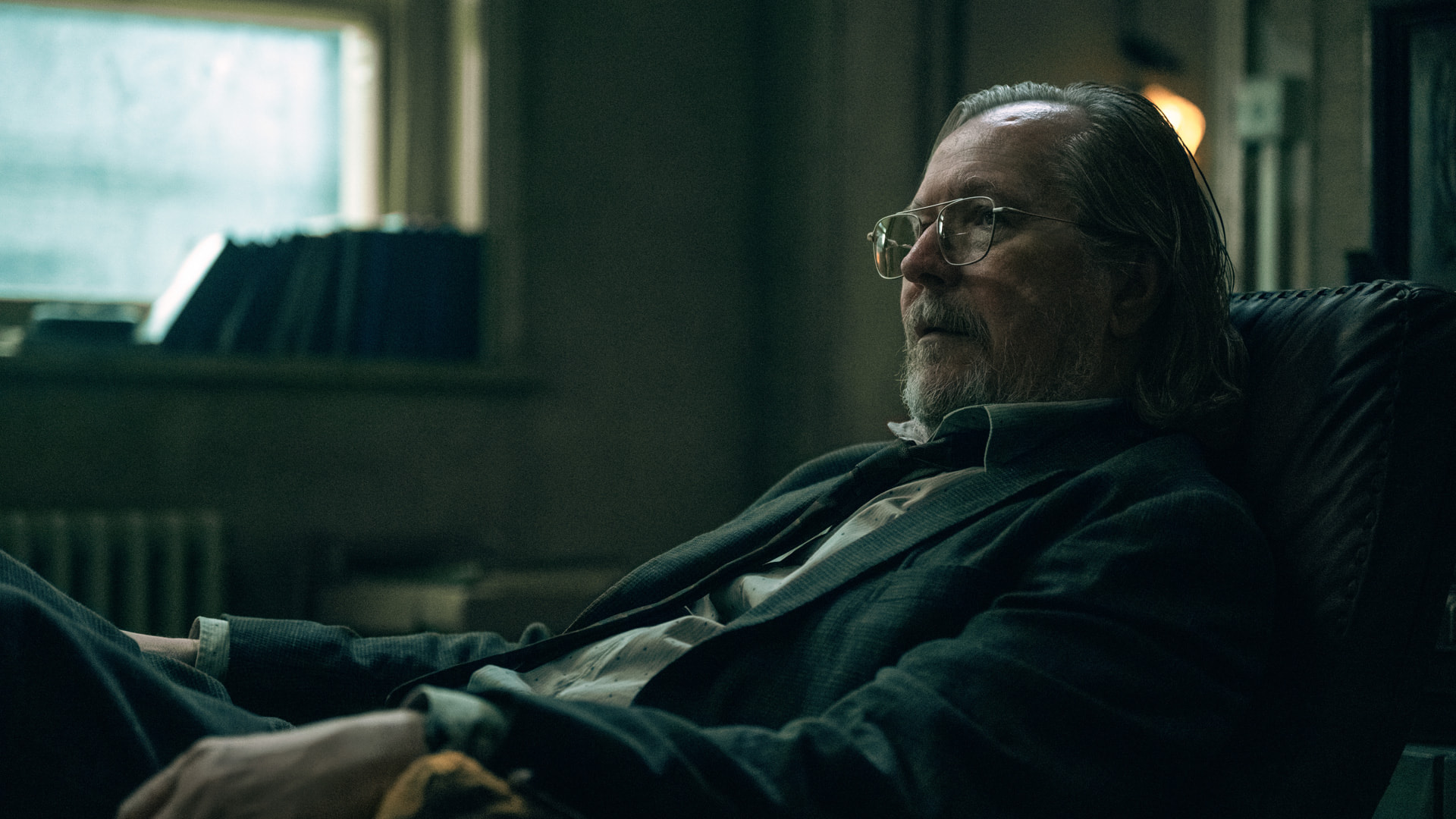
The Contending: The scene where Jackson Lamb is telling that story in his office about being tortured by the Stasi is a very intense scene of the season. For a lot of it the shot is just on the faces of the actors listening to him as he’s telling this horrible story, but then we slowly start to realize through his talking and through shots that he’s telling his team what they need to do. Then we cut to that really quick action of his team in motion. What was it like to try to capture that mood and then go straight into that action afterwards?
Danny Cohen: The best bit is filming Gary Oldman doing anything. He is so magnetic and he’s a thoughtful actor where any tiny little bit of action helps build the character of Jackson Lamb. So in a way it’s a gift because you’re filming him doing his thing and it’s lots of fun. Then filming the people who are listening to the speech who all have expressive faces in their own backstories that you just want to make things as simple as possible. Wherever we can we cross shoot or shoot with two or three cameras so we shoot as little as possible to keep it as fresh as possible.
The Contending: You have been with the show for quite a while now. What is it about it that makes you want to keep working on it?
Danny Cohen: I think one of the big things which makes Slow Horses very unusual is that they have one DP and one director per season. Normally on streaming shows or big TV series, just because of scheduling, actors availability, vacation availability, studio time, it necessitates having more directors and DPs. Because there’s always the equivalent of a car crash scene where the shooting time is the most expensive, and you try to squash everything into the shortest space of time as possible. Which means usually you can’t direct a DP through eight episodes of all of that. Slow Horses has six episodes and I think that’s just the right amount of work where, with the prep time, gives you enough time to shoot it and just keep ahead of the game.
The Contending: Aimee-Ffion Edwards’ Shirley has a huge sequence where she is chasing after the assassin trying to kill Ho that leads to that great fight sequence in the skating park. What was that like to capture that scene?
Danny Cohen: Aimee is amazing. She is just full of energy and the idea is to give her the space and not tie her down. They pre-choreographed the fights to avoid people falling down or having trains go by. So there are a lot of actions and the idea was to give the action energy and give the camera freedom. Because of the architecture of the park we used cranes that slowly pulled back and we had no hardware on the floor so we didn’t have to work around anything, which gives us a real good sense of the scale of the park. I think what’s interesting is the way the action is knitted into the story so they bounce off each other. I think that’s a big part of the world of Slow Horses.