

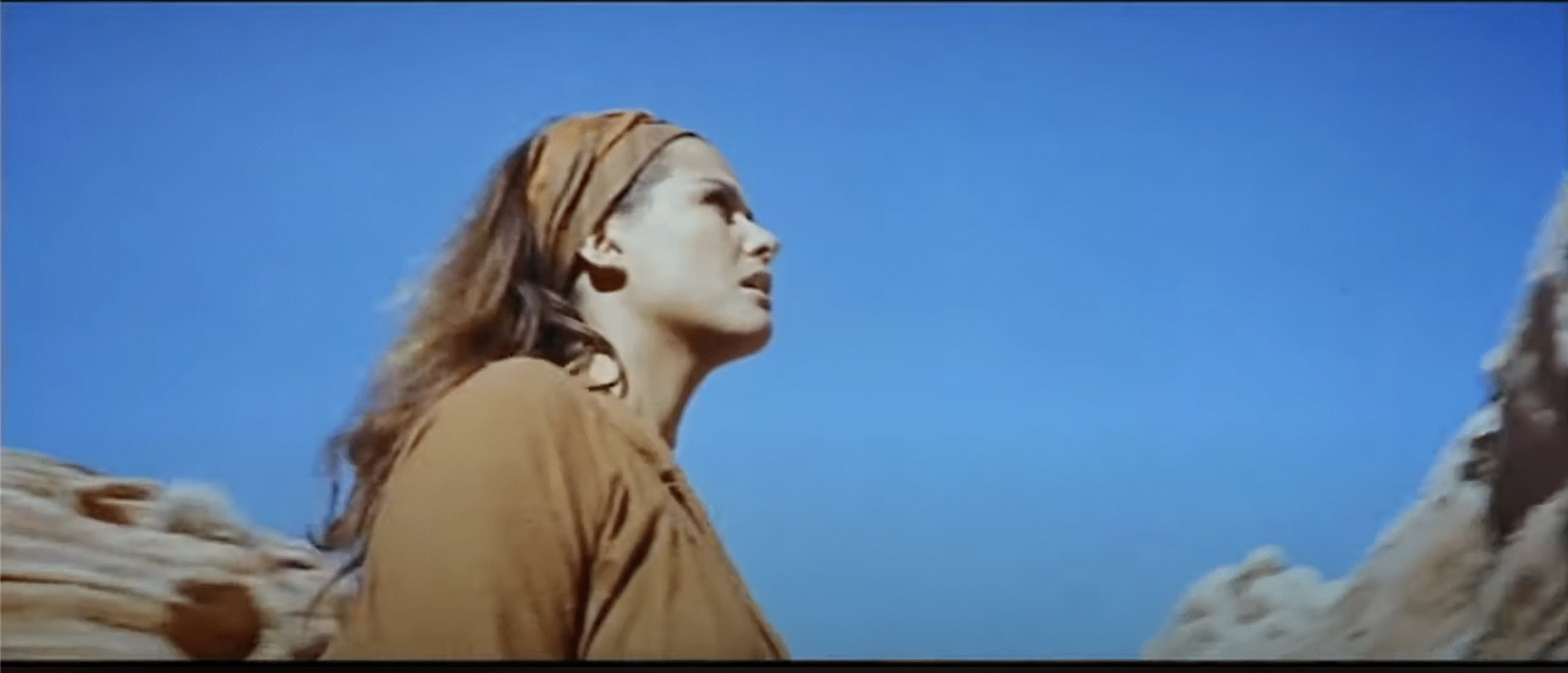
There is no way to write about the great Italian actress Claudia Cardinale without talking about how stunningly beautiful she was. I first encountered Cardinale in the gritty 1966 Western, The Professionals. Directed by Richard Brooks and starring Burt Lancaster, Lee Marvin, Robert Ryan, and Woody Strode, The Professionals was a substantial critical and commercial success upon its release. Cardinale plays Maria, the wife of a wealthy rancher (played by Ralph Bellamy) who hires a small group of mercenaries to rescue her after she is “kidnapped” by a Mexican revolutionary turned bandit named La Raza (Jack Palance).
Cardinale doesn’t show up on screen until the 66-minute mark. As Lancaster and Marvin sneak into the bandit’s compound, Cardinale is seen lying back on a bed, and then she turns her head toward the camera. I must confess that as her face filled the frame, I audibly gasped. At a certain level of beauty, one’s distinction is merely about taste. But I can say that anyone arguing that Cardinale was the most beautiful woman in the world deserves no brushback. Close enough.
Earlier in the film, as the mercenaries accept their mission, Lancaster comments on how the then-extrordinary sum ($7,000) that the rancher is willing to pay for Maria’s safe return must mean that she’s a special woman.
Marvin replies, “Certain women have a way of changing some boys into men and some men back into boys.”
Lancaster then responds, “That’s a woman worth saving.”
It’s not hard to wonder if Cardinale’s striking appearance often overwhelmed her acting ability. As pretty as her face may have been, Cardinale wasn’t simply relying on her looks. Certainly, her beauty and presence made her a movie star, but she was much more than that. Cardinale was like an Italian Raquel Welch, with chops. While surrounded by talented American actors, playing a Mexican woman, and speaking her lines in her second language, Cardinale dominates every scene she’s in. The twist in The Professionals is that Maria isn’t a kidnapping victim; she left with La Raza of her own accord. Around a campfire, Maria explains to her “rescuers” that her marriage to the rancher was arranged, and La Raza is her true love.
It is entirely incumbent on Cardinale to sell the twist, and her fiery eyes, and the way she punches out her dialogue does just that. Cardinale was not playing a damsel in distress. She was playing a woman rescuing herself.
The Professionals is hardly the only film that Cardinale appeared in that is worth mentioning. She was in Blake Edwards’ original comedic masterpiece The Pink Panther, Fellini’s masterpiece 8 ½, Rossellini’s masterpiece Rocco and his Brothers, Visconti’s masterpiece The Leopard, Leone’s masterpiece Once Upon a Time in the West, and Herzog’s masterpiece (notice a pattern here?) Fitzcarraldo. In fact, you could make a reasonable argument that all of those films are stronger than The Professionals, but that’s the film that I came to know her from, and the one that helped lead me to the others.
Cardinale is billed sixth in The Professionals, which I suppose makes sense if one is tracking her screen time, but she is very much the film’s greatest asset.
The opening credits read as such:
“With Claudia Cardinale as Maria”
She doesn’t even utter her first line in The Professionals until 73 minutes into the film. “Do as I say,” she tells one of La Raza’s men. Of course, he does.
After all, who could deny her?
Claudia Cardinale died on September 23, 2025. She was 87 years old.








A Goddess of cinema has left us. Rest in Peace & thanks for gracing us with your beauty and art.
* A small note: Rocco and His Brothers is from Mr Visconti, not Mr Rossellini.