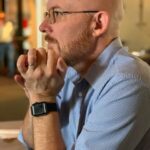

At this year’s 39th annual Virginia Film Festival, writer, director, and actor Tim Blake Nelson was especially busy. He had two excellent films screening (The Leader – read review – and The Life and Deaths of Wilson Shedd), and he also received the festival’s Virtuoso Award, which “recognizes the achievement of a remarkably innovative and multi-faceted artist.” Nelson is every bit of that description. While Nelson is perhaps best known for his eccentric performances in films like O Brother, Where Art Thou, The Ballad of Buster Scruggs, and HBO’s Watchmen, he has also written two novels, scribed five plays, and directed six movies (of which he scripted five).
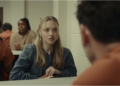
His latest film as a writer/director is The Life and Deaths of Wilson Shedd (read review), starring Anna Seyfried as Karen, a woman who falls for a convicted felon (Wilson Shedd, played by Scoot McNairy) while teaching a writing class to prisoners. The film uses what sounds like a pitch for a conventional prison-break thriller to explore themes of violence, loneliness, and retribution. Seldom have I seen a film so willing to make the audience sit with such darkness and ambiguity. This isn’t a film that tries to sway your opinion; it asks you to consider your own views on issues with the highest of stakes. It’s a bold, uncompromising film and one of the best movies of the year.
In our conversation, Nelson and I discuss the harrowing nature of the film, what he hopes viewers take from it, and his decision to avoid easy answers.
The Contending: I wanted to start off by talking about casting, particularly the two lead roles. You and Amanda worked together on The Testament of Ann Lee. Is that part of what led to casting her as Karen?
Tim Blake Nelson: It is. Many other actresses were considered for this role. At one point, Michelle Williams was attached, and she had some conflicts in her life, so she had to drop out, and the movie fell through. Then I had Sienna Miller, and Kevin Costner offered her the lead in what he envisioned would be a three-picture western with Horizon, and understandably, she dropped out. She wasn’t going to do a little indie over that, and I don’t blame her. Eventually, I was working with Amanda on Ann Lee, and within minutes I knew she would be extraordinary in this role; it felt like some greater force was protecting me, with the other actors dropping out. Because although they would’ve been extraordinary, I just can’t imagine anyone else in the role now.
The Contending: I think what drives her character in this film, to a large degree, is loneliness and the need to feel useful. But her poor decisions lead to unintended consequences. Amanda has this ability to make you feel empathy for someone who makes these bad choices. And it doesn’t seem like she’s trying, which I think is fascinating.
Tim Blake Nelson: You also see her making decisions in real time. Great film acting involves stuff happening to you in the moment, while the camera is pointed at you. And in these moments when film acting is most exquisite, the decisions seem to happen ahead of any conscious machinations on your part. They’re intuitive and quixotic. Amanda does that as well as anyone I’ve ever encountered, all while transforming herself into a being that is far different from who she is. Which is what makes her more of an actress than a movie star, even though she’s both.
The Contending: Scoot McNairy is having one extraordinary year between your film and Furious. He’s been an actor I’ve admired for a long time. Halt and Catch Fire, I think, is one of the most under-seen quality series in recent years. Wilson does unforgivable things, but through the writing class Karen is teaching, you get a sense of who he might have been if his life had been just a little different.
Tim Blake Nelson: I cast Scoot because, in addition to the fact that, like with Amanda’s role, other actors fell out over the years, I saw him in A Complete Unknown, playing Woody Guthrie. The vulnerability and the selflessness he brought to that part, in which he’s in scenes with Timothée Chalamet and Edward Norton—who have everything to say, and are these movie stars in their own right, as well as actors—and his willingness to yield space to them evinced a generosity in a guy whom I’d also seen play virile, selfish male characters with stubborn blind sides that couldn’t be more opposite than what he did in A Complete Unknown. I wanted that soul inside of Wilson Shedd, and that’s what Scoot brought. The responsibility of the actor to garner sympathy with the audience is especially difficult in this role, because I’ve given him very little to lean on in that regard. He’s not repentant, and he’s guilty as hell. So those usual advantages that a character has in a movie like this are stripped from the guy, and all that’s left is what an actor can bring. And that’s why Scoot is so tremendous in this role, because he draws you in without the writing giving him much of an arsenal.
The Contending: Speaking to the death penalty in particular, is that if you are a person who is against the death penalty, which I am, you put in front of us a character who, as you said, is guilty as hell and is unrepentant. So I have to, as a viewer with my perspective, think, “How do I hold my position with this person in front of me?” Conversely, when it comes to the death penalty being administered, it’s so cruel and methodical: everything from the walk with the guards to how the medical staff addresses the prisoner, to the hooded executioners, and then the process of administering lethal injection. If you are for the death penalty, you have to deal with that, too. It seemed like a deliberate choice to raise hard questions to the viewer with no easy answers. The film doesn’t tell you where to stand, but it asks you to consider where you stand.

Tim Blake Nelson: That’s all deliberate. One of the things I love about A Clockwork Orange is that it forces you to examine a potential system of psychological castration that’s painfully and mercilessly utilitarian in that it denudes the individual, the character played by Malcolm McDowell, of any individuality and any creative impulse. It neuters him, and you’re forced as an audience to examine that extreme in a character you don’t much like. And I wanted to borrow from that template for this movie and give us a character who, for all intents and purposes, you might want to see killed. Then you examine the anodyne brutality of what the death penalty is as administered in this country, and therefore kind of what any death penalty is. At the same time, I’m not trying to make polemical movies. It’s similar to The Grey Zone. I felt like we know the Holocaust was horrible and horrible for the Jews, and in that case, taking my lead from Primo Levi, let’s examine some of the real human genealogy of it. I read about the Sonderkommandos in Primo Levi, and I thought, “My God, what about Jews who were given this deal where they could have extended life and privileges inside the death camps that were outrageous, in terms of being able to pilfer clothing and food from those being killed? What about those people and that one group of them that happened to rebel because they were so conscience-ridden about the bargain they’d made?” That’s always interested me more than polemics.
The Contending: You couldn’t have possibly known, at the time of this film hitting festivals, that we would have a botched execution in Tennessee. In this moment, are you thinking of the film’s secondary impact due to what just happened with Christa Pike?
Tim Blake Nelson: Sure. There’s this Tom Waits line about keeping your antennae up, as a writer and a storyteller. He likened what he does as a songwriter to a ham radio-type enthusiast who has all these antennae up. He’s just there late at night with his headphones, trying to hear stuff and catch stuff out there. That metaphor taught me a lot. It’s kind of what I do now. I’m a voracious reader of everything from fiction, to several news periodicals every day, to a great deal of nonfiction. I was inspired, in part, for Wilson Shedd by an execution that took place in Oklahoma in, I think, 2011. That stuff repeats itself, and the exact same problem occurred in Tennessee as the one in Oklahoma. It’s nearly identical. I guess it’s just because I had my antennae up. At the same time, like most of the stuff that plagues us as humans, there’s been a failure to rectify the problem.
The Contending: Something that your movie does too is, like in the case of Missy Pyle as Warden…
Tim Blake Nelson: Isn’t she amazing?
The Contending: Yes, and with so little screen time. That whole sequence of her talking about what am I going to remember at the end of my life. Is it going to be my time with my children, or is it going to be the 112 executions that I was, on some level, a part of? Even if somebody is for the death penalty, if they are forced to be a part of that process, it takes a toll. She’s reckoning with the fact that part of her job has been to preside over all these deaths, for all these years.
Tim Blake Nelson: I don’t know exactly what was going on there with me when I wrote that. I love actors, and I love writing challenging parts for actors, and I had come up with that warden character, who was originally a man. But then when I had my antennae out and discovered that execution in Oklahoma, I learned that the warden was a woman. I just thought “Oh, the truth is much more interesting.” Then the character just led me there. We were having trouble casting that role. Missy’s a friend of mine, and I was at a barbecue joint with my crew about five weeks out from principal photography, in the middle of pre-production, and I just thought “My God, Missy.” I had this vision of Missy as ex-military who’d gone into the carceral system, as opposed to going into the police force. I imagined that she was ex-Air Force. I had a whole story for her that just fit Missy. Then Missy, not known for this type of role, came down and just filled the character out beyond my wildest expectations. I am so proud to be a part of what she did, and so proud of her for showing that tremendous latitude as a performer. To be in the room when she performed that monologue, shooting it was a highlight of my career as a director.
The Contending: The film has a number of acts of violence, and all of them are painfully methodical. I don’t know what was more upsetting, the murder of the family or the killing of a squirrel. I think that’s a statement about how strong the film is, that these innocent characters, whether it’s an animal in a tree or it’s human beings trying to catch their cat and ending up in the wrong place at the wrong time, the consequences to living beings are enormous and wrenching. Why do you ask the audience to sit with those moments for so long?
Tim Blake Nelson: I think if you’re going to make a movie like this, you need to mean business. I felt that I had no choice, based on the subject matter and where I see us right now, as Americans in this culture. I can’t really put it any other way. Plus, it’s all true. The squirrel story happened to a friend of mine. We were about 10 years old, and he told me that he had done that, and that he just couldn’t stop himself once he’d started. It has stuck with me my whole life. I think about him and how it ramified in his life. Therefore it’s not something that I gratuitously made up. What happens to the family is inevitable in the story because I think if you put somebody like Shedd on the loose and he’s desperate and he has nothing to lose and guilt and conscience aren’t really a resource for him, that’s probably what’s going to happen. Once that happens, the state will exact its most serious consequences. It’s also an homage to one of my favorite pieces of literature, Flannery O’Connor’s “A Good Man is Hard to Find”, which will take you about forty minutes to read. It’s a great story.
The Contending: I think this is one of the best films of the year, and your best film as a director. Do you feel that this film showcases your growth as an artist, and that you may have hit on something even better than I have before?
Tim Blake Nelson: I do want to keep getting better, and I want to keep challenging myself. I think if this is my most accomplished film as a director, it’s because I’ve challenged myself, having been inspired by other great directors. One of the things I did on this movie, just as an example, is that I decided to do no master shots, which is something I learned from Joel and Ethan (Coen). I think it made for a much more carefully subjective film, and a more dangerous approach to the storytelling, which improved what I do. I owe that to Joel and Ethan. The more I get to act in movies with some of the great directors, the more I learn. I want to bring that to my approach to storytelling. I don’t know, maybe I’m older now and have done it a few more times, and so that has been inevitably helpful. What I don’t want to do is rest on what I’ve done before, particularly since it’s not like I’ve had rampant success as a director. I’ve done well.
The Life and Deaths of Wilson Shedd is awaiting a release date