Tim Blake Nelson is such a fine and prolific actor that it’s easy to forget he’s also an excellent director. The Life and Deaths of Wilson Shedd is his sixth film behind the camera. It is also his best. Be forewarned, though: it is not an easy film.
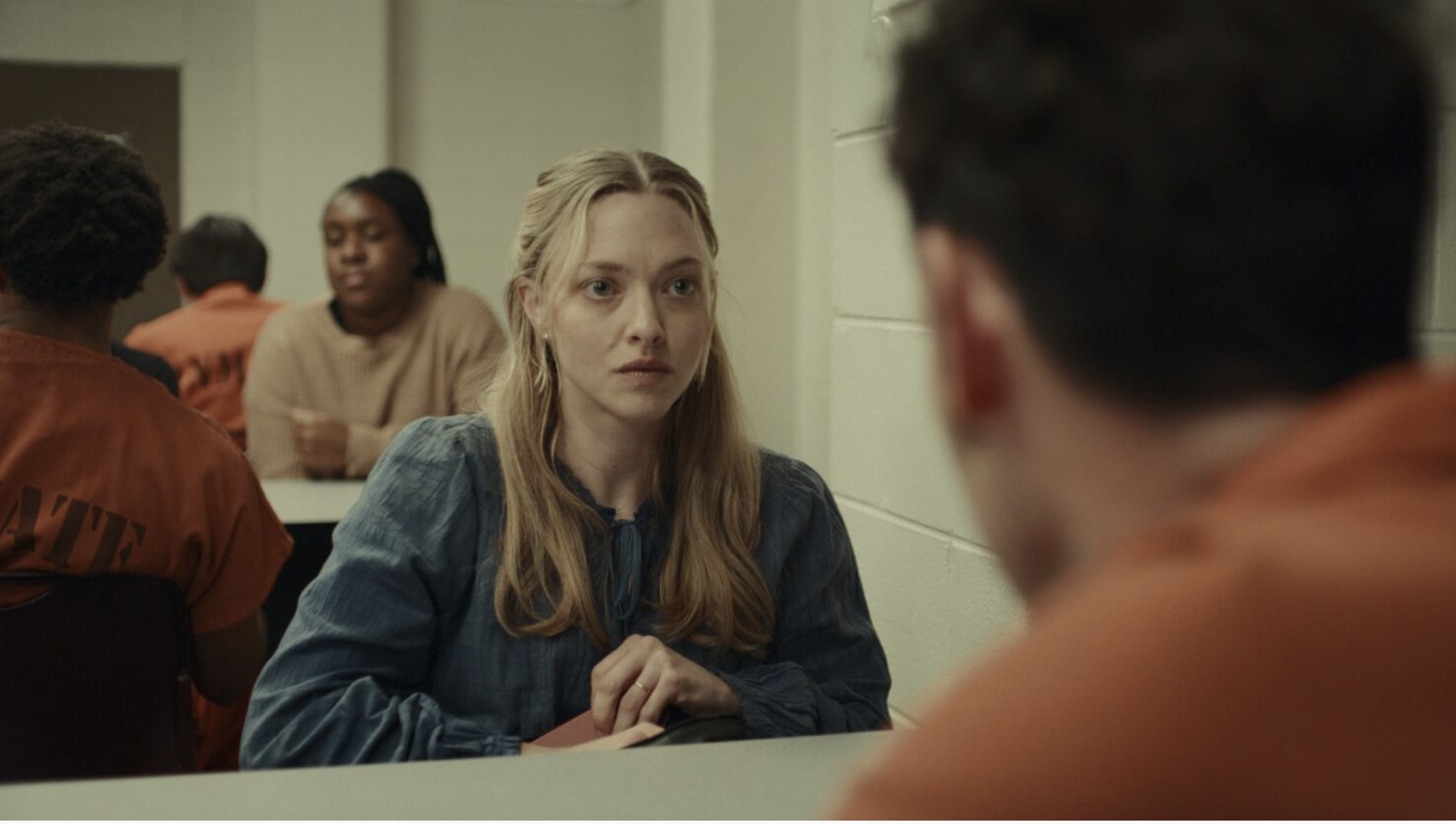
Set in Oklahoma, Nelson’s latest directorial effort involves a young woman with a terribly unhappy home life, who, driven by a need to feel useful and seen, volunteers to teach a writing class at the local prison. Amanda Seyfried plays Karen. She is saddled with a jobless, abusive husband who promises that the last time he struck her is the last time that will ever happen. Karen doesn’t believe him, and neither do we.
In Karen’s class is a man named Wilson Shedd (played by Scoot McNairy). Shedd showcases a natural gift for storytelling. He and Karen connect in a way that at first feels hopeful. There is most certainly a world that exists where The Life and Deaths of Wilson Shedd could have been an inspirational drama about a troubled young woman who brings the art of literature to an inmate sorely in need of an escape from the drudgery and dangers of prison life. Nelson’s film is not that film. Nelson has made a bold, uncompromising film that asks difficult questions while offering no easy answers.
Karen and Wilson’s connection soon becomes inappropriate. Then it becomes unlawful. The Life and Deaths of Wilson Shedd has thriller elements and carries the tension of a white-knuckler, but it is more interested in larger themes. What causes a man to be violent? Is it nature? Nurture? Are some of us just born bad? Is rehabilitation possible? Is our penal system even trying to rehabilitate? How deep must one’s loneliness go for them to abandon reason and take risks that result in horrific consequences (some intended, most not)?
At the top of the difficult questions the film asks rests the very notion of life and death: if someone is irredeemable, unrepentant, and undeniably guilty, is a state-sanctioned execution ethical, moral, and necessary? Nelson is very careful not to take sides in his drama. The Life and Deaths of Wilson Shedd is no polemic. It presents its case without trying to sway you one way or the other. What it does do is challenge your position on issues of crime and punishment by making you sit with the actions of the killer and the state.
The film features multiple deaths. All of them are dealt with in a methodical and excruciating manner. The film may boast a movie star in Seyfried and a very recognizable actor in McNairy, as well as strong supporting turns from recent Oscar nominee Wunmi Mosaku (Sinners) and Nelson himself, but it is the rare film that is able to strip away the “movie” veneer and place the audience in a space so intimate that to view the picture is akin to looking through an open window at a human tragedy that you can’t avert your eyes from, no matter how much you might want to.
And you will probably want to.
So much of this film relies on its leads, and Seyfried and McNairy deliver at the highest level. Their performances barely seem like acting at all. It’s more like inhabiting. Seyfried is something of a wonder in how she so easily moves from commercial fare (Mamma Mia, The Housemaid) to deep, character-driven material (The Testament of Ann Lee, First Reformed) and excels so gracefully. She truly is one of our finest actors. Her Karen makes terrible, selfish, and dangerous choices that compromise herself, those she knows, and a family of four that she will never meet. At no point does Seyfried ask us to excuse her character. She only asks us to understand. And we do.
Likewise, McNairy’s title character is not someone who is easily forgiven. Yet there are moments of charm and vulnerability, and in Karen’s writing class, we see the man he might have been with just a turn or two of the wheel. Many people come from nothing and grow up in exceedingly difficult circumstances without committing crimes so heinous that considering them in detail requires a steeling of the spine and a catching of one’s breath. McNairy asks for no excuses. He only asks for understanding. And we do. Not that it necessarily helps.
When Nelson was shooting this film, a film whose events are culled from true stories, there is no way he could have known that The Life and Deaths of Wilson Shedd would be premiering in festivals at the same time as the botched execution of Christa Pike in Tennessee. That it is making its way from festivals to the public in the wake of Pike’s horror story just makes the film all the more poignant. There is a cost to all of those who are involved in the events that lead to a death sentence. The killer, the victims, the lawyers, the jury, the judge, the guards that walk the convicted to the chamber, the medical staff that oversees the technical aspects of administering death, the hooded who press the plungers, the witnesses of death viewing through a sheet of glass. No one gets off free.
Missi Pyle plays the prison warden. She shares that in one way or another, she has been a part of 112 executions. She wonders aloud what her final memories will be before she leaves the earth. Will it be of her children, or will it be of those 112 men whose lives she had a hand in extinguishing, however legal her part may have been. In asking that question, it occurred to me that the choice to end another person’s life isn’t just about them and what they’ve done. It’s also about us and what we choose to do in response to their grievous actions.
Wilson Shedd presents the hardest of cases for all involved. Every step of this remarkable film is so keenly observed. It’s a remarkably human film. One that has a powerful regard for the life of all things. The guilty, the complicit, the innocent, all the way down to a lost cat and a stubborn squirrel. There will certainly be films that make more money at the box office this year. Some will likely get better reviews. None will be more unflinchingly honest than this film. The Life and Deaths of Wilson Shedd demands to be seen, no matter how hard it is to watch.