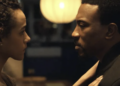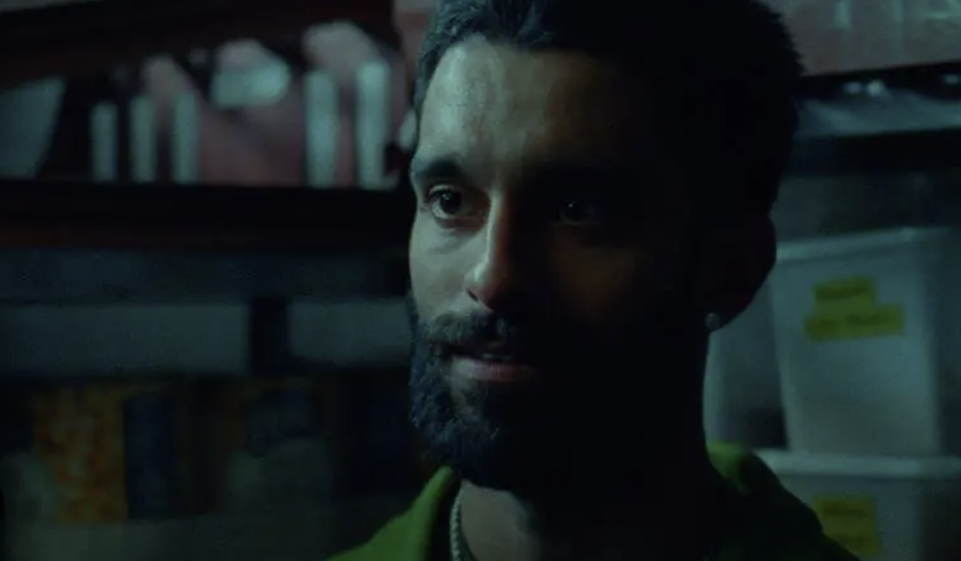
Luís Hindman’s BAFTA-nominated short film, Magid/Zafar exists at a beautiful intersection of tension and sexiness. Set in the bustling nucleus of a Pakistani takeaway restaurant, two men resist one another until they simply can’t any longer. With fast-paced editing and staging, Hindman’s film quickens your pulse but then you realize that your heart is racing not just because of the surroundings but because the two men at the film’s center are inching closer and closer to letting their insecurities fall away.
Magid’s won’t stop pinging. First it’s a call then message after message after message as he tries to get ready for a busy shift at work. The family takeaway is full of familiar, male faces–the kind that have probably known Magid since he was a kid. I couldn’t help but think about how a man of his age has enormous expectations places upon him, as if every move is met with comment or scrutiny.
“We had the archetypes for what the two characters would be like quite early on in terms of how they’d be presenting themselves,” Hindman says. “The thing that unlocked it for us was I’d just seen The Worst Person in the World and I was thinking of Joachim Trier a lot, and I knew that we needed to treat these characters in the same way that he treats characters or the same way that Xavier Dolan treats them. Diving into it with that sincerity really helped click it into place, especially when dealing with masculine presenting Asian guys and the bravado that comes with presenting that.”
“Coming from this background where there isn’t this huge canon of movies with this kind of representation, Wong Kar-wai was someone else we spoke about a lot too,” Salam, the film’s co-writer, says. “There’s a cinematic language for these characters that doesn’t quite exist yet–they haven’t seen themselves on screen enough. That pressure that they put on themselves was another key thing. There are a lot of cultural reference points with the texture and the visual cues from the film, but no one from Magid’s family is homophobic and the two white guys in the takeaway are only sort of curious or even celebratory of cultural things. Any sense of nervousness or repression that Magid or Zafar feel is this thing that comes from growing up in the UK–they’re putting it on themselves.”
The takeaway itself doesn’t let you breathe. Men are shouting as we are passed around as orders are being filled, and we bounce about from the workers’ point of view to what it might be like to step in for a bite to eat. The editing on Hindman’s film, by Joseph Taylor, is a beast. What breaks through all that noise is the appearance of Zafar, his face illuminated by the takeaway’s neon lights in the window before he steps inside.
“At the script stge, it was written very concretely to the emotion of everything that’s going on,” Hindman says. “There wasn’t a lot of overdressing, and I don’t think we talked about that energy even if things like The Bear or Shiva Baby were good reference points for tension. We didn’t want to direct it from the page, and we sort of stuck to that. When we got the greenlight, we had a lot of conversations about how to make two people talking on screen as cinematic as possible. I wanted to approach it all from the head of the main character as opposed to looking out at it. Honestly, it didn’t feel like it was going to be that frenetic until we got the first minute of the edit completed. When I looked back at it, I realized how intense it could be, but I was never prepared for the level of anxiety [on screen] until we started cutting it.”
“We were almost approaching it like a play,” Salam says. “We wanted to create attention to the drama, so the idea was if you just have two people reading this in the room, hopefully you want to make the first part feel so much more stressful. Magid doesn’t want someone walking in the takeaway, and he definitely doesn’t want Zafar to visit. We wanted to work with words first on that emotional level, and then you can add other things on top of it.”
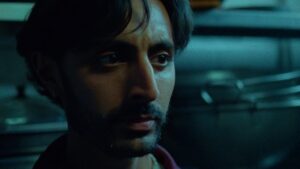 A particular detail that I appreciated was how Magid and Zafar have known each other their entire lives. Magid’s family knows Zafar, and there is a trust built all around them.
“I did the full backstory when I first met them,” Hindman says, plainly. “I sat down and wrote biographies as much as it was more of a shared knowledge between them. I thought about it for so long that I don’t think it needed to be spoken. There was such a solid history, but there were things that I knew that didn’t need to be told to the actors since it wasn’t relevant to our story. They had the full version of what was important for what they had to play with each other.”
As Zafar comes inside and he begins to speak to Magid, the entire tone of the film changes as they make their way towards the back of the space. When they enter the office area of the takeaway, even the coloring and sound alters. The majority of the film carries a green-ish, yellow hue while the final five minutes feel steeped in deeper emotions with maroons and shadow. When these two men speak to each other, Hindman keeps the camera cutting back and forth, so they are never sharing the same space until they cannot help it anymore. There is an image of a flickering light at the film’s close that absolutely killed me.
“No one has mentioned the color to us before, so that makes me happy,” Hindman says. “For that whole second half, we leaned into the conceit of dropping everything that had been used up until that point. Color was one of them but even lighting. Any tool that we utilized was dropped to make you feel that change, and that comes down to the music too. My colorist, Thomas Mangham, presented such great work from the start, and we ran with it. In terms of the two-shot stuff, that was actually a conceit for the whole film. The final shot is the first time that they share the same frame. The moment where they share that same space and come together, that is like a two or three minute one-shot. And that flickering light? That was one of those gut images that we had written early on in the script. When you know something is right, you trust the images in your head.”
“Once we had this location of the takeaway, it becamse clearer how you would frame this personal journey through the location,” Salam says. “You’ve got Magid talking to customers while cleaning up and ealing with people–he’s in full performance mode. As we venture back into the kitchen and Zafar comes in, he sees that there are a lot of men in there. When we get towards the back of the takeaway, Magid is shedding his armor whenever he is around him. That space that Magid works in is very masculine, dominant, and competitive. Becoming more stripped back is the point of that scene. Zafar is really choosing different tactics to try and get answers from Magid, and he’s not denying Magid’s reality anymore.”