If you’re still reeling from last night’s The Gilded Age season finale, then thank director Salli Richardson-Whitfield. As an Executive Producer and frequent episode director, Emmy nominee Richardson-Whitfield (Winning Time: The Rise Of The Lakers Dynasty) understands that audiences come to HBO’s latest ratings sensation for the drama, the scope, and the “wow” factor. The final shot of season three provided all three in abundance as Bertha Russell (Carrie Coon) ran to her bedroom window to make one last grasp for her potentially estranged husband George (Morgan Spector).
The shot and the feelings it evokes are a shining example of classic American filmmaking echoed by Richardson-Whitfield.

“The way it was written, she was downstairs at the front door, and then he was gone. It didn’t feel separate enough, so moving her upstairs visually and through these wide crane shots kept that separation between the two of them. It supports what we’re feeling about their relationship. It gives you that epic Gone With the Wind moment there at the window,” Richardson-Whitfield explained. “It brings you back to old moviemaking honestly, and I think that’s what I enjoy about it so much. I can mix this old style with modern filmmaking. That’s what keeps keeps me coming back and excites me as a director. I feel like there are things that I can still do with the show.”
And there will be more opportunities for Richardson-Whitfield and team to fashion even more drama. The Julian Fellowes and Sonja Warfield-penned series recently received a hotly anticipated fourth season pick-up. Not entirely surprising given that recent ratings consistently built upon itself week to week.
Perhaps some of the stellar ratings for season three can be attributed to its persistent evolution. Not only does it embrace the “new” within the series’ narrative (the suffragette movement, divorced women retaining their position in society, black doctors operating on white patients), but it also opens filmmaking styles up to a more modern approach when appropriate.
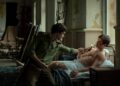
For example, the episode opens with a stunning 5-minute sequence in which Dr. William Kirkland (Jordan Donica) operates on the recently shot George Russell. The rapid-fire sequence feels more akin to ER or The Pitt than to a traditionally lensed Gilded Age scene. After reading the scene in the script, Richardson-Whitfield knew she had the opportunity to “go rogue” and approach it uniquely.
“I talked to the other producers, and I said, ‘Guys, I think that I’m gonna go rogue and shoot the sequence handheld.’ That’s different than anything we’ve ever done on Gilded. We definitely have a style, and it’s not handheld camera, but I felt we needed to open this episode with a bang,” Richardson-Whitfield recalled. “I just treated it as an action sequence. I knew what pieces I needed to get. We have two or three different cameras on it, and we are treating it like ER.”
But Richardson-Whitfield also knows that Gilded audiences also like to see small moments of humor sprinkled throughout the narrative. For example, Peggy (Denée Benton) and her mother, Dorothy, (Audra McDonald) gleefully await Dr. Kirkland’s visit once George Russell appears in the clear. They anticipate a marriage proposal, but what follows is a wildly different conversation.
Richardson-Whitfield accentuates that moment with something of a shock cut from audible glee to a deathly somber tone and an ominously ticking clock.
“I had them add the ticking of the clock, and we laughed as we were editing it. This scene is heartbreaking and f—ing hilarious because you go from that moment to dead silence. They’re sitting there, and it’s not what you expected,” Richardson-Whitfield laughed. “I think that’s the beauty of this show honestly. How do we marry this really ridiculous, sometimes funny, storylines mixed with really heartfelt drama, and it’s what Julian [Fellowes] does so well. If you add a little bit of the visual to pump up some of that comedy, then it’s gold.”

Following that moment, however, is a deeply intense moment of heartbreak and desperation coming from Benton. Richardson-Whitfield engages with her actors differently as each has their own method of approaching the material. In that scene, she allowed Benton the space and time to prepare herself mentally for the exacting exchange. Benton leveraged specific music to stay in the moment. By the time she was ready for her emotional outburst, Richardson-Whitfield’s cameras were ready to capture what they needed.
Richardson-Whitfield also worked closely with McDonald to prepare for Dorothy’s hotly anticipated showdown with Phylicia Rashad’s Elizabeth Kirkland who leveraged gossip about Peggy’s past to dissuade her son’s romantic interest. The scene generates a period-influenced variation on the old Dynasty cat-fights between Joan Collins and Linda Evans. Striking that tone was something Richardson-Whitfield and McDonald carefully considered.
“We were trying to find this balance. These are two women act since they’re accustomed to keeping their poise because of the time period etiquette. But, these are also two mothers, and now one is speaking negatively about another’s daughter,” Richardson-Whitfield said. “We really tried to find that balance while also marrying it with a little bit of the funny. The two of them, particularly Phylicia, are being so catty. It’s so funny. It’s one of those times where everything — the shot selection mixed with the performance — comes together in a magical way. You can make plans, but then you hope that magic happens on the set and it did.”
All three seasons of The Gilded Age stream exclusively on HBO MAX.