

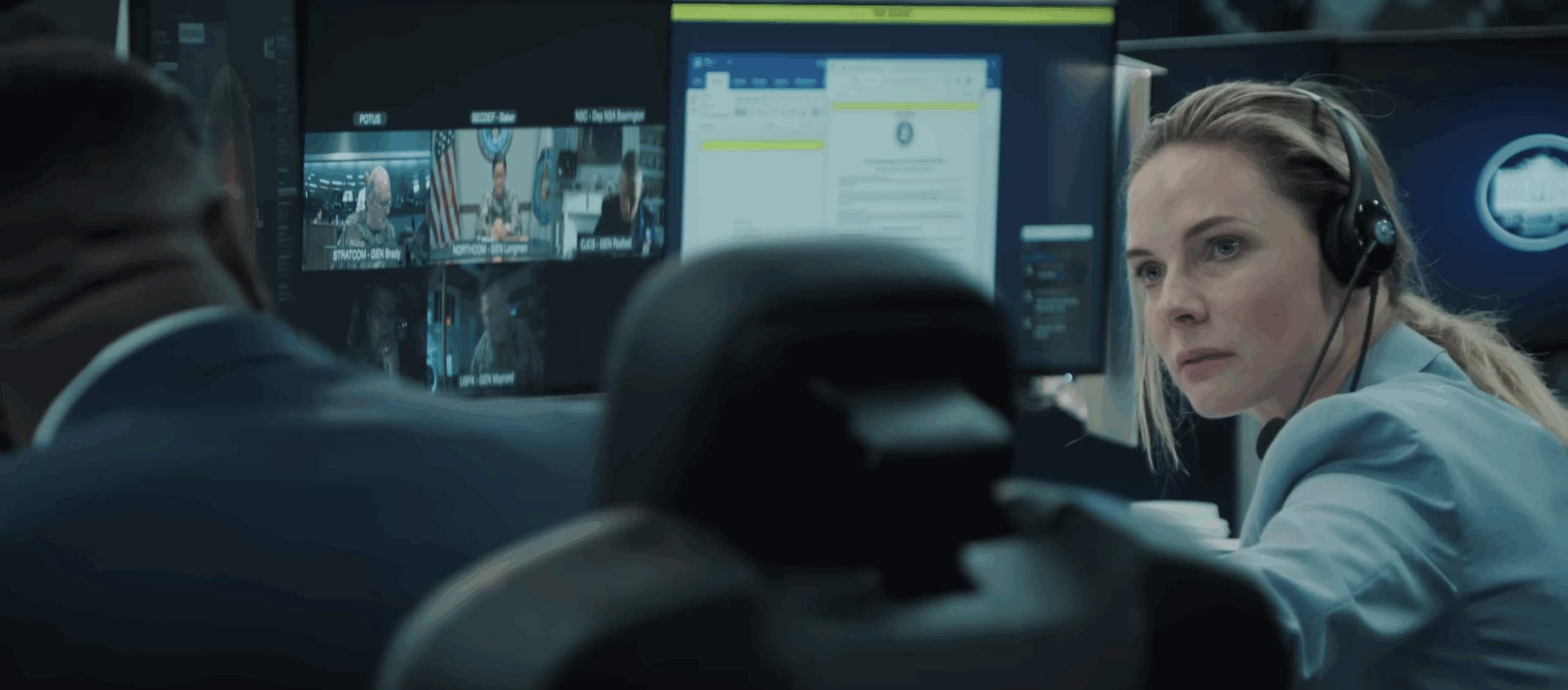
When the first female director to win a Best Director Oscar (for 2008’s The Hurt Locker) makes her first feature-length film in eight years, you do expect people to take note. And they have. After a brief, limited, Oscar-qualifying theatrical run, Kathryn Bigelow’s A House of Dynamite debuted at number one on the streaming network that funded the film’s production, and was viewed 31 million times in its first two weeks on the platform. Reviews for the film have been strong, and there has been considerable discussion about the film’s controversial ending (more on that later). Yet somehow, Oscar buzz for Bigelow’s new film has seemingly diminished by the day.
Make no mistake, this isn’t a quality issue. A House of Dynamite is a wrenching, nerve-rattling, beat-the-clock thriller about a subject that has long been left in the back of our post-Cold War minds: nuclear devastation. Bigelow’s direction is typically restrained, realistic, but also fierce and committed. The pacing of the film is like watching a timed chess match in Central Park, with the players slamming their hands down on the clock with each move. While the film has no real lead (it’s a true ensemble), the main players (Rebecca Ferguson, Idris Elba, Tracey Letts, and Jason Clarke) all give top-shelf performances. The screenplay’s construction, which involves responding to a missile of unknown origin headed to Chicago and unfolding over the same eighteen minutes, is both demanding and ingenious.
The film also looks great. A House of Dynamite is a top-shelf production. It should be able to compete in numerous categories: Best Picture, Best Director (Bigelow), Noah Oppenheim’s screenplay, Ferguson and Elba for Best Supporting Actress and Actor, Volker Bertelmann’s avant-garde score, cinematography, editing, and probably in some other categories that aren’t immediately coming to mind. It is a worthy film for the Academy to consider.
The only part of the film that is polarizing is its open-ended close, but A House of Dynamite isn’t about seeing the Windy City get blown away; it’s about the frailty of our safeguards despite all our modern technology. The film is no fantasy. Numerous experts who have worked in Defense have declared the film all too rational in its premise and delivery.
So what is the issue with its campaign?
Well, part of the problem is that there hasn’t been much of one. When Netflix dumped the film into 200 theaters on October 3rd, you couldn’t find an ad on TV promoting its release. Not to mention, of those 200 theaters, not one was affiliated with AMC, the largest theater chain in the United States. Why? Because in the post-pandemic theater chain survival story, AMC will not show films from studios that don’t commit to at least a 30-day theatrical window before heading to streaming.
With no effort to promote A House of Dynamite as a theatrical release and treating a topical, big-budget thriller like an art film by placing it in so few theaters, Netflix isn’t giving the film a fighting chance. Worse yet, dropping it on their streaming platform with such little publicity makes the film appear a straight-to-streaming release. How many people even knew the film was in theaters? I was on the lookout for it, and I didn’t know. The impression many will have when they cue the film up on Netflix is that it was a made-for-TV film. This is not the path to Oscar glory.
Not for a second do I believe that Netflix doesn’t want an Oscar for Best Picture. They’ve been chasing the gold statue for years. The network spent over $150 million on a three-and-a-half-hour gangster epic directed by Martin Scorsese (The Irishman) just six years ago.
The problem is they are doing it all wrong.
Netflix can score nominations (Emilia Pérez managed a whopping 13 bids), but by rushing their releases to their platform, they undermine their own seriousness about the films they fund and acquire. While they have certainly bankrolled a number of excellent films in recent years, the streamer has built a reputation as a collector of “product” and not a purveyor of quality cinema. They flood the zone so desperately with “content” (dog, how I hate that word), that browsing their menu makes you feel as if you need an ark for the long journey to the good stuff. They make the gems difficult to find, and without a theatrical release, those gems often fade into obscurity.
What’s equally depressing is that Netflix is using the same formula with Guillermo Del Toro’s sumptuous and powerful Frankenstein (an even stronger Oscar-bait picture). Fortunately, Del Toro’s reputation will likely carry his latest film into the Best Picture 10, if a win seems very unlikely. They haven’t come close to winning the top prize since a shattering The Power of the Dog loss to Apple’s CODA in 2022.
The fact of the matter is, Netflix isn’t going to be taken seriously until it starts taking its films seriously. I implore them to embrace the inevitable intersection between theatrical and streaming to give their high quality films a sorely needed larger platform. What could possibly be the downside to debuting new films by Bigelow and Del Toro in theaters with a wide release for 30 days before bringing them exclusively to their streaming platform is beyond me. At a time when theatrical releases are struggling, it would be great to see such a big player in the Oscar game use their heft to bring people back to the theater rather than cultivate (and eventually kill) hot house flower films.
The definition of insanity cliché does come to mind.
Netflix is doing the same thing over and over, expecting a different result.








I wholly agree with all of this and Netflix needs to wake up. But there’s one more major factor at play here no one wants to call out. There are less than a handful of influential Oscar prognosticators (you know the ones) who take pride in steering the conversation and often enjoy (thrive in) promoting their own agenda. Then the other outlets seem to fall in line. A HOUSE OF DYNAMITE is also victim to these whims. My 3 ½ cents.
That's sobering bullseye.
Sure, a film like Eden's too divisive and nihilistic but then there is Hedda directed by a Black woman, led by one & masterfully updates Ibsen's nominal play.
It also happens to have the best performance of the year (In my humble opinion) via Ms Nina Hoss who shines even more thanks to Ms Lindsay Pugh's masterfully provocative costume design. Both should be FRONTRUNNERS in their respective Oscar categories but mentioned prognosticators have chosen not too.
It's frustrating how difficult it is for movies outside the preseason list of contenders to gain traction. Maybe forcing the voters to watch everything will help.
I think Netflix wants to win Best Picture as a way of further legitimizing itself and what it does as something that is equal to or better than what traditional distributors do. Thus, though a wider theatrical release for these movies would be preferrable (or, from a personal point of view, a theatrical release of any kind in smaller countries), I imagine winning Best Picture through a more traditional release strategy would only push them away from where they want to be. I'd imagine this is also why even the big prestige Oscar-friendly Netflix productions usually have those same dull visuals (which I refer to as "streamer sheen") as all of their other stuff.
Also, concerning A House of Dynamite, I feel like people bandy about the notion that the film seems accurate in terms of process as this brilliant thing about it and being the ultimate proof that it is a good movie but I'd question whether if you want to describe process as accurately as possible, the ideal form to deliver that idea is this very loosely thematically connected structural division and the form of a thriller.
And concerning the ending, I don't think you needcities blowing up in order for that ending to be better. It just can't end at the exact same moment as the other two seem to (especially since the closing shot is from the ending of the first part) . I feel like at least 60% of the ending's problems would be fixed if they managed to in some way express coherently a moment after the loop , I don't need a specific decision to be made (because it's not about whether the answer is yes or no) but the act of deciding or the inability to do so needs to be expressed somehow because without it the film becomes not about how the situation we have built ourselves into is so messed up that there are no good options (which is what I think is the intention) but rather about how difficult it is to choose out of options in a theoretical situation with incomplete knowledge (thus implying that except for these circumstances, there would be a simple and correct solution). It basically feels like Bigelow is attempting to hack the Kobayashi Maru by stalling until the experiment runs out without having offended anyone by making the wrong choice (which again gets into why I don't think the process stuff is an automatic plus for this movie because it seems like Bigelow and Oppenheim place immense imporance on the notion that this film be a responsible policial object by not arguing for a specific solution but by being scared of making any possible gesture in any direction, the movie remains stuck in the "yes or no" conversation while presenting itself as being above it by refusing to answer it)
In my view, the film functions as a descent towards this central thesis statement in the third part. The first section is preoccupied with answering "what happens?", and we get this thorough exhibition of the process of nuclear defence, when we're coming at it essentially from an angle that surely there is all this military equipment and personnel there to be able to do something about the situation. The first section kinda destroys that notion – and if defence is impossible, we move on to the second section, which is about the response. Again, if we come from a naive prior, we would say that if the bombing cannot be prevented, surely there are reasonable actions we can take afterwards to sustain the rational and orderly state of the world. The second section then challenges that idea as well – making the right decision in that moment seems impossible.
But when we get to the third section, I think it is a rather striking rejection of even the questions that we have been asking before. Not only is there no defence, not only is there no way to respond, but the whole logic of the universe breaks down in the situation presented. What should the response be is an insane question to ask, because there shouldn't even be a situation when a response is needed. All of the deterrence, all of the various armed forces teams that we have followed up to this point is there only for show – their job is not to actually do anything in this situation, but to prevent the situation from arising in the first place. So all the "process" elements that are rightly praised for realism get recontextualised into this (to me, at least) interestingly cynical wink about how power projection is what actually matters, not power itself.
The ending probably could have been executed in a more successful manner, but I think it worked well thematically.
You make a very good argument that makes me want to rethink my experience with the movie but perhaps for me thedifferentiation between the parts wasn't clear enough for me (though the segmentation you describe seemed clear, its point and the actual lines at which the distinctions are made seemed very hazy to me) to actually see the accumulation required to get to what you're describing . I guess Billy Wilder's notion still applies: if you have third act problems, you really have first act problems.
Absolutely agree with you on the ultimate goal of Netflix but have to disagree regarding the streamer sheen. I'd use Roma, The Trial Of Chicago 7 or Emilia Perez as counterpoints but then again I actually prefer and WISH for the longer theatrical releases to go away because online / digital watching IS the future but AMPAS & many others refuse to accept.
What I won't disagree with and absolutely support is having the OPTION of theatrical release for smaller countries. It is the new vinyl and it should always be available to those to prefer it (Coming from someone who actually grew up with theatrical films and has solely relied on them for more than a decade).
Yes, those (and for example May December and Nouvelle Vague) are exceptions because they were not made by Netflix but rather picked up by them, thus meaning that they didn't go through production and post-production under the Netflix umbrella (although The Trial of the Chicago 7 also looks absolutely horrendous). But even great directors have been caught under this nonsense, some perhaps more successfully (Fincher basically gifted them that aesthetic with House of Cards so they know how to use it most of the time, except with Mank, which looked demented when I got to see it in a theater before they stopped screening the Netflix movies here) while with others it is soul-crushing to see.
Concerning the length of theatrical windows, beyond me wanting to see as many things new and old in a theater as possible, it seems to me that movies actually playing in theaters is still the way for them to make a cultural footprint that doesn't dissipate within two weeks (except if there is some other element to it that's easier to reference and maybe even becomes the main thing, such as the songs in K-Pop Demon Hunters). Thus, if we want the perception of movies to not shift into merely becoming oddly long bits of audiovisual content on streaming platforms that people don't talk about or see after their brief moment of being highlighted, we need theaters because saying "I want to see this movie, I'm willing to pay for it and not merely a service that has it, I'm open to getting out of the house to see it and I will pay attention only to the movie for the duration of it" actually makes people more invested in what they're watching and helps them carry it around in their heads after it's over. I understand that there are reasons why streaming is a lifeline to a lot of people who don't have the ability or means to go to the theater all the time but the theatrical should never become merely an afterthought or a hobbyist specialty because the culture fully losing the cinema might completely rewire the way in which we engage with the artform, pushing it from art to content.
Additionally, the new vinyl in this case requires infrastructure and employees so I don't think taking money away from theaters by keeping theatrical windows short is particularly helpful to keeping it as an option in the future because it trains (as the past decade and a half already has) that unless seeing something is time-sensitive (to be part of a phenomenon or to avoid hearing spoilers beforehand), they can just wait for it on streaming.
I'd add Frankenstein to the list of stunning Netflix pics but.. soul-crushing!? Guess we have to agree to disagree regarding them.
As for oddly long bits of audiovisual that are soon forgotten, the first part has become the definition of movies and cinema for generations that are born and RAISED by holding tablets. Regarding staying in the conversation, I beg to differ. Films like Emilia Perez or The Power Of The Dog stayed in conversations FAR longer than biggest hits like MineCraft movie or Lilo & Stitch remake (Or probably the upcoming Toy Story 5.. which soon will reach Toy Story Revival per Years and Years mini-series).
Finally the jobs in comparison to vinyl: They are done and should be looking for new careers, the same way many, MANY other vocations should be (But aren't because social and geopolitical preferences don't allow it to happen).
But surely people in the industry notice and resent Netflix's desire to kill movie theaters, and this could be part of the reason why their contenders keep losing.