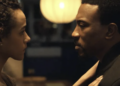
An act of sudden violence brings us to a peaceful limbo in Letitia Wright’s Highway to the Moon. No one knows where we go when we die, but this film shows a world where we must learn as we wait. Stunningly photographed and lovingly directed, Wright’s directorial debut highlights how we can sometimes have more questions than readily available answers. How looking within ourselves might unleash an amount of healing that we didn’t know we needed. Highway to the Moon brings forgivness to the forefront.
**We have linked Wright’s film below. Please consider watching it and then scrolling up to read our conversation.
Wright’s film came from a tragic place. She lost a friend in a violent moment when he was stabbed in London. To bring such trauma to your art can be cathartic and it is almost always difficult, but Wright knew that she had to do it in order to calm a part of herself. She wanted to show young Black men in a place of beauty and possibility.
“I was trying to find a place to put such a traumatic experience into something that could soothe me, in a way,” Wright says. “I don’t have the words to comfort my friend, and I didn’t know what to do in the physical day-to-day. It wasn’t enough, and it wasn’t going to bring him back. The only way that I could navigate it was through cinema and putting words to paper and just writing what I was seeing and feeling. He was here and then he wasn’t here anymore. I wanted to take a look at that perspective, because we often see stories where these boys are painted in a negative light. They’re in gangs, they’re in urban cultures and urban cities and they’re struggling in school. It’s all different narratives that feel very stereotypical, and we never see them in environments that look like this. The birthplace of this film was pure.”
We enter this “in-between” with Micah, a young professional who is assaulted on a busy street by his friend. When the film opens, he doesn’t know where he is, but he is led around by three other young men. This group, often referred to as Kings, navigate this unknowingness with one another. Wright wanted to show a stark difference between the jagged images that brought Micah to this place versus the place itself.
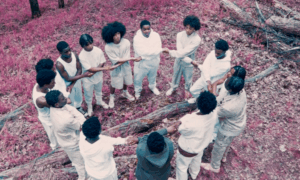 “With those scenes, especially, I started from a place or spirit, as in what do I want the scene to feel like,” she says. “At the start of the movie, there’s these distorted images, and as we follow this kind of nightmare, we see this tragic event in glimpses. Any time he’s touched in those moments, it’s either to guide him to the floor and to accept his passing or it’s a violence against him. It was important to me, though, that we never see a knife, but because of the way that he’s touched, you immediately believe that he’s been harmed by a weapon. That’s sad to me, because that means that there is a common trait in things that’s happening when young people are in violent situations.
In the in-between, I wanted to play with the opposite of that. I wanted to switch it and have these young Black boys in a circle and for the physical touch to be something that he’s still unsure about. The way that they touch him, though, and the way that they comfort him is something that he’s never had and something he’s struggling to accept.”
Confusion and fear drawn joined together has a way of bonding these young people. When they hold council with one another, the camera is very calm and welcoming. The Kings must learn how to trust one another, and they aren’t afraid of physical contact. When Micah has to welcome another King, he is alone to greet him.
“Trust, vulnerability, and forgiveness are things often left out of narratives with young Black men,” Wright says. “For Micah, he ends up looking right at the person that has committed this crime. He took a life, and he was like a brother to him. In that moment, Micah has a choice. Even in the in-between, he could continue this path of anger, but he chooses to have a conversation. When Trey comes into the in-between, he’s terrified, and he doesn’t know if he’s going to find any help. There will be hard days where they hate each other and they have to fight things out, but in order for them to get to the other side, they have to make decisions together.”
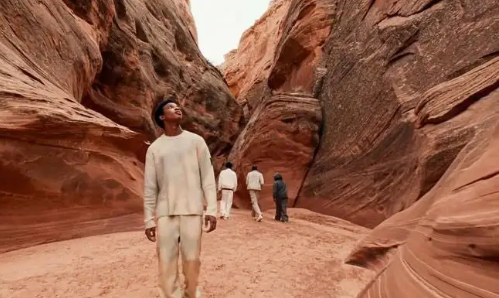
How do you create a place that no one knows what it looks like? In certain instances, you just have to make those decisions, and Wright was eager to try and see what places she could secure to film her project. I love how the film is almost entirely outside, as if hinting that we might all return to the earth in some form or another. When we are in the in-between, there is so much light, but the real world is often seen at night or more darkly lit.
“Honestly, the biggest obstacle, in a lot of instances, was finding it,” she admits. “How do I find a place that mirrors what I’m seeing and being haunted by–these images of vast, beautiful desert land. How can I get the film commission to say yes? I found it in Arizona, but there were still some hurdles to jump over. The Najavo Nation Film Office was really gracious and let me film there. I didn’t have a lot of resources to offer, and all I had was me and my young kings–we went out and prayed about it. I just threw things out there like filming in Horseshoe Bend or Monument Valley, and people would look at me like I was crazy. I got everything I wanted, and sometimes even better. There is a scene of the three boys guiding Micah into the caves, and that was literally just the graciousness of the familty that owns that land. It was a beautiful experience. I’ve never seen Black boys with the beauty of that kind of cinema.”
In one of the film’s most emotional moments, a young man expresses frustration over his expectations of his own happiness. He says, ‘I thought you had to go through the worst to get through to the best moments in the future.’ It’s a line that came from this young man’s real life, and Wright earned his blessing to make it part of her vision.
“That scene is very hard for me,” she says, taking a moment. “The three boys that Micah meets are all non-actors. Kenyah Sandy was in episode five of Small Axe, “Education,” but we weren’t in the same episode–I’ve been chasing him ever since. When I spent time with them at the camp in New York, they had recently lost a friend to suicide and they were still processing it. I saw with them, and we cried together. We spoke about so much, and that’s one of the questions that kept coming p for us. When do you get to the best points of your life? Why do we have to go through hard things to then find beauty? I found a way to put it into the script, with his blessing, but we only did that take once. It was hard to watch him process that. Once the film wrapped, I made sure all the boys got therapy provided, which oftentimes we don’t get. People can take from you on a film set–I love what I do, and I honor it–but sometimes people don’t ask you if you’re okay. I made sure that that was offered to them, and they took it.”