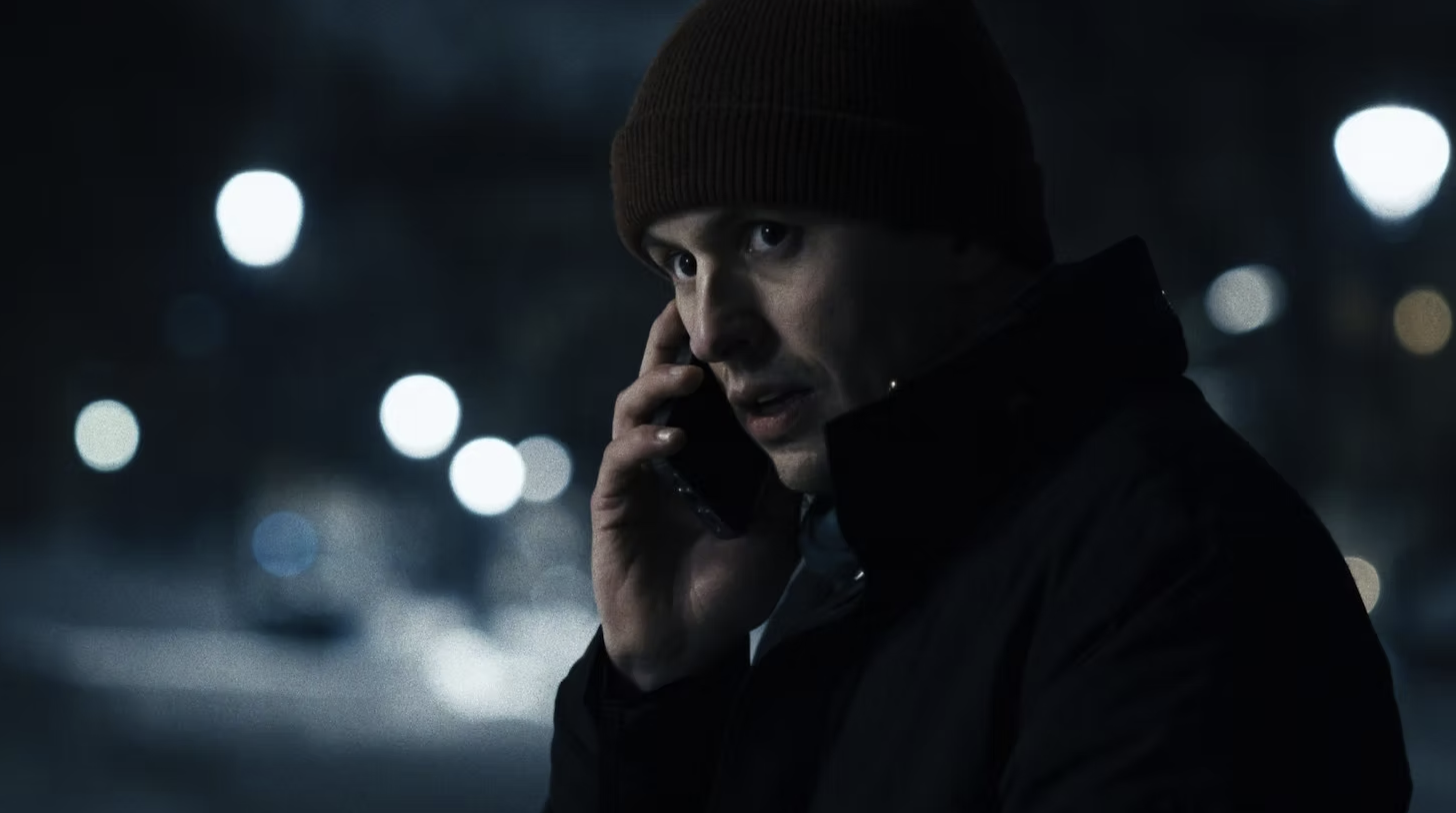
Iain Forbes’ After Dark wastes no time with asking what we would do if we had the same experiences as the lead character of his film. A man is walking home in Oslo on a frigid, snowy night when a young woman asks if she can walk with him. Everything about her signals distress, but she doesn’t comes right out and say what is wrong. Is she scared or is she trying to get something out of him. With its simple premise and foreboding atmosphere, Forbes’ film is a relatable morality tale.
We all like to think that we would help a stranger in need. If someone appeals to our kindness or our good nature, we tell ourselves that we are reliable and generous. While After Dark is set in present day, there is a timeless quality to it.
“This happened to me,” Forbes admits. “I had been to the cinema, and I was approached by a young woman. There was such panic in her eyes, so I took off my headphones before what happens in the film happened to me. So many things were going through my mind, and a lot of the dialogue was lifted from this encounter. I am walking down the street, and I was just waiting to hear the sounds of footsteps racing behind me. She must have gotten away from a violent situation, but she would never give me a clear answer. The ambiguity stuck with me. Was she someone that I should’ve helped or not? Maybe I should’ve stayed with her. How involved should we get in these situations?”
Kristian agrees to walk Mia a certain distance, but then she asks for his phone to make a call. We can sense the hesitancy in his voice as he watches her call her mom, but she still can’t get anyone to pick her up or rescue her from what danger might be lurking. With a character like Mia, Forbes acknowledges that has the toughest role in the film. She has to appear helpless but also telegraph some uncertainty to Kristian.
 “That was actually one of the biggest challenges in the writing and directing,” he says. “Mia was kind of finding that line between how much exposition does this girl get? How much should we understand her, and how much is she going to blindside us, as the audience. Billie Barker and I came up with the whole backstory, and she held onto every detail of what had happened to the fictional character of Mia and why she responds in that way. We charted everything she did that night and what had actually happened to her and why. I think Kristian reminds Mia of someone she’s trusted before, so there’s a lot of layers going in as to why she falls in line with him on the street.”
Forbes skillfully switches the perspective to make us feel like we are being watched. When this pair first meets, they are in a small wooded park, and we flip to the point of view from a ferw yards away. Are we the person that Mia is scared of? Are we simple out for a stroll or walking our dog and we happen to see them chatting? Later, inside a convenient store, we get a different kind of eyes on eyes as strangers witness an argument between Kristian and Mia.
“It swaps between being very highly subjective in Kristian’s physical space to Mia and then to them together,” Forbes says. “You feel like you are being chased or being watched, so it’s that thriller language, especially in the park. That’s honestly my favorite shot of that feeling so exposed in that environment. In the 7-11, those two guys are much closer to them, and things can be taken wrongly, too. The camera is not always subejctively linked to Kristian.”
You can almost feel the brisk, frigid air as the negotiations between Kristian and Mia continue. If you were in the situation, you might let a stranger come with you just so you can get out of the cold. Or, perhaps, you might feel sympathetic when you notice that Mia should be wearing something heavier as she deals with something dire. That darkness Forbes’ captures enhances the tension.
“One thing I’m sure every director will tell you is that you cannot control the weather,” he says. “We had scouted the film in December before we shot it in January, and there was no snow. We storyboarded it, and our main concept was finding pockets of light and use shadow light in all directions. That gives you some characters always in light and some always in shadow as they are surrounded by these pockets. After the snow came in, it melted, so suddenly we have this sludge weather–it’s so inhospitable and oppressive. It’s the worst feeling in the world. We realized that we could lean into that. The exterior of that day was the city of Oslo at its worst. You don’t want to be out there, and you don’t want to be forced into any encounters. It’s just people in black clothes, huddled, trying to get out. I wanted every stop in Kristian’s night to be uncomfortable.”
When Kristian finally leaves Mia in that convenient store, they part on harsh terms. She berates him for assuming something about her, and he just wants to get out of there. Before he continues down the street, though, he looks up through the store’s window one last time before he finally makes his way to his own apartment. My favorite moment is the very end when we see flashes of the places we just were. Kristian is haunted by the images of these places–but for how long?
“We’re putting him in this empty home where it’s very quiet, and he doesn’t have anything planned,” Forbes says. “He sits down and he’s heavy with this inner turmoil and this feeling that he got away. That shot of him looking at her in the store was very crucial for me. He makes it out after being yelled at by a stranger and having people watch him. When he sees her through the window, he almost considers her as a sad puppy. Maybe he is thinking that he should go back in again, but the film would’ve been very different if he went back. Him not finding out the truth is a full-blown tragedy. That emptiness of not knowing.”
View this post on Instagram