
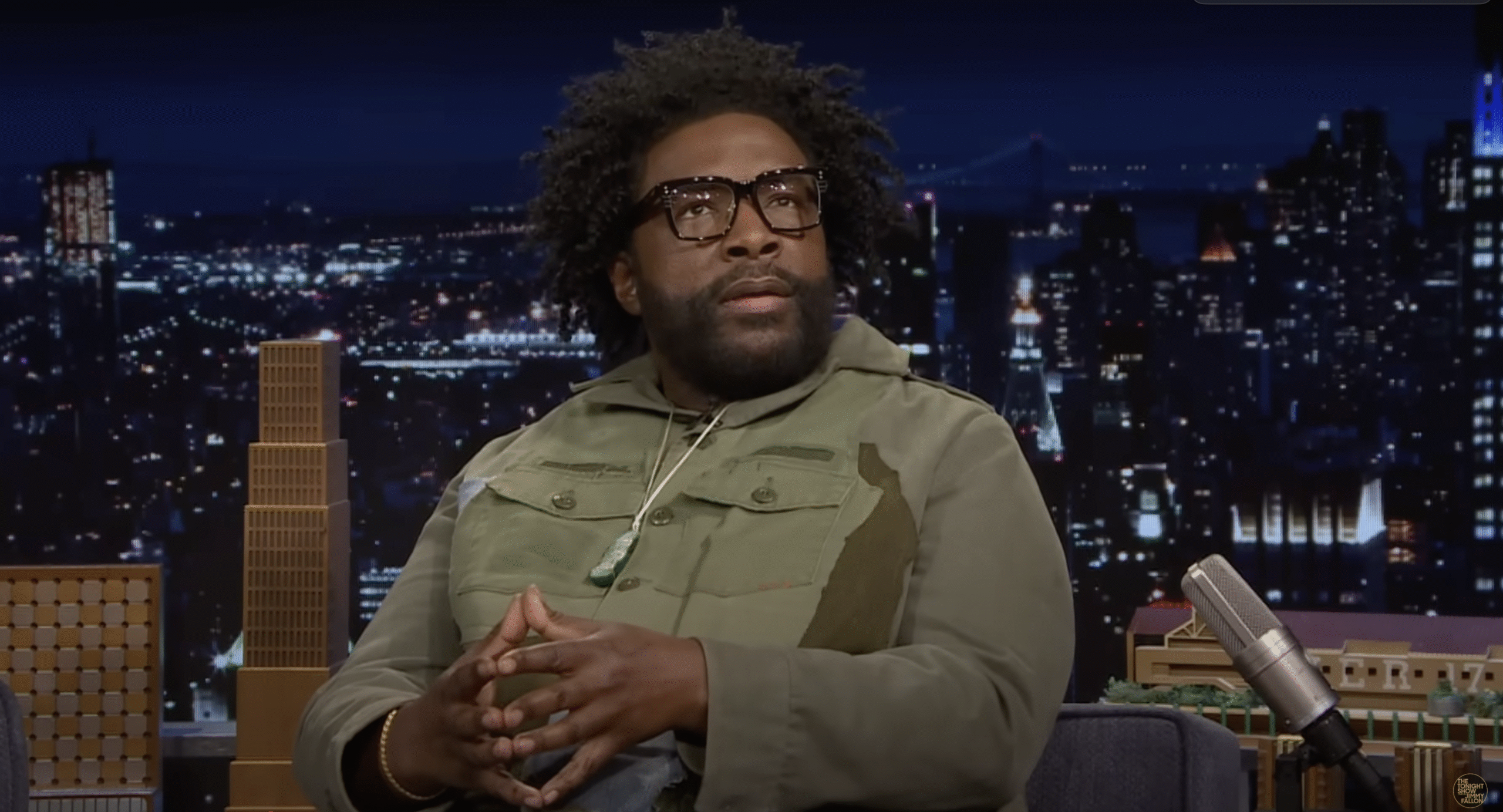
In recent years, Questlove and his band The Roots have become something akin to musical historians. The band has been together for more than three decades, serving as the house band on Late Night with Jimmy Fallon and then The Tonight Show (also with Fallon) for 16 years. Questlove did a five-year stint teaching as an adjunct professor at NYU and became a filmmaker in 2021, winning an Oscar for Summer of Soul. The terrific doc on Sly Stone (Sly Lives!) followed this year and was recently nominated for an Emmy. All of his experience came in handy when curating and co-directing (as well as taking on the responsibility of house band) for SNL 50: The Homecoming Concert, which earned Questlove another Emmy nomination for direction in the category of Variety Special (Live).
In our conversation, we discussed the long history of Saturday Night Live as a live music venue, as well as the challenge of assembling the Homecoming Concert, and the burden and desire to document the importance of popular music.
The Contending: I know the curation of the special was months in the making. When did you find out you’d be in the position of director, organizer, and house band leader?
Questlove: When you get summoned up to the 17th floor to Lorne’s domain, especially when you’re not given any reference—‘Ahmir, Lorne wants to see you on 17’— it felt like The Green Mile. (Laughs). I was like, guys, I must have done one tweet too many about da da da. I’m trying to figure out, did I say something snarky about an SNL sketch? Why am I getting called to the 17th floor? I didn’t know how big the Cannes Film Festival was, but it was kind of the Summer of Soul part of my life. The first domino to fall was the meeting in Lorne’s office, mid-2021, when Lorne pitched me doing the SNL 50 documentary. Then there was this sort of “Oh, by the way, we’ll most likely call you about this concert special we are planning.”
So I knew by late 2021 that this was going to be waiting for me. It was like a nice version of a boy telling you, “three o’clock, bike rack, after school.” (Laughs). I know somewhere in 2025 I’m going to have to learn a mountain of songs. I have a habit of agreeing to stuff years in advance. Oh, 2025? Yeah, okay, I’ll do it. I’ll say that the second step in the seriousness of it was probably early 2024 when Lorne summoned me and Mark Ronson to his office just to talk generally about, what can we do? It’s what I always call the spaghetti method, which is to name every artist in existence, and we’ll see what makes sense, what does not make sense. I always wanted to know when the most powerful force in the universe puts out a bat signal, is that a “drop everything”? In some cases, it was a drop everything like, “Oh my God, I got called.” This is an honor. And for some people, it’s “Yo man, I’m in Australia that weekend, let me see if I can try to cancel.” SNL is powerful. You’ve seen SNL rollout announcements when they do the three-by-five cards and the different colors. I’ve learned about the power of vision boards just by going on 17. 17 is like vision board heaven. There’s what’s going to happen, what we would like to happen, and ways that we could make it happen. It is like a whole CSI/Beautiful Minds setup. By mid to late 2024, we were using our resources, calling any and everyone. Some people came super early, like the B-52’s and David Byrne. Getting Lil Wayne for Sunday night was almost like a four-day-in-advance thing. It was hard.
Getting the rappers was hard. (Laughs). The hardest part was the planning, the easiest part was the playing. Let me rephrase that. You would have to have the 16 years of experience of being a sponge in this environment. There’s two things that’ll make me a better artist: one is that I’ve learned–unlike this answer–how to write succinct pop songs. You’re always asked, “Hey, we need a seven-second jingle for Dad falls in a pool.” The education you get here in terms of comedy—and comedy has the same rhythm as music—I learned how to write succinct songs. But I’ve also learned that at any given moment someone’s going to bust through this door and be like “Hey, somebody can’t make it, you’ve got five minutes to learn Eddie Vedder’s song.” Anyone else would probably fold or buckle under pressure, but being here for 16 years at The Tonight Show has literally taught me no fear, some nervousness, and nervousness is usually making the other person feel at ease, like Cher’s concern that we might miss the hits on verse three. So that’s the nervous part. But yeah, throwing 32 songs at The Roots, no problem whatsoever.
The Contending: Can I speak to my favorite musical moment? I don’t know if this is an obvious one for you or not, but when David Byrne and Robyn were performing “This Must Be the Place,” and there’s that “you love me ‘til your heart stops” and then you stop—pregnant pause—and you kick back in, and you guys rolled in like a wall of sound. I was just over the moon about it.
Questlove: I will say if I had to do a top five moment, “This Must Be the Place” wound up being it. There was one week where it was strictly about deep cuts versus Captain Obvious. If it’s a Nirvana reunion, do you want to fight for “Teen Spirit” or do you want to just go to the side of the road and do “Come As You Are,” and not climb the mountain of the most famous song in their history? In the case of Byrne, I’m in love with “Artists Only” only because of my history with watching the first five years of SNL in real time. I’ve shared the story that even though I was five years old when SNL first debuted, I lived in a household in which my parents only let me watch music programs.
So they’d wake me up at 12:30 at night, and I’d watch the second half of SNL, which was the music half. And then I’d watch Soul Train at 1:00 AM and then get up and go to church at seven in the morning. I remember watching Devo do “Jocko Homo,” and I definitely remember watching Talking Heads do “Artists Only.” Literally all of ‘78, I was singing “Are we not men? We are Devo.” What 8-year-old black kid from West Philly knows what Devo or Talking Heads is? So I fought hard to put Byrne into deep cut Smurf territory. But around August, Mark (Ronson) suggested Why don’t we do pair-ups? And then it was like, okay, we’ll pair up Nirvana with Post Malone, and everyone was doing these duets together. Then it was okay, I guess we gotta do “This Must Be the Place.” At first, I didn’t think it was going to be special, but then I forgot about their presentation and the quirky dancing. It’s fun to play those songs. The more simple the song is, the more I feel like we nail it.
The Contending: That’s the other thing about the show, it’s like a three-hour-long live mixtape. If you’ve ever seen High Fidelity, which I’m sure you have, there’s talk about how you bring the flow of a mixtape. You’re mixing in Bonnie Raitt and Nirvana, and it’s all over the place in a way. Was that a challenge to figure out how do we warm this up, cool it down, and bring it back?
Questlove: Probably my area of expertise is the ebb and flow of it all. But in this particular case, I couldn’t really take credit for it. Only because you’re dealing with a lot of A-list stars and they’re going to get the final say. In a perfect world, we all agreed that if “Seven Nation Army” gets performed, that should be the first thing out the gate. Jack was like, “Nope, I want to close this bitch.” I was like, “No, man, you don’t see how powerful this is going to be if you open with this?” Once you have a few of those things, then you have to adjust. The one thing I’ve not gotten used to in this whole ambush “surprise, you guys have three seconds to figure this thing out” method of being here at 30 Rock is also them not giving us much recap time. We don’t commit every song to memory, but The Roots are a well-oiled, 34-year-old machine. We do have a math method of memorizing songs. So even if it’s a guest whose song we’ve never heard of before, we scientifically have a way to commit it to memory so that we know the song.
Now, after the song’s over, it’s going to leave us forever. But in this particular case, I thought it might be wise to also have acts on the show that we’re not backing up, just so that we can have a five to seven-minute recap. Thus, Bad Bunny with his band, and sadly, as much as we wanted to do it, Lauryn and Wyclef performing without us, gave us a break. The hardest song for me was “Walk the Line,” because of the time signature changes and us needing to be in sync with Jelly Roll. So we needed at least a three-act, then take a break, and recap. I would have probably had a different order, in terms of perfection, as if it were a DJ set, because that’s just how I think. But in this case, we had to pace it just so that we don’t have to cram 32 songs in our heads at the same time.
The Contending: Speaking of Lauryn and Wyclef, did that feel like a sizable coup when you got the two of them? I know as soon as they walked out, I was checking all my flesh for goosebumps.
Questlove: You know, you also have to take into account other issues that have nothing to do with the music. I will tell you, there were zero issues there, almost to the point where I wanted to snatch the song back. Wait a minute, if this is this damn easy, maybe we can back them up. I just thought in my head, oh man, if we go here, then there might be a lot of rehearsal time just for these two songs only, and we have 32 other songs, so maybe we shouldn’t. You get your first draft pick of who you want to work with and that sort of thing.
But I just figured that organizing it, there was no time for us to have any downtime to spend five hours on something or whatever. It’s almost like a half hour with the artist, do it about five times each, and then, all right, any issues? Okay. We’ll fix the third verse. We will readjust the key. It was almost like a factory; you miss one bottle and then you’re in Lucille Ball territory. I will say that not playing behind Lauryn and Wyclef)was one of my regrets; we could have been a part of this. But for the most part, there’s nothing I regret. Everything came out the way it should have.
The Contending: Is there anything more enjoyable than watching Jon Hamm doing call and response with Snoop Dogg? (Laughs).
Questlove: I’ve been privy to award shows, and there’s nothing more scary than when you’re ambushed by the camera guy in the pit and his camera’s right on you. I feel as though, for the most part, The Roots have to battle two identities: the idea of The Roots, and the actual “Nah, I’ve seen The Roots 10 times. They never fail.” I almost feel in The Roots folklore—and I do this a lot with Radiohead—it’s almost like, I don’t want to be left out. Oh yeah, of course I love Radiohead. I know everything. You don’t want to be the odd guy out that doesn’t know something that’s cool. For the most part, I felt like since we’ve been here, people have heard about The Roots, or they might turn on for two seconds, okay, that’s cool, and then change the channel after nine seconds of evidence.
But I knew that’s probably the first time that this world that we’ve been immersed in for 16 years walked away going “Holy shit. They made Vedder sound as hard as Pearl Jam. They made Byrne sound as groovy as Talking Heads. They made Bonnie Raitt sound that emotional.” The amount of praise we got at the after-party let me know that, yeah, the idea of The Roots got replaced with “I actually spent two hours with them and these guys are actually as good as they say they are.” For the most part, I was just grilling Maya (Rudolph), Jon, and Adam Sandler, and I am asking, “Were you guys really enjoying yourselves, or did you know the cameras were on you?” Is the fear of Lorne like that for real, or were you guys really into it? And they were all, “No, man. It was the best thing I ever went to.” I’m so used to industry shows being so blasé, like, when do I get out of here? But it was very unpretentious. People were happy to be there. I couldn’t imagine a better landing after two years of prepping for this.
The Contending: You’ve moved into filmmaking in recent years, with this special, Summer of Soul, and your Sly doc. It struck me that you have this deep commitment to history when it comes to music. I sense this need in you to put forth projects that you don’t want people to forget about, to document it and make it last. Am I onto something there?
Questlove: Once I turned 40, I was trying to figure out what kind of adult am I going to be. I remember the first 10 years of my life with my dad binge record shopping every two weeks, because my dad ran a band. Twice a month, we would go to the record store and, in the seventies, purchase like $200 worth of music. We had this bond. My dad fell out of love with music around ‘79. His anger over Stevie Wonder’s Journey Through the Secret Life of Plants was legendary. (Laughs). And he just retired. But for me, the part that was broken was that was my real, true bond with dad. Binge record shopping with my dad and me, trying to explain to him, “Hey, let’s give BT Express another chance. I know you didn’t like the last album, but I think this one might be good.” I’m an 8-year-old, what do I know? But we had that bond, and once it was broken, he just changed in the eighties and then just became so closed-minded about music. I remember we argued about It Takes a Nation of Millions to Hold Us Back. I remember saying, “Man, when I turn 48, I don’t want to be like my dad.”
My dad used to be in love with music, and now he’s just an old grump. Then, once Quincy Jones started promoting Back on the Block and the Listen Up documentary, he became like the ideal dad. Wait, you actually like rap music and things? I’ve never seen an adult like you. So I’ve been hyper-aware of what I want my position to be. And it’s not to say that I’m exhausted or sometimes very numb to the offerings out here, but for the most part, I didn’t want to be the hall monitor adult that’s always correcting or #wellactually. My first foray was teaching at NYU. I was an adjunct professor at NYU for five years, and then that became time-consuming. Then I started the podcast Questlove Supreme. But for me, this level of storytelling, when you think of it, is my calling, even though I didn’t ask for it. To be frank, I ran away from it. It took seven months and a pandemic and boredom to bully me reluctantly to say, “All right, I’ll do this damn film (Summer of Soul), and then I realized later it was my destiny. On one hand, I’m overqualified for this job, and on the other hand, I’m scared to death. I’m putting the finishing touches on the Earth, Wind and Fire doc right now. It’s scary, but I think that when you’re scared and nervous, that’s a good thing. But yeah, this is a new destiny for me. And it’s a good, scary path to be on. It’s new for me. I’m on my P’s and Q’s.







Secret life of plants is bad, but not THAT bad
Agreed!