Criterion delivers three amazing films via Home Entertainment this month.
Network – 4K-UHD/Blu-ray – Criterion
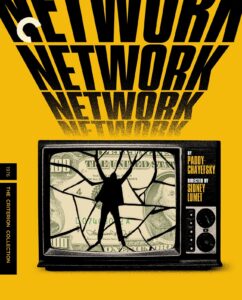
“You’re talking about putting a manifestly irresponsible man on national television.”
Directors like Sidney Lumet, Robert Altman, Alan J. Pakula, Sydney Pollack and Francis Ford Coppola, to name but a few, were working at the top of their game in the mid-1970s, creating films that were bold, daring, relevant and clever comments on the complex political, social, and sexual situations of their time.
Lumet’s string of extraordinary ‘70s features included Serpico (1973), Murder on the Orient Express (1974), Dog Day Afternoon (1975) and Network (1976), with all four films netting the master craftsman much deserved DGA nominations. He was Oscar-nominated for Dog Day and Network. The latter should have won him the prize, but more on that unconscionable loss later.
Network remains one of the most frighteningly prescient, bold, riveting, masterfully acted, brilliantly directed and scathingly penned films of that time and, arguably, all-time.
And it was billed as Paddy Chayefsky’s Network, a rare bow to the genius scribe who already had two Oscars (for Marty and The Hospital) and would win his third for this audacious gem.
As with many classic films, Network was not universally embraced when it came out, although it did win a slew of awards. It has gained in stature over the decades and, viewed today, is still a daring, perspicacious work where you can easily replace television with social media and, presto, you get a crazy combination of satire and, well, reality. Much of what Chayefsky was satirizing has come true in so many ways. He predicted reality TV and the hold it would have over viewers as well as the media conglomerates who buy up TV networks (and studios) and then attempt to control the news divisions (CBS much?). And he glanced into his crystal ball and saw just how the media would become slaves to salacious stories for ratings. Today it’s all about likes, shares and clicks.
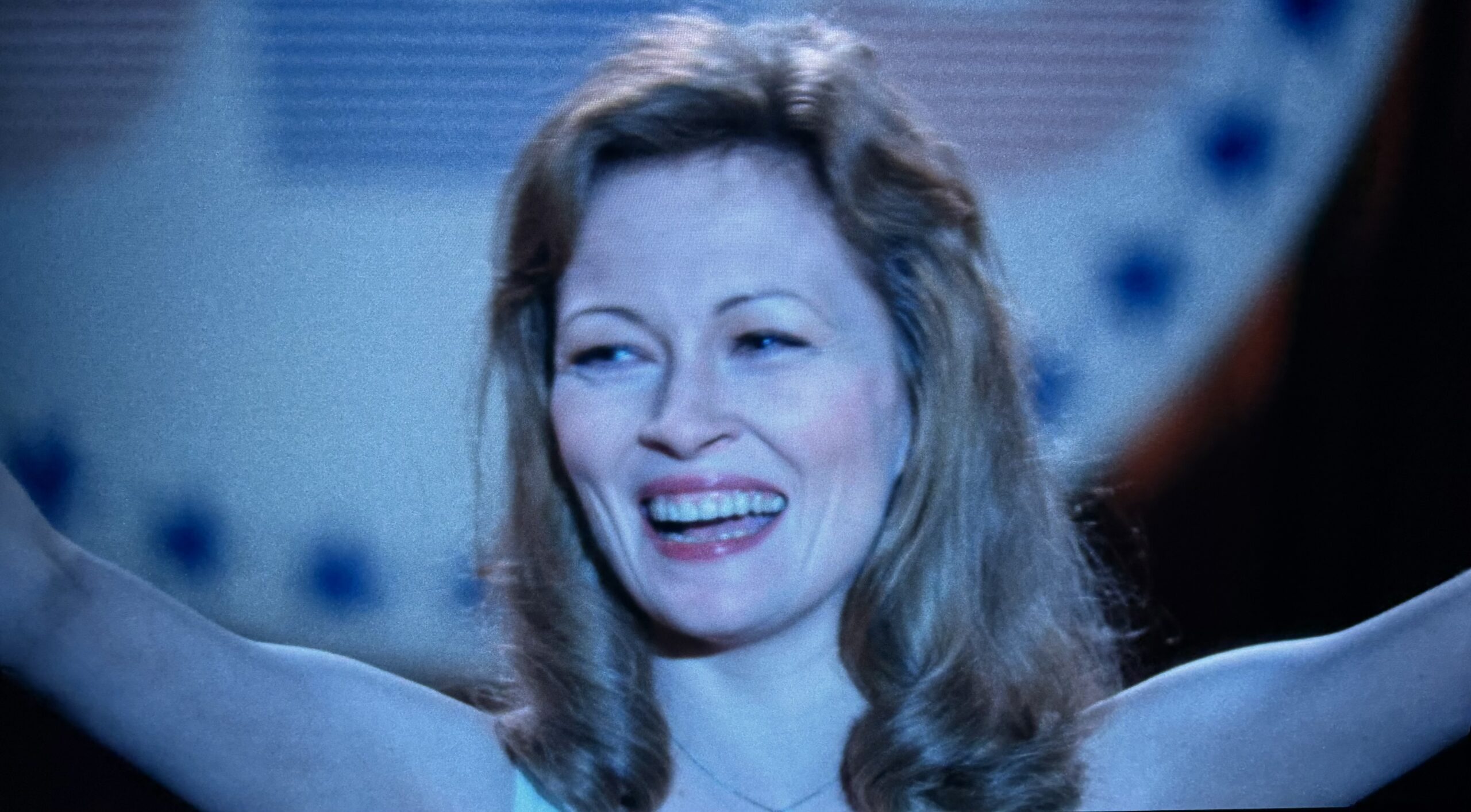
The film chronicles the fall and rise of UBS (Union Broadcasting System) and how this low-rated network would become a sensation thanks to a ravenously ambitious exec, Diana Christensen (Faye Dunaway), and her ability to capitalize on the ravings of a disgruntled news anchor, Howard Beale (Peter Finch), who becomes the “Mad-as-Hell” prophet raving about the injustices in today’s society. Of course, news division president Max Schumacher (William Holden) and Diana’s profits-focuses boss, Frank Hackett (Robert Duvall), go toe-to-toe on whether it’s a good idea to exploit the thundering loon. And the film just keeps raising the satiric ante beyond the outrageous.
Network received nine Oscar nominations winning for Original Screenplay (Chayefsky), Actor (Finch, posthumously), Actress (Dunaway) and a surprise Supporting Actress grab for Beatrice Straight’s five-minutes of impressive dramatics.
Among the wondrous ensemble members, Ned Beatty was nominated for his near-six-minute standout part, brilliantly shot by Oscar-nominee Owen Roizman.
Duvall’s wackily over-the-top performance did receive a BAFTA nomination.
And props need to go to Marlene Warfield as the savvy counter-culture revolutionary, Laureen Hobbs.
Finch delivered a bravura performance. He, sadly, died of a heart attack at the age of 60 while on a promotional tour for the film, just a few weeks before the Academy Awards ceremony.
Holden, in the less flashy role, received his third career nomination —I know, only three???—and it was widely reported that upon learning of Finch’s death, commented, “”If the son of a bitch hadn’t died, I could have had my second Oscar.” Holden won for Billy Wilder’s Stalag 17 (1953).
If there’s one role that epitomizes all that Chayefsky found simultaneously seductive and horrific about the medium of television it was that of Diana, magnificently brought to scathing life by Dunaway. It’s her best screen work and one of the most significant. Dunaway earned that gold statue by rarely showing us any vulnerability (Lumet wouldn’t allow it). Diana is TV incarnate, much like a certain current orange-haired world leader who enjoys abusing his power.
Criterion brings us a spectacular disc boasting a new 4K digital restoration, with uncompressed monaural soundtrack. It’s never looked this good.
The Blu-ray features an informative audio commentary from Lumet from 2006 as well as a fab six-part doc on the making of the film, directed by Laurent Bouzereau, also from 2006, boasting great insights, especially from Dunaway.
The one new goodie, which premiered on TCM, is Matthew Miele’s terrific 2025 doc, Paddy Chayefsky: Collector of Words, which dives into all aspects of the writer’s amazing career.
At the 49th annual Academy Awards, Network, along with Alan J. Pakula’s All the President’s Men, Martin Scorsese’s Taxi Driver and Hal Ashby’s Bound for Glory—all astonishingly great cinematic achievements—lost the Best Picture Oscar to John G. Avildsen’s feel-good travesty, Rocky. This tragic upset can easily be cited, alongside Paul Haggis’s Crash besting both Ang Lee’s Brokeback Mountain and Steven Spielberg’s Munich, as two of the worst Best Picture choices in the history of AMPAS.
Lumet lost the best director award to Avildsen. Who, you ask? He’s the director who went on to helm craptacular movies like Neighbors, A Night in Heaven and For Keeps. Who, you ask again? Exactly.
But regardless of the Oscar megablunder or in spite of it, Network stands as one of the best. Period. And we now have a 4K-UHD edition that allows audiences to rediscover this masterpiece in all its mad-as-hell glory.
https://www.criterion.com/films/34869-network
3:10 to Yuma — 4K-UHD/Blu-ray — Criterion
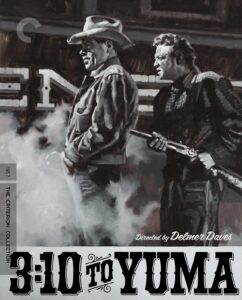
I recall really being taken with James Mangold’s version of Elmore Leonard’s 1953 short story, Three-Ten to Yuma. That 2007 film had great work by Russell Crowe and Christian Bale. But I never got around to the original 3:10 to Yuma, until now thanks to a stunning Criterion 4K-UHD digital restoration. Firstly, it looks pristine. Secondly, what a surprisingly terrific film.
I write, surprisingly, because I have never been a fan of Glenn Ford, but, again thanks to Criterion, my opinion of him has altered, beginning with my viewing of The Big Heat, and now watching his suave villainy at work in 3:10.
In addition, I’ve never had much use for Van Heflin who appears rather wooden in most of his movies. I do always enjoy his poor sad sack blowing a hole through the airplane bathroom in Airport. Here, as the apprehensive hero, he has an interesting arc to play and does a fine job.
Director Delmer Daves helmed the Bogart-Bacall noir Dark Passage and here he creates a western noir that is a lot more psychologically dense than it initially appears to be.
Set in the 1880s (although we aren’t told that) in the Arizona Territory, the film, written by Halsted Welles (The Hanging Tree), begins with a stagecoach robbery and gang leader Ben Wade (Ford) shooting two people in cold blood. Rancher Dan Evans (Heflin) helplessly watches along with his two young sons. But Evans is desperate for money to save his farm, so when $200 is offered, he volunteers to help bring Wade to justice via an elaborate plan to make sure he’s on the 3:10 train to Yuma. As you can imagine, things get quite complicated from there. And the movie has quite the surprising yet satisfying ending.
Much of the film’s joy comes from watching Ford and Heflin spar and wondering if greed might win the day. Felicia Farr (future Mrs. Jack Lemmon) has a small but potent role as a bartender who falls for Wade a bit too quickly. She also, strangely, gets top billing with the two lead actors.
3:10 to Yuma, received a BAFTA nomination for Best Film of 1957. The film’s terrific black and white photography is by Charles Lawton, Jr.
The catchy song, “The 3:10 to Yuma,” was written by George Duning and Ned Washington and sung by Frankie Laine. A second version of the song was recorded by Laine, altering the lyrics so it was more of a love song.
Criterion presents the 4K along with a Blu-ray with 2 features, a chat with Elmore Leonard as well as an interview with Ford’s son and biographer, Peter Ford, who discusses his father’s notorious womanizing.
https://www.criterion.com/films/27910-3-10-to-yuma
A Woman Under the Influence — Blu-ray — Criterion
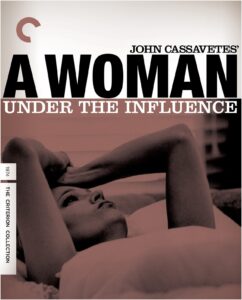
“She not crazy. She’s unusual,” insists blue collar worker Nick Longhetti (Peter Falk) when one of his co-workers wonders about the sanity of his intense, idiosyncratic, non-conformist wife, Mabel (Gena Rowlands) in John Cassavetes’ seminal portrait of a topsy-turvy couple and one man’s inability to understand his unique and loving wife, A Woman Under the Influence—at least, that’s how I interpret the film through a 2026 lens. I’ve read many differing and too-often misogynistic descriptions of Mabel, from then (1974) and now.
The first time I saw this film I did wonder if Mabel was a bit nuts, but today I feel that it’s Nick’s abusive behavior that causes her to go slightly mad and his insidious need to repress her behavior forces her to retreat within, until she must act out.
What little plot there is centers on the Longhettis, their three children and a host of mostly annoying family members and friends. The very Italian-American, working-class Nick (played by the very not-Italian Falk—who often played Ital-Americans) cannot seem to tame his sexy and overly friendly wife Mabel and, midway through the film, he has her committed. The movie’s Wikipedia page says, “she becomes increasingly detached from reality.” I disagree with that statement. She fights for her own sanity in a world where her mama’s boy husband is constantly beating her, her own parents don’t care to defend her, and her feckless doctor can’t wait to put her away.
Six months later, Mabel returns and doesn’t seem any better/different, except she’s initially a bit more subdued—probably because of the shock treatments she had to undergo. But as soon as she begins to act a bit strange (I say unique), there’s Nick slapping her to the floor.
It’s difficult to watch Nick’s brutish treatment of Mabel today and still root for them as a couple.
The film is considered Cassavetes’ masterpiece, although for me his best work is the little seen, psychologically dense, Opening Night (1978).
Cassavetes enjoys giving us very long, raw scenes that feel deliberately intrusive. And they work. But there is way too much Nick. Some of his work/buddy scenes could have been cut to make for a less rambling story. But I would not lose a second of Mabel.
Rowland’s brave performance has such emotional depth it sometimes threatens to go off the rails, but the actress always knows just when to dial it back a bit. It’s a true beguiling turn. I was reminded of Jessica Lange’s stunning Oscar-winning work in Tony Richardson’s Blue Sky (1994).
Rowlands was nominated for the Best Actress Oscar in a very competitive year, ditto Cassavetes for Best Director. The pic copped 4 Golden Globe nominations including Best Motion Picture Drama and Rowlands won for Best Actress.
This was after a valiant effort by the writer-director to get the film shown in theaters since no distributor would release it. Woman became an art house hit but received very mixed reviews—although most critics praised Rowlands.
A DVD was originally released by Criterion via a 5-film Cassavetes box set. That same package then came out on Blu-ray. Here we have a high-definition digital restoration, with uncompressed monaural soundtrack. The film is deliberately grainy but looks rather remarkable and the sound is fantastic.
Special Features, portaled over from the box set, includes an audio commentary by sound recordist and composer Bo Harwood and camera operator Michael Ferris, an interesting if too-brief convo between Rowlands and Falk, where he does too much of the talking, and an archival audio interview with Cassavetes by film historians Michel Ciment and Michael Wilson.
A Woman Under the Influence is, indeed, one of the most influential films of the 1970s and, although it is a grueling sit at times, it’s definitely worth a watch, especially via this fab Blu-ray. And most especially for Rowlands complicated, powerhouse work.
https://www.criterion.com/films/510-a-woman-under-the-influence