If you walked outside and noticed that your dog had broken off its chain, do you know where you would start looking first? Would you trust to bring friends along, or would it feel too person to have anyone join you? In Christoffer Rizcanovic Stenbakken’s The Thief, one young man realizes how he has to rely on himself in order to sustain the bond with his own dog before realizing that it’s time to grow up.
Stenbakken was not interested in making a film to appeal to future travelers to his home country of Greenland. Rather that simply photograph nature, he strived to create a story centered on the people who lived there.
“I grew up in the town where The Thief was filmed, and I really wanted to do something that felt as if it came from that place and was very rooted in the people,” Stenbakken says. “I wanted my film to be something that the people of that area could see themselves in. There [have been] some films set there, but, for me, it always felt like the script had been written somewhere else, like maybe Denmark. The setting would be right and the language would be right, but it never felt truly Greenlandic–definitely not East Greenlandic. I went there and spent a lot of time talking to the young people of the town, doing workshops, researching and then found the real story that ended up inspiring the script.”
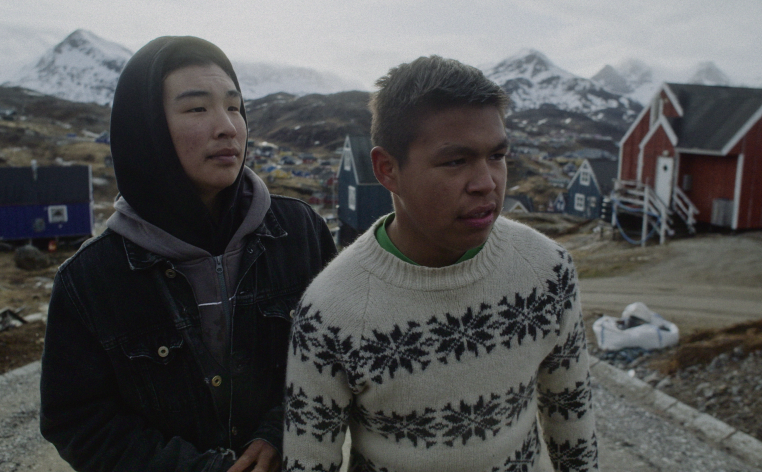
Stenbakken’s film belongs to Kaali, a young man who suspects that his beloved sledding dog has been taken from the property where he lives with his father, a mechanic. He enlists the help of his friend, Bertilaa, as they encounter bullies and a shooter of dogs. The closer he comes to finding his pooch, the more he realizes what the definition of thief really means. What struck me almost immediately about The Thief is how a frantic situation is set against the backdrop of silence and calm.
“I didn’t want to score it too much, but I wanted it to be quite clean,” he says. “In a way, I haven’t thought about how I used the silence purposely, because it’s just the nature of the setting. It is very far from where I am right now in a big city. You can hear cars going by outside and dogs barking. It’s so different than the tone of the film. A lot of films in Greenland are about landscapes and ice or glaciers–there’s a lot of expedition films. I didn’t want to do that. Some filmmakers like to focus on the place, but I wanted to talk more about the people. I didn’t want to put the landscape in the foreground. When you really listen, there are sounds everywhere–they’re just different.”
The notion of a man who goes around shooting dogs is a foreign and alarming one to me. As Kaali traverses around the town of Tasiilaq, we are worried that we will hear a gunshot echoing from the distance.
“Sledding dogs are work animals, and they can be really dangerous,” Stenbakken says. “You do not go up to someone’s dog and try to pet it, and you shouldn’t approach them. The dog shooter will advise you to chain up your dog, and you are solely responsible for it. If you don’t do that, they might shoot the dog. It’s actually integral part of the sledding dog culture there. But that also speaks to the fact that Kaali, and Kamillo Ignatiussen as an actor, has a different relationship with the dog.
The reason I found this story was because I saw him walking around with a big dog on a steel chain, and he was walking him as a pet. You don’t do that in that place, so that was the first thing that got me curious about who this kid is. Why is he walking him like that? You normally exercise your dog by sledding them, but people there love their dogs and they tend to their dogs so well. It’s just, to us, that different animals have different purposes. Maybe that’s an uncomfortable truth to some people, but it is the truth of that place. It’s peoples’ livelihoods.”
Photo by Karin Rørbech – © Karin Rørbech / Nordatlantiske Filmdage)
Stenbekken did not arrive in Greenland with a story fully formed–a fact, he joked, that didn’t help with gaining funding at first. Rather than try to impose a story on actors, the filmmaker allowed his curiosity to lead him. When he ran into Ignatiussen, he listened instead of pitched an idea. Perhaps more directors should try and infuse their stories with more truthful experiences. Who knows how a script will form.
“We were doing these acting and writing workshops with between 70 and 75 kids, and we were just following them everything,” he says. “I’d seen Kamillo, and when I caught up with him, he didn’t really want to speak to us at first. Later he offered to play some guitar for us, so we sat on the hood of the trashed car that’s in the film and he play for us. Then he told the story that became the jumping off point for the film. I had a very small team of Greenlanders from the sea with me, and we were all so moved by his story.
Some of the story is true and some is not. In real life, unfortunately, the dog died, and I knew that I didn’t want to do that in our film. There was a lot of negotiation throughout the whole process of what to feature from real life and what to create. Kamillo would tell us what he was comfortable with, but I didn’t want to do a documentary for a lot of reasons. Sometimes you hear these stories about documentary filmmakers coming in somewhere to collaborate, and they pull apart someone’s life and then just leave. For a place like this, my responsibility is magnified.”
The relationship between Kaali and Bertilaa is tested in unexpected ways. When Kaali finds his dog chained in another person’s yard, he uses a rock to break it as the homeowner tries to get outside to catch him. Bertilaa pays the price and is caught, as his friends runs away. One of the final moments of the film is the most satisfying: Kaali asks Bertilaa a question but the answer changes after certain words are said.
“Kamillo is actually very popular in real life–I feel like I should clarify that,” Stenbakken says, with a laugh. “Him and Mikkel [Paalu P. Bianco], who plays Bartilaa, are good friends in real life, so that helped very much. I believe in doing things that are very close to the world of the universe of the actors and having them know the emotional beats of the story. With working with untrained actors, that’s the only way to work, in my opinion. I wanted Kamillo’s character to make a choice about keeping his dog or keeping his friend–that’s growing up, isn’t it? It’s being able to compromise and make hard choices in order to keep relationships in your life.”