Allegiances and families are established before we even begin our journey back in time with HBO Max’s Dune: Prophecy, and that is exemplified greatly in the costume design. Set thousands of years before any film adaptation of the Dune universe, costume designer Bojana Nikitović was tasked with not only pleasing the eyes but also making these vast worlds cohesive and curious. Not only are order and rule created with silhouette and shape, but familiar dynamics and character are drawn with color and draping. Nikitović, with her first Emmy nomination, proves that austere beauty transcends time and history.
It’s so impressive that Dune‘s fanbase is so devoted to the interconnected stories in this world, and the two Best Picture nominated film adaptations only piqued that thirst more. Nikitović acknowledges that there is a lot to be nervous for when building a new visual palette, but she was driven by her excitement for this freshman season.
“There were so many things to be excited for and so many things to be nervous for when you start something so big,” Nikitović admits. “I was given the opportunity to create something that hasn’t been done before. We know the movies, and those are based on the first books of Frank Herbert. So many people have read those and so many people have loved Denis Villeneuve’s films, but there comes a certain point where there is no other way to start than just to start. You can’t get stuck thinking about it too much.”

With so many characters right from the beginning, we can learn more about their history or relationships with how they dress. When Brendan Cowell’s Duke Richese has a conversation with Mark Strong’s Emperor Corrino in episode one, the two men could not be dressed more differently. One group opts to bring attention to thei wealth while the other is subtler and doesn’t have to peacock at social events. The Richeses wear extravagant textures and could be considered “new money” while the Corrinos choose a darker palette of teals and deep reds.
“I thought of [The Richeses] as people who just came into money for the first time,” she says. “If House Corrino represents tradition, Richese is the opposite of that. I wanted something totally different from the Corrino family because they are very settled and very elegant with lots of blues and pomegranate reds. For Richese, I wanted everything to be over-the-top and exaggerated. Everything that they wears is to impress and show off. Duke Richese is a very powerful man, and he doesn’t have the class or the background as Corrino. It was important to see those two men together to see that difference, and the same went for their wives. The costuming really supporting the scenes and how they were written, because Duke Richese is always showing off, and he has this attitude.”
The pilot’s standout frock comes in the wedding gown worn by Ynez in her arranged marriage Richese’s young son, Pruwet. The union might shock many viewers considering Pruwet’s age, but Corrino is hopeful that it will secure his family’s bloodline. The idea of blood is on display in the shockingly red color of Ynez dress and in the ornate, golden headpiece worn across her face. Before we even see the full look, Ynez’s mother, Empress Natalya, shows off boning and supporting elements of the dress before the entire dress is revealed later on in the episode. The color is unlike anything else in the entire season, and it’s clear that it’s one of this designer’s favorite garments.
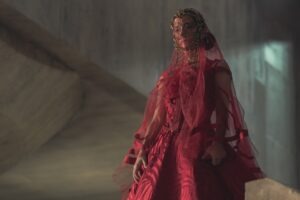
“When I came to the project, it was already decided that it would be red since it was in the script,” Nikitović says. “For me, it was never red enough, and we kept dyeing the fabric more and more. We ended up making that fabric practically, by putting one layer of laser cut silk on top of the other in a different direction just so the light would catch in different ways. I have to admit that making the concentrate for that dress was the best thing ever since it was such a problem to be solved. I love that we got to see the little camisole and the corset and the pannier that her mother gives her. It’s important in the scene between them, but it shows the building of that dress. We see her mother wearing it at her wedding in the portrait, and it was so important to tell the history of the women in that family and in this universe. The dress isn’t just decorative or pretty, but it shows the strong message of these arranged marriages. Sarah-Sofie Bussnina, our lovely Ynez, also wears it beautifully, especially with the veil and the headpiece.”
I commented on how the texture of all the costuming–no matter the status or intelligence of the character–is exquisite. Even the texture of the jewelry carries weight and unique feeling, even if it’s a simple-looking clasp or a ring on someone’s finger.
“We couldn’t make anything flat,” she says, plainly. “The camera likes texture so much, and, I have to tell you, all the printing is hand-printed. The printing is almost soaking the fabrics to make this embossing on the surface. Our metal master also handmade everything, whether it be a signet ring for the Sisterhood or a clasp on a robe. It’s really combining very high-tech, laser-cut 3D printing with handmade things. It made everything feel so new.”
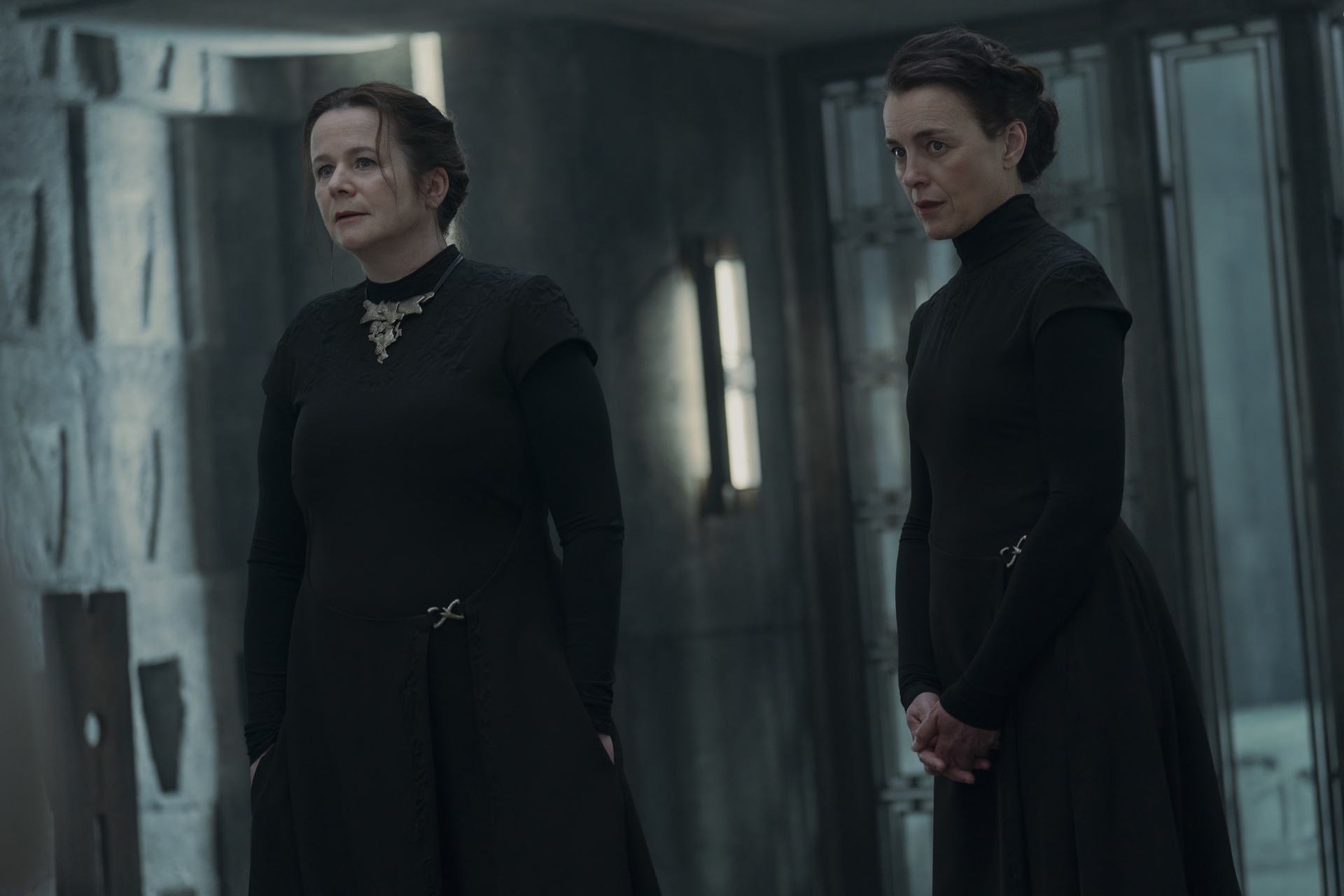
The leaders of The Sisterhood project strength with a dash of mystery. The dark, long outfits worn by Emily Watson and Olivia Williams’ sisters look uniform but they carry an individuality that’s hard to achieve. When something appears simple, it’s usually anything but, and you have to ensure that the details all on point.

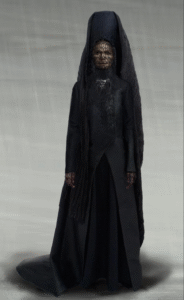
“My main thing for the Sisterhood was the silhouette,” Nikitović says. “When you’re doing something that is so uniform, you have to find that so it’s recognizable and strong, but you also have to find the fabric that works well with the silhouette too. I love how the fabric moves behind them when they are walking down these corridors. It flows behind them so well. For Emily [Watson] we wanted the embossing and texture on hers, and we wanted to create that mysterious necklace that she’s always wearing. When she goes to Salusa Secundus, she puts on her mother superior full garb and the metal details were put onto her costume, which were created with that same hand-printed technique. Our metal guy made every piece separately according to the design, and our milliner created that wonderful veil for her.”
Nikitović even lit up when talking about that one element.
“Veils are so special,” she says. “Emily told me how much she loved having it, because it can be the smallest guard against the world. It may look so delicate, but it can provide so much for a character.”
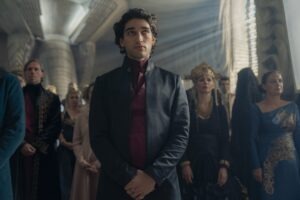
One might assume that a costume designer would have no use for the costumes for Dune: Prophecy if Nikitović decided to sneak something for her own closet. I love the brown outfit worn by Travis Fimmell’s Desmond Hart, and I want to feel the textures of the opulent clothes worn by the Richese family. There is one piece, though, that Nikitović might fight over: Keiran Atreides’ leather jacket
“It’s not in the scene very long, and the lighting is very dark,” she says. “It was aged in a certain way, and it had some embossing that we laser cut and pressed into the leather to achieve that shape. I love that jacket so much.”
Dune: Prophecy is streaming now on HBO Max.

![Emmys 2025: It’s Charades, Emmy Edition! [VIDEO]](https://thecontending.com/wp-content/uploads/2025/08/Screenshot-2025-08-18-at-10.53.23-PM-75x75.png)