
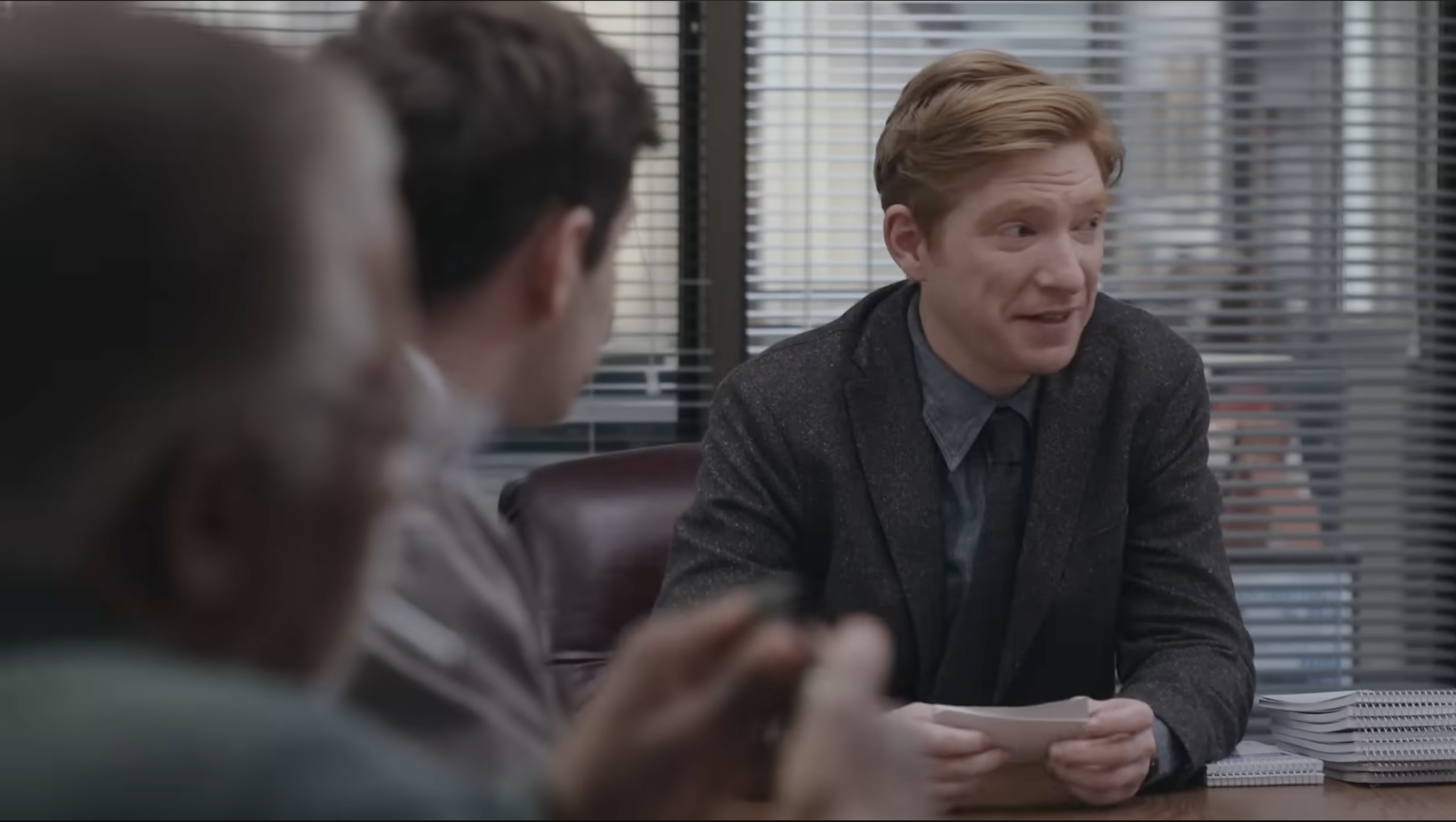
As someone who adored both the British and the American versions of The Office, I was somewhat skeptical of whether The Paper could, well, deliver the paper. Oh, “Ye of little faith.” With Greg Daniels, the creator of the American version of The Office, sharply written screenplays, and a more than game cast. The Paper’s inaugural season (on Peacock) proved to be a complete delight. Heading the cast is Irish actor Domnhall Gleeson, as Ned Sampson, the new Editor-in-Chief of the struggling newspaper, The Toledo Truth.
Before joining the cast, Gleeson felt a similar skepticism, but when he opened the email from Daniels, read the treatment, and then the script, he saw the opportunity to write a terrific new chapter in The Office universe. His bet on Daniels and the writers proved to be a good one. The show was received well by critics, and the network quickly greenlit a second season.
In our conversation, Gleeson and I discuss those initial reservations, his desire to set his “boss” apart from David Brent (Ricky Gervais) and Michael Scott (Steve Carell), and the worthy effort to retain the written word and the value of holding it in our hands.
The Contending: I remember when The Paper was announced; I wondered, “Can you go back to that well another time?” Granted, The Paper does differentiate itself from the previous iterations of The Office. But with Greg Daniels at the helm and a certain level of style, personality, and humor translating into a different occupation, did you have concerns about whether this would work?
Domhnall Gleeson: They send you a breakdown of what the story is, who’s producing it, and how it’s set up, and then they send the script when you get the offer. You always read the breakdown first or the logline first, or at least I did. When I read that it was not a remake of The Office or a reboot of The Office, but a sort of cousin to The Office—it’s the same documentary team going to a different workplace, and it’s not a paper company, for example—I was still reluctant to open the email. And the reason you open the email is that it’s Greg Daniels, and he’s made some of the best TV in America over the last 30 years. He’s just right at the pinnacle of television makers. Once I read it, got into it, and saw how different its setup was, I weirdly felt at ease. I knew that we would have a hard time convincing other people that we were different and to plow our own furrow and allow people to see us on our own terms, but we’re not in charge of that. All we can do is hope that people give us a little bit of space to be our own thing. Once I read it, it felt very clear to me that they were trying to do a different sort of show, and that my relationship as the boss with the staff and with the people who work for me was a very different setup than it was with either Ricky Gervais’ character, David Brent, or with Michael Scott, played by Steve Carell.
The Contending: So you are sitting in that slot, but that slot is differentiated here. Not that there weren’t moments of sweetness with Ricky Gervais and certainly Steve Carell’s variations on “the boss,” but there’s a positivity to Ned, and a hopefulness, and how he treats the moments of humiliation. When you were thinking about going after those people, including Ed Helms and James Spader, who were in The Office, too, you were in a line of some really fancy actors and performances. Were you asking yourself, “How am I different? How am I not doing the same thing?”
Domhnall Gleeson: Because I only had one script that I read when I originally talked to Greg and Michael, my main question was, “Do you want this character to be different from the people who’ve gone before?” And the answer was unequivocally yes. Because that was the only way that we could make it clear that this is not a remake or another version of The Office, that this is a whole new world that you’re going into. And yes, the hopefulness, the niceness, the naivety, the optimism, his ability to inspire people regularly, that is how he begins. Those were defining characteristics for Ned that I thought just immediately put him in a different territory. The fact that, as it grows, there is the possibility of romance with one of the people who works below him, I think, was really interesting because that is more fraught in today’s world than it would have been at an earlier time. They never crossed that bridge with the original Office shows. But this was all new stuff. He has to be able to be a version of a romantic lead. He has to be a good boss in lots of ways. Primarily, these people have to want to continue to work for him because they have the option not to. They don’t have to keep working for the paper. They can still keep making the same amount of money working as accountants or working elsewhere in the paper. They’re doing extra and going above and beyond, I think, because he’s helped them see the best in themselves. That was a big thing that I liked about him, and then you just have to make sure that he also functions comedically, because all of those positive characteristics are not the most comedic things in the world. So finding the comedy in him was the big thing after that.
The Contending: Ned is a sweet human being, but he is also full of neuroses. I have this thought that I’ve always had about the show Seinfeld: a lot of people like to think they’re Jerry, but most of us are really George. (Laughs). I think in Ned there’s a little bit of that. He believes in what he believes in very strongly, but he’s got some self-confidence issues. He’s got peculiarities. I imagine that made him a lot of fun to play.
Domhnall Gleeson: Totally. I think he imagines himself as a really regular guy, but maybe smarter than the average man on the street. These are the thoughts that he has about himself. But actually, he is very distinctive. And he does have his own peculiarities, as you say. He’s a romantic, but he’s had his heart broken. What you find out early on in the show is that part of the reason for his coming back to newspapers, for the first time since he was in college, is that when he was in college, he really wanted to be in newspapers, but then saw that the industry was cratering. As he gets older, his father separates from his mother, and he finds out that his father was cheating on his mother for 20 years, and he has his notion of what romance is shattered. So he tries to buy back into his own version of romance. He’s trying really hard to see the good in the world, but he does see the ugliness. It’s just that he really tries not to, and I love that about him. There’s a lot to strive for there, but what’s good is we know that he’s got these holes and these blind spots that are absolutely imperative if you’re going to keep somebody funny in a comedy.
The Contending: You alluded to Chelsea Frei as “Mare” earlier, when you referenced the workplace romance. That is such a wonderful relationship. Their relationship is this classic “will they” or “won’t they” thing. Because it is in the workplace, and we are in modern times, it is trickier to navigate. How did the two of you work to build this chemistry that has all this wonderful awkwardness and this sort of leaning towards each other, and then trying to slightly pull away because they are unsure of how to proceed, despite their attraction?
Domhnall Gleeson: That stuff is way easier said than done. I do think it takes skill and delicacy, and it takes really good writing, and it takes moments of really good acting to get you there to care for those people in a way that doesn’t feel cheap, that isn’t just filling out the tropes. I thought the writers on the show were great about that because, early on, I said, “I don’t want him to be into her early,” because I’ll find that weird, since he’s her boss. I just won’t be okay with that, and he wouldn’t be okay with that. He would not allow himself to see that. So as it went along, I think what was smart about it was they leaned into the notion, and I leaned into the notion, that something is happening and that he doesn’t see it himself. That’s something that happens in real life. It often happens to people who are already in a relationship when they start falling for someone new while they’re with someone else. The difference is that Ned’s relationship is with the newspaper. So for the good of that, he’s not allowing himself to see this other thing. On the other side of it, you have Chelsea, who’s giving this brilliant performance where she is into him earlier on, it feels like, and is more vulnerable as a result. But because she’s playing quite a tough character, the clash between vulnerability and toughness is where a lot of her comedy comes from. When you put them together, you have to want to be around them. That was the big thing that we just tried to find the interest there. She’s a very good scene partner, a very good actor–keeping them fun was important.
The Contending: Ned, in a way, gets to be both the Michael Scott and the Jim character at once, juggling this potential workplace romance while also being the boss. It adds a different layer. As you say, he kind of doesn’t know that it’s happening, and it’s almost sneaking up on him as opposed to him sneaking up on it.
Domhnall Gleeson: You want people to care for them—which I do, I really care for them, and I don’t know if they can make it work—but you want them to make it work, and you want them to try. You have to try to create that tension between them where there is genuine attraction and positivity about the other person. I think you have to go back to the basics of what makes a good relationship and what makes a good romantic pairing. They have to be good for each other on some level for us to care about them, but there also have to be enough personal problems within them and in their setup to keep it interesting. They have to fight for the relationship or scrap the relationship–those are their options. In the writing and in the acting with Chelsea, finding the time of when to lean serious, finding the time for when to lean fun, how to push each other in a way that elevates the scenes and makes you not know what’s going to happen with them is what all good acting and all good scene work is about. But then putting it into this funny mix of romance and comedy at the center of the show is part of the joy for me.
We’ve shot season two now, and without getting into anything of what happens, we finished the season with a really cool scene in the corridor between Ned and Mare, and I think it is deeper than where we had been before, and I’m hoping that we can continue to keep it. My hope for the second season is that it’s funnier and has more heart than the first, because what I love about the first is that it is funny and has heart. So bigger isn’t always better when it comes to sequels to things, or next seasons of shows, but I think what you do want is to develop the things that really work. And that’s what really works for me, the heart and the comedy. I’m very proud of what we did in Season 1 and where we got to, Chelsea and I, particularly. I’d never done ten episodes of anything in quite that way. So I’m very proud to have made 10 half-hours of funny TV that also has some heart. I don’t think there’s a lot of it going around.
The Contending: The first season of The Paper begins with Bob Vance. So there’s that initial tie-in to The Office. It always makes me smile to hear “Bob Vance-Vance Refrigeration.” You also have Oscar Nunez (Martinez), who moves over from Scranton to Toledo. Aside from being a wonderful character and a great actor, how invaluable was he for helping the rest of the cast with the tone and being that connective tissue?
Domhnall Gleeson: He helps in two, no—let’s say three, major ways. First of all, if you need him, he’s there. If you want to chat to him about things, just as a really good actor who has seen this stuff before, who has been through this before, he’s there to have a chat about, “Do you think this is leaning too far this way or that way?” He’s always there to talk things through with, because he’s excellent at it and a smart, emotionally receptive man. One of his great gifts to us was his practice of leading by doing rather than talking. He didn’t arrive and say, “On The Office we did this,” or “Do you know what? This is not quite what we did in The Office,” ever. He never, ever said that, which is a massive gift to a young cast like ours. Not all of us had done this sort of show before. I hadn’t done this sort of show before. But he never said, “These are the rules, because this is how we did it before.” We got to see how he was in group scenes, how he contributed, or when he contributed. When he chose to get involved and elevate things, when he chose just to observe. It was brilliant the way that he did that. And the last way I would say is that he is so good in the show. He’s so good at what he does, that is the main thing. What you want from an ensemble like ours is for everyone to hold up their end of the bargain, not by dominating, not by demanding attention, but by doing their jobs brilliantly. Whether that’s at the front of a scene, which Oscar often is, or further back in a scene, which he also sometimes is, and he is amazing at all of that, and he’s also amazing at knowing when to do, when to get involved, and when not to. I think just by being brilliant in the show, that was the way that he helped us most. Leading by example is better than leading through words.
The Contending: There are several members of the cast I could single out, but I do want to speak about Sabrina Impacciatore as Esmeralda. When you are in a scene with her, maybe even when you were in the first scene with her, were you like “Oh, man, we’ve got to keep up”? Because she’s really bringing something really unique to that role.

Domhnall Gleeson: I don’t think it’s to do with keeping up. That’s a strongly written character. She is a strongly flavored character. She plays her to the hilt. But again, as I say, your job is to turn up and hold up your end of the bargain. It’s not about dominating, or it’s not about worrying about being dominated. It’s about doing the right thing for your character and the right thing for the scene. And so with Sabrina, as with everybody, your job is to find out what the main conflict is, what the main comedic dynamic is, and to get the most out of both. And it’s very easy to do that with Sabrina because it’s so clear. It’s just so clear what she’s doing and how she wants to do things, and sometimes you push back against that hard because that’s the job. And sometimes you let her go, and that’s the job in that given moment. Then sometimes your job is for you to take the ball and run—unusual when she’s around, but it does happen. I think that’s also part of the to-and-fro of being part of an ensemble. She’s fantastic in the show. But actually, it’s the same working with her as it is with anybody else in terms of finding your place and finding the sweet spot.
The Contending: That’s a really generous way to put it. “How do I serve the scene?”
Domhnall Gleeson: I think that has to be central always. A lot of people think the job is to turn up and go crazy and say as many mad things as you can, and that is not the job. You can say as much crazy stuff as you want as long as it’s right for the scene. But otherwise, you should wait until you have something to contribute. I think that’s one of the brilliant things about those shows that run for a long time, which have that, they astound me. It speaks so highly of the writing and the ensemble to keep those elements on track.
The Contending: I lived most of my life in the Midwest in Michigan and Indiana. I was born in Kentucky, so I was next door to Ohio, and I’ve been through Ohio many times. Toledo is one of the quintessential Midwestern cities. It’s interesting because much of Pennsylvania outside of Philadelphia feels like the Midwest, even though the state is not in the Midwest. Scranton and Toledo have this connection. How much time had you spent in places like that before you did this show? Was it easy to fit into that sort of Midwestern-ness, if you want to call it that?
Domhnall Gleeson: I wouldn’t say it was easy, but it was important to understand, or to get some sort of a grip on it. I went out to Ohio, and I went to Cincinnati, and I went to one of the college newspapers, and then I went up to Toledo as well. I traveled around a bit just to try and get a sense of what those places are like and what the Midwest was like, because I’d spent so little time there. As an actor, I’d spent time in the places where people shoot the most, which are on either coast, and then Atlanta, Georgia, or up in Canada, in Vancouver or Toronto. It was invaluable to go there. It was great just to get a sense of the place. What you realize is that these are places much like anywhere else. I come from Dublin. In Ireland, a lot of people talk about the coast, but the midlands are just as much a part of it and just as important to the country, and so it’s the same in America. What I liked was that I didn’t go to Toledo and go “Oh, this is glum,” or “This is a good place to make fun of.” I went, and I thought, “This is a really nice place with really nice people.” That was the thing that helped the most. That and visiting people who work at the newspapers there and seeing how much they care about it. Seeing how hard they work, how much it matters to them to be part of it. The newspapers I was talking to ranged from very small to very large, and from very visible to nearly invisible in the local community. But seeing how much it mattered to all of them, that was the key. I really enjoyed my jaunt around Ohio.
The Contending: Earlier, you said that one of the differences between The Paper and The Office is that it’s not about paper. I was a journalism major in college. I’ve written in print a lot, and at one point in time—because it’s hard to make a living writing, to be perfectly honest—I was assistant manager at a Kinko’s–FedEx Office now. I used to sell paper and have written for papers. One of the things that I think really connects the show, whether you want to talk about it being literally paper or not, is this sense of the value of the tactile, and how in our modern life, we’re moving away from that. I think it re-centers the idea that there’s real value in holding something in your hands.
Domhnall Gleeson: Yeah. It’s so easy to delete anything online or to have something changed. There is something to be said for the fact that if there is a retraction or a development in a story in a physical newspaper, if you have yesterday’s newspaper, you can see for sure what they wrote before, because it’s in your home. You have it in front of you. Whereas if something is just corrected on the internet, depending on the publication and the way they manage corrections, you can just delete mistakes and pretend they never happened, or you can delete facts and pretend that they’re not true, or that you didn’t believe them to be true at a certain point. In terms of the tactile, that’s obviously a lovely thing. I prefer reading a book to an e-reader. It’s not always possible. But absolutely, the tactile thing. What’s in the show is that Ned is a romantic, and he cares about all this stuff, but the financial pressure on the print industry is overwhelming, and it can only last so long. But fighting the fight is what he considers important. Fighting the good fight is the best you can do. One of the things I love about Ned Sampson is that he is doing his best to keep alive something that he believes matters.
Domnhall Gleeson is an Emmy contender in the category of Outstanding Lead Actor in a Comedy. All episodes of The Paper, season one, are now streaming on Peacock.
Bonus Question:
The Contending: I noted recently that you are in Werner Herzog’s upcoming film, Bucking Fastard. At a film festival last year, I got to introduce Werner’s most recent documentary, Ghost Elephants. He wasn’t there, but still, even being that near to his work and being a small part of getting his film seen, I get tingles thinking about it. What was it like working with Herzog?
Domhnall Gleeson: It was wonderful. The buzz in Ireland, when it was announced that Werner was coming to film here, was just massive. When I got the call, when I talked to him about working together, and it became clear that he wanted me to do it, that was the thrill. It wasn’t an audition. He was asking me to do it. It’s an overwhelming thing. I’ve been looking at his films since I was in college; when I was in college, we studied some of them and talked about them. He’s meant a lot to me. So going to work with him and seeing his vitality and care for the work at the age that he is now—there is no lessening of the passion. To be able to hold onto that, not because your mind or your body is getting older, but because once you’ve done something, you think maybe some of the passion dies. It just does not. He is still exploring the world in the way that it matters to him, whether that’s in Dublin or whether that’s in a cave. He cares about it so much and yet wears it very lightly. It was wonderful working with him. It was different from how I imagined it would be. But if it were how you imagined it would be, you would be let down. He was surprising and wonderful in equal measure.
The Contending: No one on earth like him.
Domhnall Gleeson: No. (Smiles).