For a production designer, world building hits the sweet spot. Sure, in the case of Dune: Prophecy, the series lives in the same world as the Denis Villeneuve-directed films. However, it’s set 10,000 years before anyone knew who Paul Atreides was, and we’re exposed to worlds and environments the likes of which we’ve never seen. Emmy-nominated production designer Tom Meyer and set decorator Carolyn Loucks were then able to re-envision this world on their own.
The ultimate end result became the best possible mixture of new locations with a toe in the Villeneuve world.
“You see a little bit of Dune in almost every science fiction story out there. What Denis did is he re-birthed it and found a new voice and a new tone for the series. That’s what the studio, both Legendary and HBO, wanted us to latch onto,” Meyer explained. “It wasn’t so much the design or the look because it lives in its own world and it has its own beauty, but they wanted us to be mindful of the tone. What I think Denis was able to bring to it is this sense of pace and introspection and tone that hopefully we also were able to achieve.”
Here, in an interview with The Contending, both Meyer and Loucks chat about their work in Dune: Prophecy. They reveal the visual relationship to the Villeneuve films and the inspiration pulled from the works of Frank and Brian Herbert. They also talk about the real-world (re: here on Earth) inspirations for their intergalactic designs, including the stark and severe world of the Bene Gesserit. Finally, they describe the process to envision and construct the elaborate world of Salusa Secundus and why Greco-Roman inspiration felt so incredibly appropriate.
The Contending: First of all, Tom, I have to say, working on a television show that is a prequel series to such a popular set of films had to have been a daunting task. What was your relationship to the property and to the films of Denis Villeneuve when you were looking at creating your own world for Dune: Prophecy?
Tom Meyer: That’s a great question. What Denis created a canonistic work, right? It is a work that is a touchstone. These Herbert books, both Frank Herbert and his son Brian Herbert’s books, are foundational to science fiction, and they’re really the foundational work that everybody looks to when you’re springboarding off for new stories. You see a little bit of Dune in almost every science fiction story out there. What Denis did is he re-birthed it and found a new voice and a new tone for the series. That’s what the studio, both Legendary and HBO, wanted us to latch onto. It wasn’t so much the design or the look because it lives in its own world and it has its own beauty, but they wanted us to be mindful of the tone. What I think Denis was able to bring to it is this sense of pace and introspection and tone that hopefully we also were able to achieve.
These books are sprawling. There’s 26 of them and, we dove in and read a bunch of them to give us a good platform so that we could tell our own story. As Denis even said in some interviews, there’s so many worlds and so many universes within the Dune epics that it was kind of really fun. It was actually really encouraging and exciting. [The films] weren’t in any way a shadow. I thought it was all positive.
The Contending: Frank and Brian Herbert had a lot of art that they conceived of to lend visuals from themselves of their creations. That had to have been sort of a guiding point for you in terms of how you were going to realize this Prophecy world.
Tom Meyer: The Herbert estate is very much involved in the production of these shows. Everything that we design and write goes to them for review and ultimately approval. They have to bless it before we bring it to life. But I would say that they too encouraged us to kind of find our voice. While there’s certainly different versions, you’re always trying to tell the story of the character and the worlds they live in. That’s where it all starts, right?
You can say it’s this epic science fiction, but it’s always based in the character and the story. They wrote these really beautiful, complex, political, intriguing worlds that are filled with warring and vying clans. That’s what they really wanted us to concentrate on.
Sure there’s other artwork that you are looking at, but it’s the idea that they want it to expand beyond what it is. They don’t want it to be a documentary or a repetition because that doesn’t bring life. What brings life is finding the new voice and the new view. That’s what I hope that we have done in Prophecy.
The Contending: You both are Emmy-nominated for the pilot episode: “The Hidden Hand.” That’s a great starting point because it establishes this world in which we’re going to live for the next couple of episodes. As we learn in the prologue, the world exists 100+ years after the basically the end of AI as represented by the Thinking Machines. How are you referencing that lack of technology in your designs?
Tom Meyer: I love that question because that’s something actually that we think a lot about. It’s this idea that we live in this world right now. We’re surrounded by AI right now. So when people think of science fiction, too often we think glossy, shiny, metal panel, plastic ship. Everything is very crisp and new out of the box and lasers firing. That’s not necessarily what science fiction is.
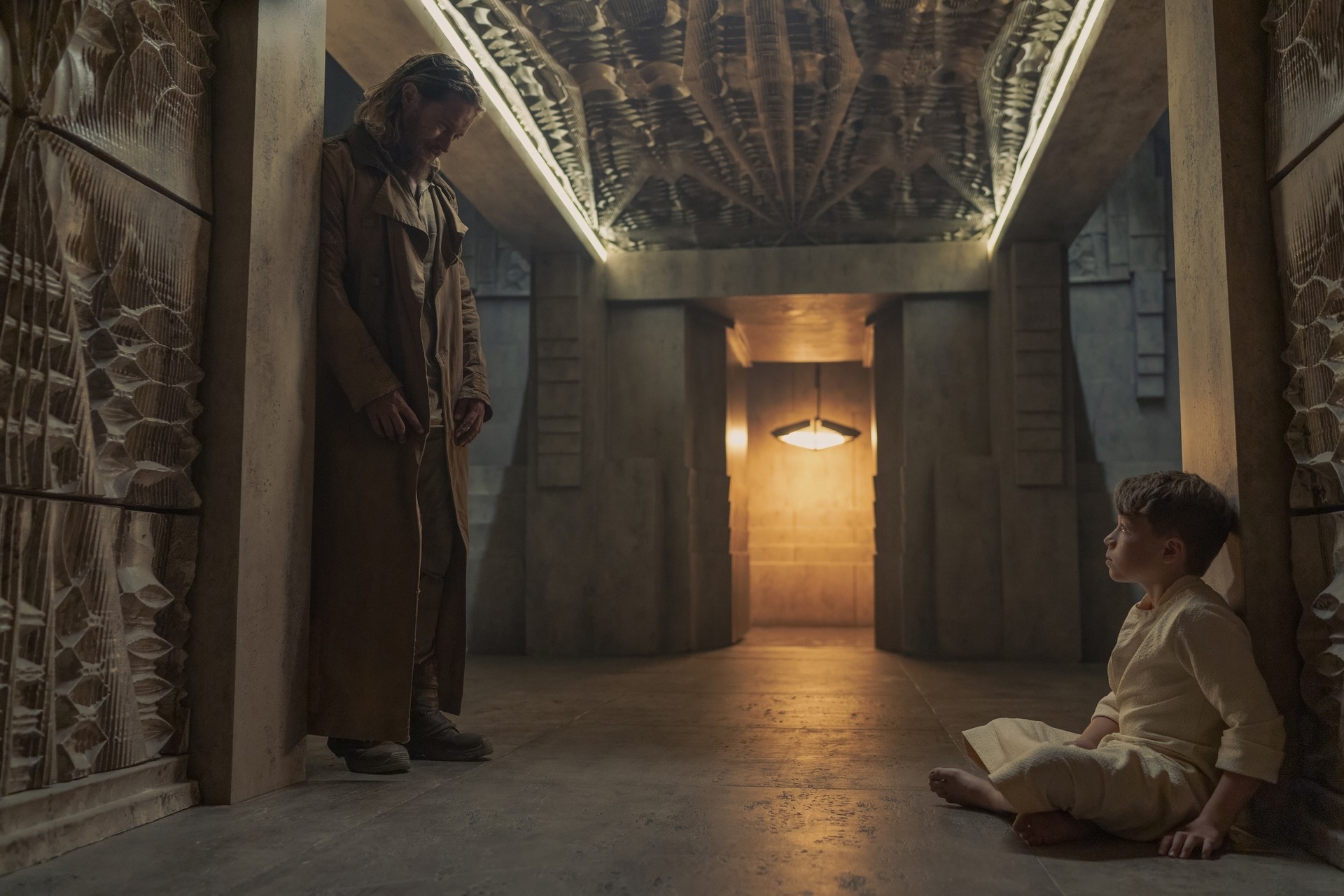
We’re in this post-technology, post-informational age., It’s more like a neo-Gothic story. There aren’t screens. There aren’t all the distractions. It’s supposed to feel like our little version of like analog too. That’s what was really important in this science fiction retelling is to bring in the history so that we can see how technology had infected or built the past culture through these complex parametric or computational designs of the buildings.
The buildings themselves are made of stone. They’re made of wood. They have a sense of oil rubbed history, if you will. What that does is it grounds the story, and it gives the audience an end to this world. The Herbert estate, plus Legendary and HBO, wanted us to bring to this world a sense of belonging of history, of realism. You get that through layers. Like a city, a city is not just built by one architect. It has layers of buildings of different ages from different centuries.
The Contending: Carolyn, given the need for historical depth in the design, how did you determine what style of objects to use to fill the sets?
Carolyn Loucks: The world of Dune is of course epic. Tom’s designs were mindfully designed to tell the story of the multiple characters of Herbert’s Dune. I believe my role was to continue to bring depth and understanding of the characters through the specific elements found in their lives. Because the characters are human, we could draw on historical periods whose culture and decorative arts portrayed their social class status and their emotional life through certain use of materials, weight and scale. I was drawn to the furniture and materials of Imperial Roman Empire, the Italian renaissance, brutalism, art deco and modernism and Wabi Sabi to name just a few.
The Contending: How do your selections refer to characters / plot points within the world?
Carolyn Loucks: There are four worlds that we created for season one. In the interest of time, I’d like to concentrate on The House of Corrino – the imperial palace on the planet Salusa Secundus. The palace is a character unto itself. It serves to demonstrate that this is the home of the Imperial ruler of 10,000 planets. The scale of the throne room is meant to inspire awe and respect with its platinum and red velvet throne, large crystal multi orbs chandeliers which prevailed throughout the palace and massive standing chandeliers inspired from the House of Tiffany.
We created the elongated amphora of marble and bronze based on roman shapes to adorn the sides of this impressive room. In the grand hallways elaborate custom carpets were inspired by Frank Lloyd Wright, crafted in Denmark then sheep shorn bare to subtly hint at the threadbare Corrino leadership. We designed massive daybeds derived from the Greco romans with an art deco twist, imperial hall chairs inspired by Frank Lloyd Wright but elongated and gilded with bronze and jewels lined the hallways with elegant crystal and bronze spice incense burners. Providing a focal point – the grand portrait of the royal wedding symbolizing the incredible unification of power – encased in a jet black glazed Victorian era frame.
While the salons and private compartments give a more intimate portrayal of the families complicated turbulent lives; the sumptuous materials never allow one to forget the family’s absolute power. The materials chosen for each creation, from the bejeweled sofas, the cycle of life silk tapestry and symbol laden carpets, were made based on materials deemed noble through history codified by Louis XIV of France. These materials – marble, bronze, gilded wood, inlaid exotic woods, silks and jewels convey a grandeur and luxury not seen in any other part of Herbert’s Dune.
The Contending: Tom, given that drive to build a history, to give that sense of time on these locations, what was your balance between practical sets and locations versus CG and VFX?
Tom Meyer: Honestly, almost everything was built for the show. We did go to some practical locations for the terrain, but all of those sets were built: the throne room, the sisterhood, all of those were built. The courtyard, that’s a hundred percent build. When you go out into contemporary architecture, you’re going to see like the aluminum casement windows and the doors and all that stuff, but we’re trying to do a period film? Our period is science fiction. It’s a world that exists 10,000 years from now. That’s just as much of a period film as the 1800s where you would have palaces to go to because it exists, but we’re doing something that doesn’t exist.
So we actually came to the idea right away that these sets all have to be original and new. The other thing is we want them to be in camera. We want these actors to walk onto sets that are real. We don’t want to do a blue screen show. So we built massive sets so that when the actor walks on, they can look to the sidelines of what they’re seeing, the people on the balconies or in the rooms or in the spaces. They’re not having to imagine or look at tennis balls. That allows that actor to get deeper into their own story. They don’t have to spend that extra energy imagining the space. We certainly use CG and visual effects who are also co-nominees, but the idea was to embellish the world. It is kind of old school filmmaking in a way to build big sets like that.
The Contending: Let’s talk about the Wallach IX, the home planet of the Bene Gesserit. It’s very austere, very resemblant of a monastery. But you’ve also got these geometrical shapes embedded all throughout the designs. Talk to me about that.
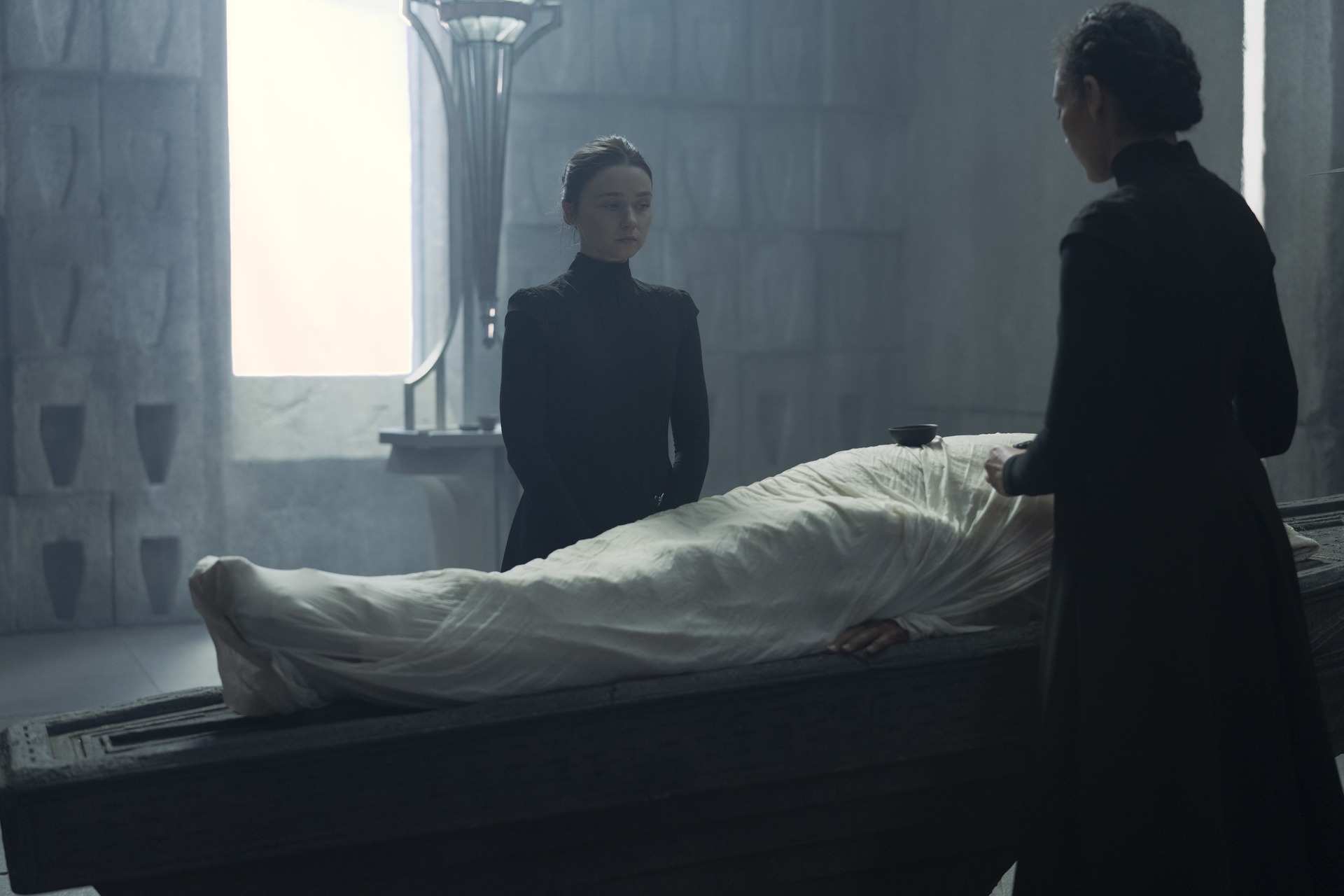
Tom Meyer: I was just talking about this with another designer. So, two things with that space. I wanted it to have a certain computational quality to it. These are all old industrial buildings that they inherited, so I wanted it to have a kind of industrial and mechanical version. When you actually get to the design of those blocks, it’s a repetition. It’s computational. It’s a certain machine tone. I was thinking about the tropes of sci-fi. So often we see in sci-fi buildings, these kind of slick geometric panels, hexagonal for example. It’s a geometry, and it’s always very shiny and very new. There’s no age and no dust. It’s just corridors. A bit sterile.
So I took a science fiction panel, I made a design, one that was metal, and then I simplified it down into this base geometry. It has this trapezoidal shape in the middle in a rectangular block that’s 40 by 60 centimeters. Then, I make it out of stone instead of metal. Now, it starts to have that neo-Gothic or primitive futurism vibe to it. So that’s one thing. The audience looks at it and says that’s sci-fi language, but it’s out of a material I’m not used to. I’m taking it away from fantasy and hopefully bending it into science fiction.
Then the next thing I did is you’re in this monastery, and all those stones are tilted in different directions, just ever so slightly. I had a great art director, Alex McCarroll, who mapped them all out. Each one was hand placed in a pattern. It makes it like the sound panel that you see in a recording studio because it’s all a little angled. When we were on set, it actually works that way. What happens is you get this hushed kind of vespers of the monastery, so it actually quieted sound because it was reflecting.
The last thing is, all those little cavities, I made them really dark. They look like little tombs in each one of those things, or little black shadows and all those blocks. Now it just becomes kind of a blur behind you. The sisterhood is about secrecy and secrets and knowledge, and I wanted this building to feel like it was holding a bunch of secrets.
The Contending: So, Carolyn, given Tom’s design, what did you choose to fill the set?
Carolyn Loucks: The Bene Gesserit school was comprised of several labs, classrooms and the dormitory for acolytes. The senior sisters had their own rooms all of which held minimal comforts. The acolytes were allowed some artifacts from their own planet. We studied each character’s biography to create their unique sentimental souvenirs from home. Images of loved ones were to be kept between glass similar to a silver nitrate technique. This system was represented in the Seven Deadly Sins art in Mother Superiors office as well as the laboratory specimens kept in the lab. The Sisterhood school furniture had an austere yet refined look inspired from Japanese modern furniture techniques and the wood preserving technique Shou sugi ban. Every piece of furniture was custom made and burnt in our workshops.
The Contending: Tell me about the complexity of filling the Bene Gesserit library. How much of that was CG vs practical artifacts?
Carolyn Loucks: One of the most challenging aspects of the library was deciding how the sisterhood archived their history. Once that was decided, the next challenge was sourcing over 400 feet of leather books, that we applied custom labels in Chakobsa and Galach. I carefully researched and designed bespoke artifacts for the library vitrines that alluded to the history and sacred rituals of the Bene Gesserit: a collection of Water of Life vessels, warrior helmets and weapons to commemorate battles, bronze spice vessels, secret message tubes and ritualistic beaded veils were all fabricated to give credence to the power of the Bene Gesserit.
The entire library was built to function practically except two items: the final stage of the mechanical movement of the book shelves was completed in CG. We alluded to the many levels of books drawn up from far below the floor. Lastly, the view outside the windows of the school library were of course CG.
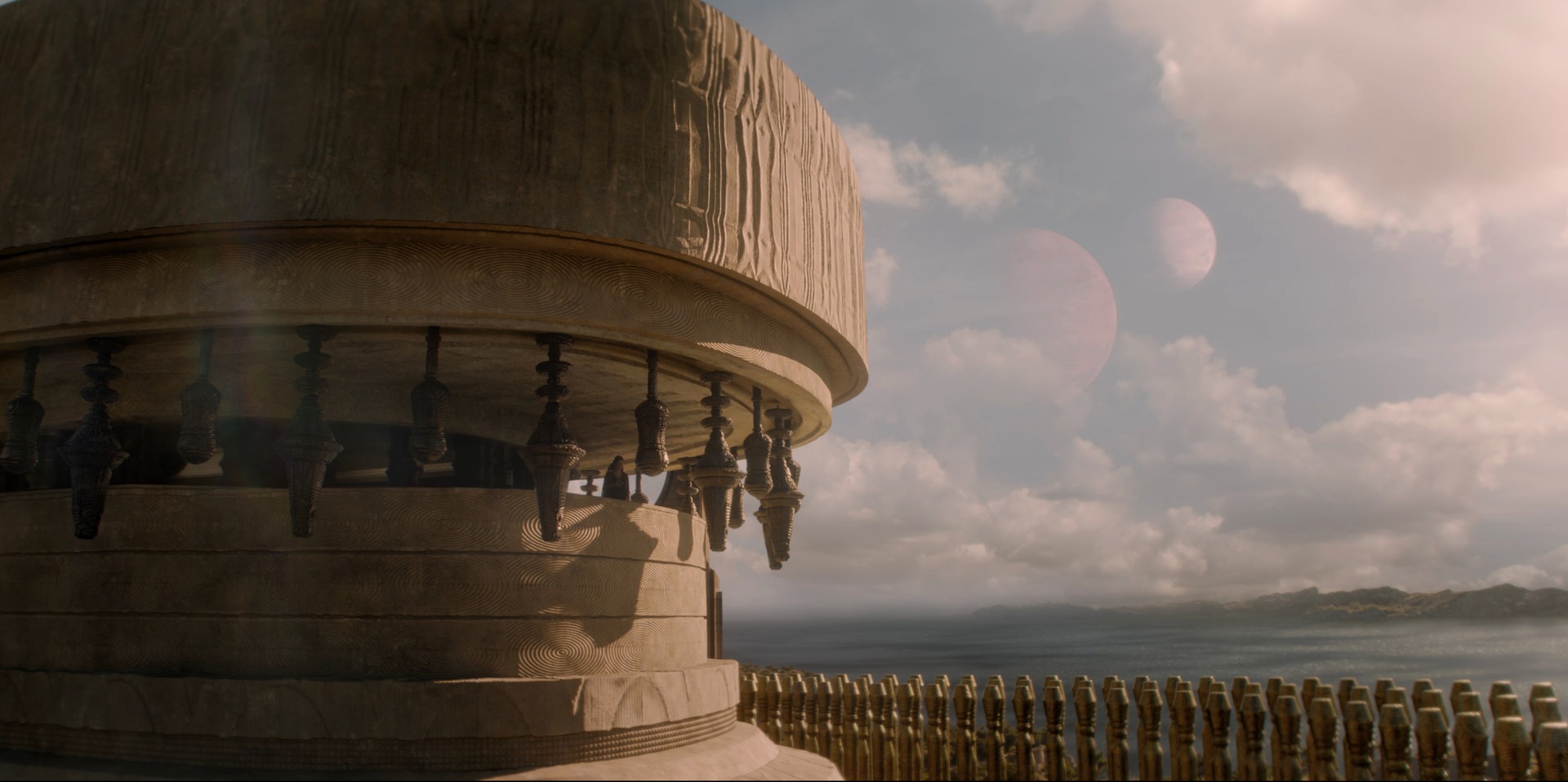
The Contending: Carolyn, you mentioned Salusa Secundus earlier, which is a wildly opulent world. Tom, design-wise, this is the polar opposite of Wallach IX. It has heavy Greco-Roman influences. Why follow that design aesthetic?
Tom Meyer: So, it’s important to know that, in the Dune universe, Earth is Gaia. It is a planet. It is a character in the Dune world. We are not in a universe where humans happen to look like human beings. The people are human beings. They’re not aliens that just look that way. Shakespeare is referenced in the Dune books. Greek mythology is referenced in the Dune books. It’s a character.
So that means that wood is wood, grass is grass, stone is stone. If you have humans, then we can have some real elements. We might tweak them and make them look a little alien or another world where we want to. You’re not just designing a volume that holds space. You’re really thinking about the character of that space. What does a Corinthian column look like in 10,000 years? What does an architrave or wainscoting or a bar relief look like?
When you start to build it using the ratio, the golden ratio and the proportions of classical architecture, you start to build them out of the oil-rubbed stone and wood that’s been touched a thousand times. It starts to become accessible and human again and relatable. Ultimately, when you’re sitting there, if the world feels too alien then I can’t get into it. You have to have a world and characters inhabit that world that you understand: understand their pathos, their passion, their vindictiveness, their drive.
That’s why the palace has that kind of detail to it. I’m really happy that you saw that. I want to put all those details in it. You design it so that everything you look at feels thoughtful. It doesn’t just feel like a big, vapid sci-fi panel with an empty space or a void. You want it to feel like it has some sort of meaning to it.
Season one of Dune: Prophecy streams exclusively on HBO MAX.


![James Cusati-Moyer On the World Premiere of ‘Sacred Creatures’ at Edinburgh International Film Festival [VIDEO]](https://thecontending.com/wp-content/uploads/2026/08/SC_MicRay_10_Courtesy-Nicolas-Villegas-H-120x86.jpg)