Our ears perk up to a sound in the distance at the beginning of Linden Feng and Hannah Palumbo’s haunting and inquisitive short film, A Bear Remembers. A repetitive sound has been echoing through a small town for what seems like forever and some of the townspeople have even grown weary of their own frustration. It’s a sound they live with now. Palumbo and Feng’s film unfurls like a cozy fable, a story revealing its true nature when you realize you are ready to hear its lesson.
The filmmaking pair, known professionally as Zhang + Knight, introduced themselves to me at Telluride this past fall, and I was thrilled to meet them since I had seen their film as part of this year’s Indy Short’s program. It was the first time for all of us, and surrounded by all the beautiful nature, one might assume that a bear would lumber down the streets to snag a cup of coffee before returning to its wooded resting place.
“We did Aspen and Telluride, and we still haven’t seen a bear,” Palumbo says. “If anyone’s allowed to see one in real life, it should be us.”
A Bear Remembers has stuck with me so vividly, and each time that I revisit it, I find a new element to latch onto. It’s the kind of film where you might have a different experience or interpretation the older you get. The origin and development came from a personal place.
“There is a surface origin story of how it was a music video idea,” Feng says. “It began as a story of the last follower [of a group] dying and all the spirits gather in the forest and they walk through a procession. They go up in space and it was very cosmic and beautiful and sad but it was for an electronic dance track. We kept pitching it every time there’s a music video briefing–it was just never what they were looking for. We kept revisiting it every year in our notes. The deeper interest in what was attached to that surface-level idea was the sense of cultural erasure or cultural displacement that, I think, is personal to both of us. I’m half Chinese and half English, and I grew up on the Welsh borders. I felt really British culturally but don’t look like everyone else who lived in the area. I felt that disconnect.”
 “My mom was a Turkish Cypriot immigrant who came over to the UK and then was chucked into the foster care system and separated from her parents,” Palumbo says. “It was at a time where the system in the UK was pretty dodgy, and they often would have strong biases against people who didn’t speak any English. She grew up a very culturally unmoored person, and I’ve been surrounded by the result of what that looks like my whole life.”
“We direct as two people, so we ask ourselves what is the commonality or things that we want to make and do,” Feng says. “There are going to be experiences that I have that don’t speak to Hannah and vice versa, and that was really burning away between us as this thing we were both interested in. I think this discarded music video idea became the vessel where we wanted to pour all of our feelings into.”
A Bear Remembers brings two unlikely people together. The constant sound has brought the media (we assume time and time again), and one reporter introduces us to Peter, a young local who prides himself on getting the best footage of the town with his drone. He has a cocky, youthful gaze, but he makes his way up the hillside with Ebba, a woman caring for her ailing husband. I couldn’t help but think of the differences between the two of them. Peter is eager and Ebba is cautious. His age might enjoy technology while she heard stories passed down from person to person. Is this town in trouble because of the advancement of technology?
“The invasion of technology can lead to that feeling of things changing in a very visceral way,” Palumbo says. “We love stuff where tech and nature intersect and there is a filmmaker named Elem Klimov who did a film called Farewell, which opens with a moment where they are trying to move a town out of the area. It starts with all these almost sci-fi ’70s vehicles driving through this very traditional Russian town, and it immeditately tells you everything you need to know about the anxieties of the space in a really nice way. British film from that time does a similar thing.”
Because these directors thrive in a world of music, the soundscape of A Bear Remembers sticks out wonderfully. Our sense prickle from the very first frame as we orient ourselves in this town. There are many ambitious short films this season, but Feng and Palumbo’s film immerses us entirely.
“There’s so much to say about that,” Palumbo says, with a grin.
“Music videos were our beginning, and with that style of media, you can’t have dialogue,” Feng says. “At the script stage, we wanted this idea that The Bear is clanging the pots together and it’s not necessarily a nice sound but it can eventually become the bass of the music. It does become the rhythm to which they dance at the end.”
“You can think that the pans banging together is not really sound design but score,” Palumbo says.
“Yorgos Lanthimos uses these musical hits in The Favourite that are very far spaced and they eventually become music,” Feng says. “In that film, it’s not diagetic, but we thought that we could let the audience hear it the whole time. It’s just simmering in the background, and the characters don’t even know it’s score. Maybe until the same time the audience realizes it too.”
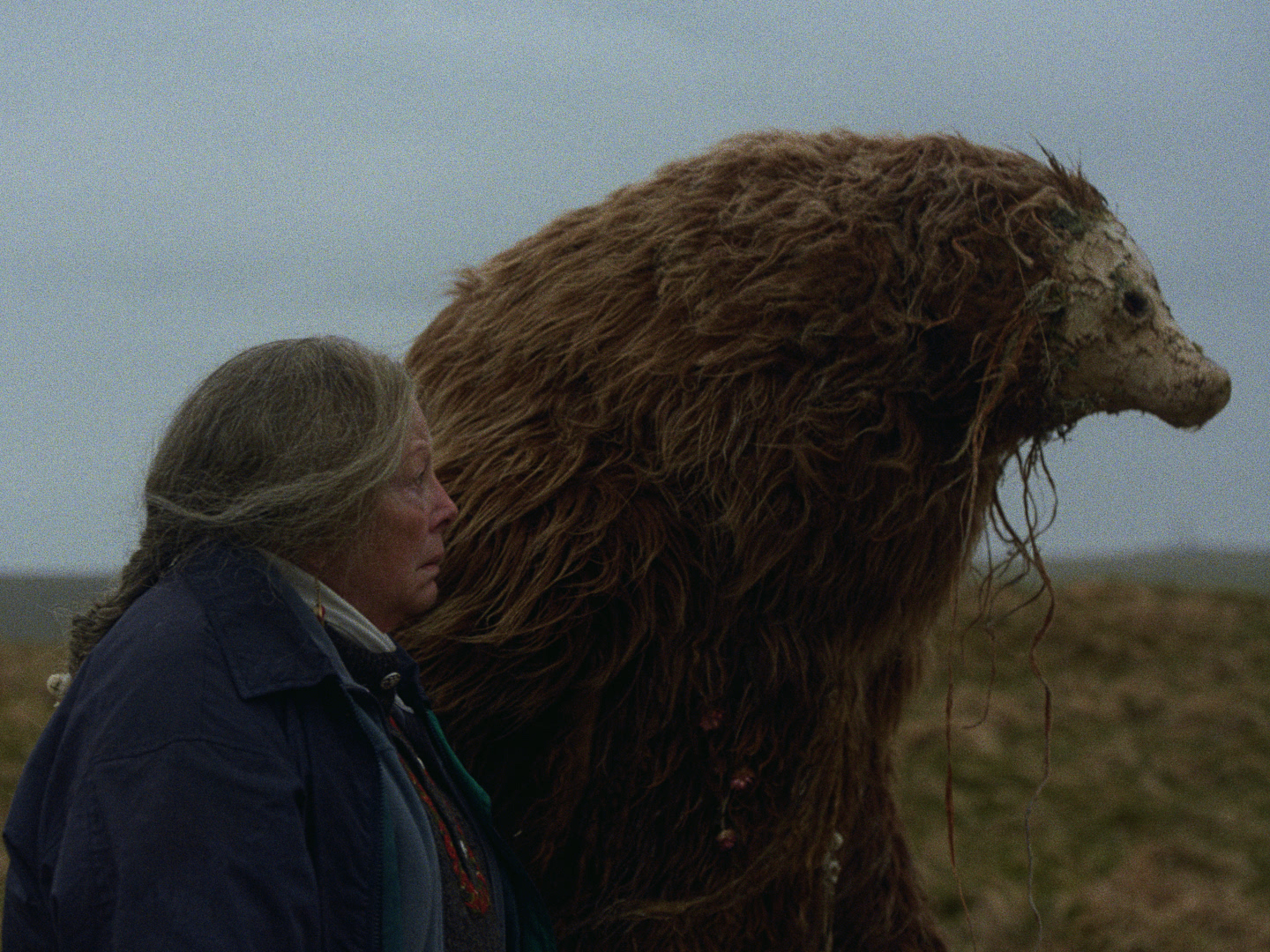
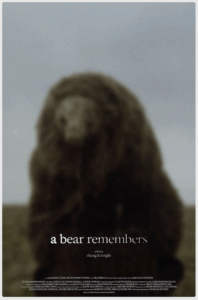 The visual style of The Bear is unlike anything you have ever seen. It feels familiar, but the more you look, the more you notice how they are different. Their arms are long, and their voice is soft. If someone was inside an off-the-rack costume, it wouldn’t fit into the singular vision. Perhaps some people might be afraid of them while others are drawn to them.
“It was tricky, because it has to do a lot of things and sit in a very particular space as a character,” Palumbo says. “You can’t go for a realistic bear, and you don’t want to do something that’s too clearly folk costume inspired and you feel the presence of a human inside. That wouldn’t have felt right either. We knew that it had to sit in an in between space, but we wanted the proportions to be very bear-like and very correct. We had this idea, which is not really in the film, that The Bear came to the village hundreds of years ago and is an alien creature from outer space that the villagers have put a mask on top of and called it a bear. If you took the mask of, it wouldn’t be a bear. With doing the claws so long, we wanted it to feel a little step to the left from being too realistic.”
“We get asked a lot at Q&As about why we chose a bear, but it feels like it was always going to be one,” Feng says, curiously. “We toyed with making it a fox spirit or a bird, but a bear felt so right for us. This is a very British Isles story, but we used to have bears in these islands before they were hunted to extinction. But they still live in our coats of arms and names of pubs and street names. They are here to stay even if they aren’t here anymore.”
I was even tempted to not gender this creature, because it felt like it transcended that. Why put something onto someone else when I am still learning about and intrigued by their presence.
“You referred to The Bear as ‘them,’ and our thought was that The Tear is genderless,” Feng says. “It’s a spirit, but for us, it was always they/them. When we were thinking about the voice, we thought that it was neither male nor female–maybe it was a trans voice? We even thought that it could be a collection of children.”
“That was such a nice idea, but that spectacularly did not work,” Palumbo says with a laugh.
“It pulled a lot of focus,” Feng admits. “We realized that it should be something that flies under the radar. Honing in on what The Bear sounds like was such an interesting process for us.”
As Peter and Ebba learn the truth of who is on this mountaintop, I expressed that I liked how Peter’s observes Ebba’s interactions with The Bear. Perhaps that assuredness falls away as he watches something that he can’t believe–something that he cannot describe by using technology.
“The writing process was longer than we thought for our first proper short film,” Feng says. “In the first week, Hannah wrote the scene with the dialogue between Ebba and The Bear and Peter wasn’t even in the scene then. He was just observing. All the lines like, ‘I’ve forgotten so much’ or ‘Where have the trees gone?’ were there from the very beginning. We then axed a lot and dissected everything and pulled it apart. That end scene was the kernel of script that told us that we knew exactly how it’s got to end.”
“We barely touched it,” Palumbo says.
Because The Bear is unlike anything we have ever seen and because A Bear Remembers stands out so distinctly, I wondered how it would feel to these friends if they ever came across one’s path.
“Maybe we’ve never see a bear?” Feng wonders.