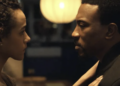
On a rainy night, a young woman locks up shop at the cafe where she works. The lights are low, and you can almost feel that wet chill gently pressing in on the large windows at the front of the space. When a woman appears, looking for her lost umbrella, this young woman, Elle, is understandably nervous, but there is a curiosity brimming there too. Jack Howard’s The Second Time Around percolates with peculiarity before it morphs right in front of our eyes. Once you have finished this short, you may wonder if the sweetness was there all along ready to warm you through from the briskness in the air.
Howard knows that some audiences hone in on the horror elements of Time Around, but he embraces it. How many scary stories have you heard that involve a mysterious stranger wanting to come inside? You don’t know their motives or what they want, but we keep coming back to them because of the odd comfort that they hold.
“I find, sometimes, that people are almost embarrassed to tell me that they thought it was ging to be a horror film,” Howard says. “You automatically wonder why is this woman here. What does she want? I realize that there’s something quite vampiric about it–a scary woman at the door asking to be let in. Even if you aren’t thinking that literally, there is something in you that knows those rules and so your instinct goes there. Especially on a stormy night with a dirty color palette–all of that feels like horror. Drifting towards the cafe like that was fully inspired by the start of Halloween. I believe that was the first steadicam shot. You follow this camera and it reveals to be the point of view of a killer. I wanted to use those tropes to mess with the audience and, hopefully, guide them into the wrong kind of assuptions. If you start by being afraid, by the time that we get to the tenderness and more emotional stuff, the catharsis of it is stronger.”
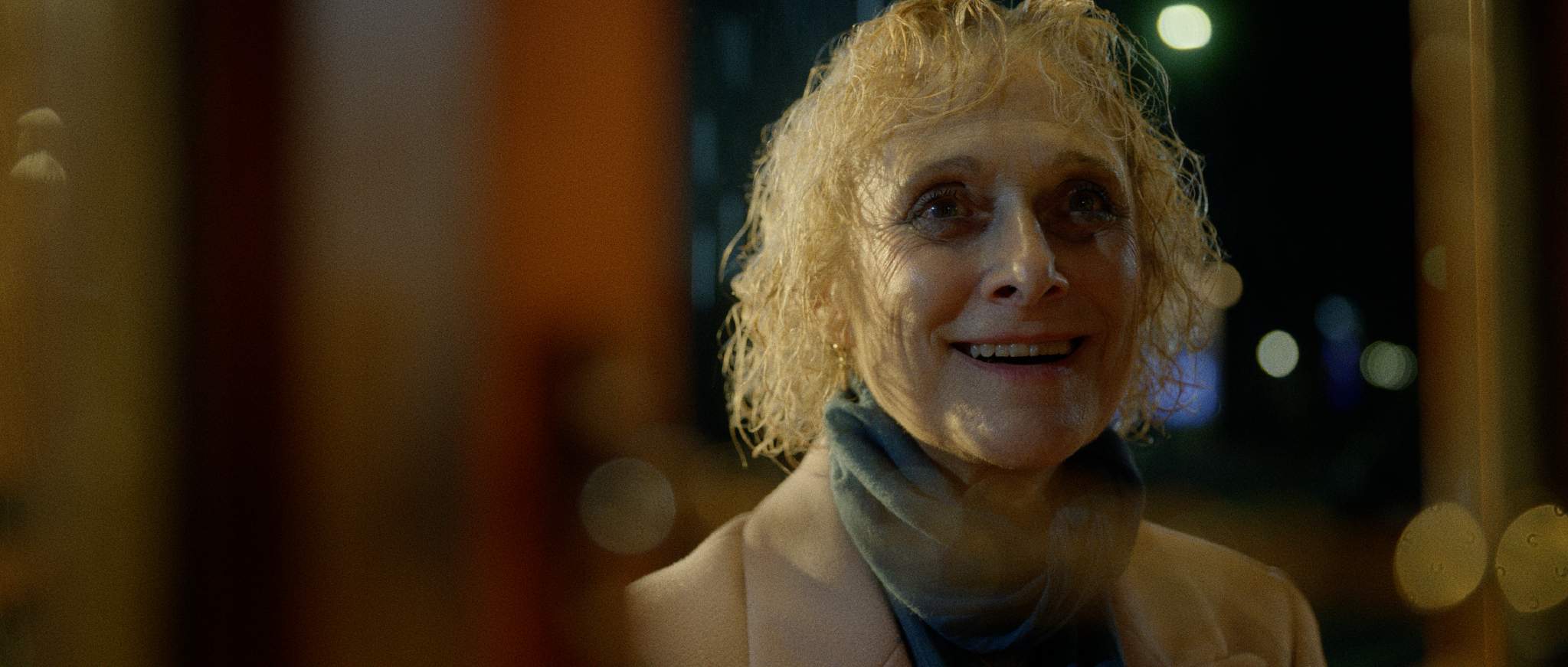
The first time we see Caroline Goodall’s The Woman, she is soaked through, her pale pink coat sticking to her body. Her curtain of hair frames her wide smile–I’d love to see her version of Aunt Gladys from Weapons. That introduction to this character was something that Howard admits that he struggled with in the first rounds of writing, but that unassuming tension is so palpable.
“That entire first interaction that Elle has with The Woman…I found that very difficult to write, becaust I just wanted to get her inside,” he says. “I almost wanted to skip over getting her in, but then I decided that I should make friends with this difficult feeling and make it difficult for The Woman to enter. I wanted Caroline to almost suggest ‘It’s me!’ as if to jog Elle’s memory in some way, even though, from her perspective, she has absolutely no idea who this person is. The Woman assumes that Elle will eventually open the door, and it will all be fine. The hurdle is really interesting in watching her encounter that resistance and Caroline’s face is almost like, ‘Oh my god…I’m being rejected.’ Apart from that drifting towards the cafe at the start, that was one of the first images that I saw, and sometimes it’s almost dreamlike in not being able to describe what I wanted to see. I remember my DOP on set asking me if I wanted a close-up and me saying no since I wanted it all from Elle’s point of view. It’s always going to be this scary, distant image, and I love that Hannah [Onslow] walked to the door as if she was being beckoned over. She has no choice but walk towards her.”
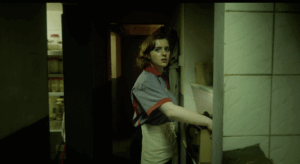
How Howard stages the cafe certainly helps with us leaning in inquisitively. The lights in the center of the cafe are low, so it feels like most of the illumination comes from the back room and the lights on the street.
“Atmosphere was so important, and that started with the rain,” Howard explains. “I wanted rain on the windows and to feel that constant sound. Originally, I tried different forms of a set like two strangers meeting on a train or the tube and it gets stuck. For some reason, the classic idea of two people talking in a diner felt very classic. That cafe isn’t far away from where I live, and it actually closed down, which is such a shame. My production designers came in and completely transformed it by putting lamps on the wall. The curtains at the bottom of the window really helped make it feel like a very wholesome place, especially to contrast to the horror tones that are there at the beginning. With the lighting being low and dim, I hope what happens is that, at the start, that palette feels potentially scary or thriller-like and the story can change without us having to change anything. Those colors start to morph in your mind and feel more comforting and more safe.
We also lensed it slightly differently as well. I took a lot of inspiration fro Osgood Perkins’ Longlegs from last year, and we actually shot it on the same camera and lenses as that did. We wanted those big, wide shots and even when you’re doing a close-up of somebody, you can sto=ill see that environment around you so your eyes can wander and look at the empty spaces.”
**The rest of this interview contains slight spoilers for the end of The Second Time Around.
Before The Woman leaves the cafe, she turns to Elle and says a rather unexpected line in, ‘You are so loved.’ The warmth of Howard’s film has creeped up on us in a way that we might not be able to pinpoint. The camera is not tight on The Woman’s face but rather right about Elle’s head. It feels like that line, and Goodall’s delivery, feel like a dimmer switch slowly turns up and that warmth cascades all over us.
“The whole film is really leading to that point,” he says. “What is the one thing you want to say to this person that you wish you could’ve said? It builds to this almost word vomit moment, and I didn’t want any of the cinematography and any of the language of the movie to indicate what she was about to say or what was about to happen. In the context of the scene, she’s leaving, and Elle says, ‘It’s nice to meet you.’ I think you would assume that she’d turn and say something maybe in a meaningful way, and you’d think that she’d say something like that back. What comes out is so shocking and so meaningful that it could’ve been so schmaltzy. You could do a big close-up on Caroline or maybe push in, but I wanted to resist the urge to do that on any of the emotional beats. I wanted to keep it strictly from Elle’s perspective.”
I couldn’t let Howard go without asking about a seemingly simple prop: the sought after umbrella. Some audiences might think that artists just grab an item to fit it into a film, but even an umbrella takes careful consideration.
“There are certain things that were scripted and certain colors that we wanted,” Howard says. “Caroline was going to be in a pink coat, and that was always in the script. The umbrella is such an important part of the story, and I knew I wanted a sea of black umbrealls in the bin. Originally, I wrote that it was a pink umbrella with yellow spots and then someone pointed out that it might be too much like Mr. Blobby. My production designer had a selection to choose from and the one we picked was just eccentric enough without it being too showy. The Woman is a kooky character, but there’s a fine line without trying to lay it on thick.”