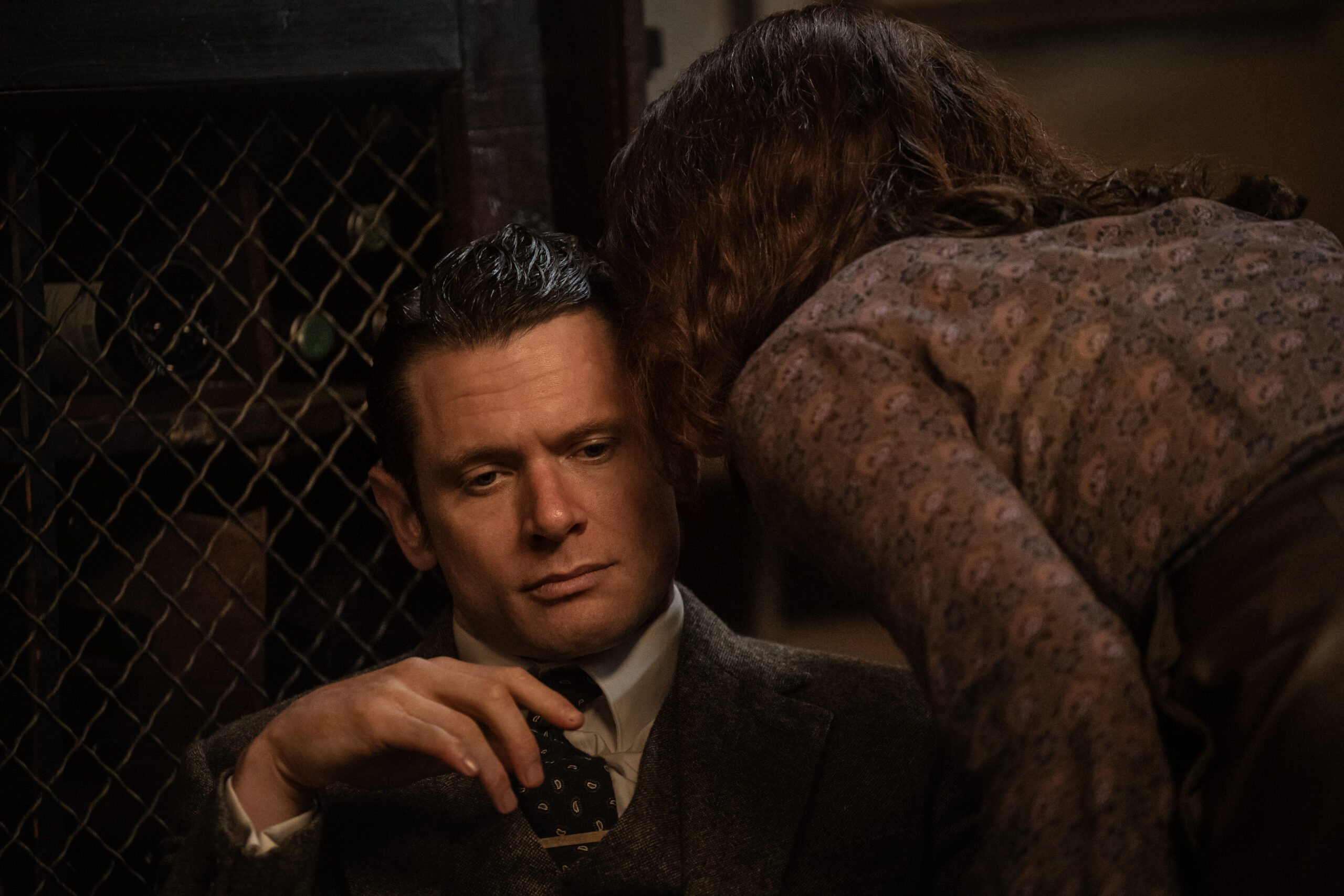
Decades before the constantly shifting power dynamics of a certain family of titans depicted on the award-winning HBO series Succession, there was a young, frustrated Aussie entrepreneur who decided to purchase a troubled British newspaper and hire a spurned, angry former Daily Mirror sub-editor. Together they would change media history, not necessarily for the better. Danny Boyle’s Ink, a hyper-kinetic dynamo of a cinematic punch, could have been titled When Larry Met Rupert. It’s more a love/hate story, though, and the ultimate orgasm is achieved through sheer tenacity towards retribution—at least that’s what motivated the man in charge.
Ink began life as a play written by James Graham, first produced in London in 2017 and on Broadway (for a brief run) in 2019. But you’d never know it was a stage adaptation (by Graham) since Boyle’s stylized cinematic approach turns it into an intense, fast-paced thriller.
The plot begins to spin as young Rupert Murdoch (Guy Pearce) wrangles Yorkshire newspaperman, Larry Lamb (Jack O’Connell) to run the future tabloid, The Sun. And gives him all the leeway with whom he hires, suggesting he go after a “ship of undesirables,” like Lamb. So, he goes on a quest to gather a slew of Fleet Street journos discarded from other newspapers with a hunger for work and axes to grind.
Murdoch starts out completely supporting Lamb, urging him to rely on his gut instinct and Lamb sets out to create a paper that will entertain as well as educate.
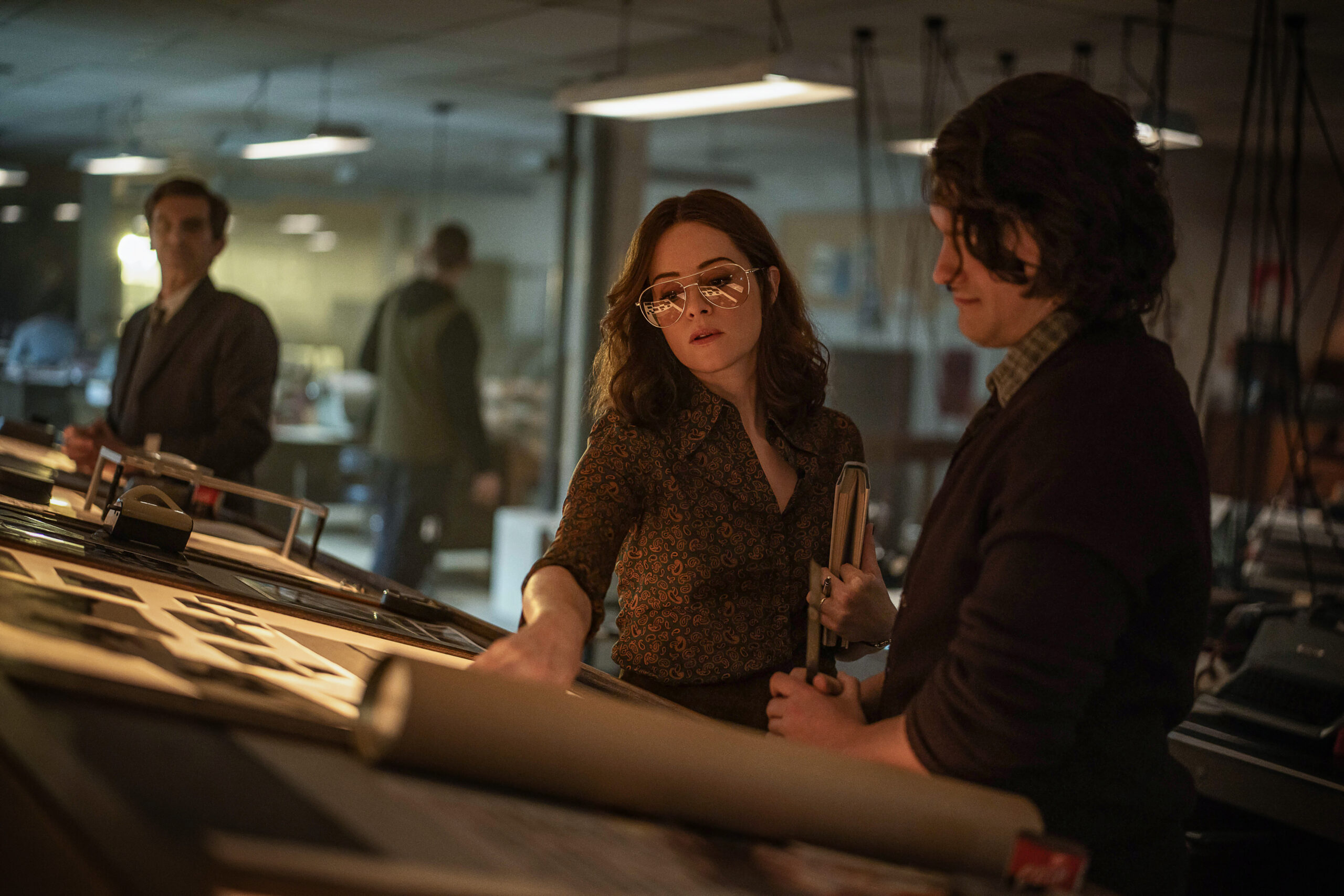
Among the gaggle of media misfits is composite-character, Jules (Claire Foy), that journalistic oxymoron, an ambitious scribe with a conscience. She realizes that a newspaper shouldn’t necessarily be a mirror of our own lives reflected (what The Sun initially was) but, instead, a window to what we would like our lives to be like—seeing things we’d never normally be able to see (the latter is what The Sun attempted to become but instead spiraled down a more salacious path.)
Slight Spoiler (so maybe skip this paragraph)
A chunk of the second half of the film (and it could be a film itself) is devoted to the 1969 kidnapping of Muriel McKay (Lucy Russell), the wife of executive Alick McKay (Jonathan Hyde)—taken by a couple of fools who thought she was Murdoch’s wife—and how Lamb handles the coverage, basically continuing to publish sensational articles about it, hoping it would help find her. This was the first kidnapping for ransom in the UK in 800 years, so it was unprecedented territory for the police. The story does not have a happy ending, and the film wonders if the coverage might have caused the tragedy. Regardless, this would be the new path forward for The Sun…and media, in general.
Boyle and his ace cinematographer Alwin H. Küchler make great use of tilted camera angles and frantic cuts, sometimes using comic book-style shots to great effect. The director’s use of popular ‘songs of the period like, “Love Child,” “Sixteen Tons” and “Green ,Green Grass of Home,” provide clever additional commentary.
O’Connell has been doing great work for years (Unbroken, Lady Chatterley’s Lover, Sinners) without much recognition. Ink should change that. He completely immerses himself in this demonically driven character. It’s a powerhouse performance that should be in the awards conversation.
Foy is also fantastic, mining nuances in what would normally be the throwaway girlfriend role.
Pearce is a surprisingly prudish, almost tentative Murdoch (at least from what he would become) and he’s, not surprisingly, terrific in the role.
Ink makes its ultimate point quite clear in its final moments, that so much of what the Murdoch/Lamb collaboration would beget is today’s social media madness, fake news and clickbait frenzy. I’m not sure the film completely makes its case, but it could play on a bill with Alan J. Pakula’s All the President’s Men to contrast two very different journalistic quests, one driven by truth and ethics, the other by money and revenge.
Ink was the opening night world premiere screening at the Venice Film Festival, In Competition.
The film will be released later this year by Netflix.