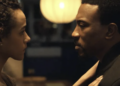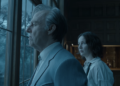

Night two of the Virginia Film Festival was all about two very different women attempting to make their way through a man’s world. The Testament of Ann Lee and Christy have little in common in terms of style, subject, and era. What they do share is themes and principles that actually existed.
The Testament of Ann Lee:
A musical about the real-life founder of the “Shaker” movement: a Christian sect that believed in celibacy as the way to the lord.
If you were to go into a lab and attempt to create a pitch for a film I wouldn’t want to see, you couldn’t do much better than the above. Musicals are one of my least favorite genres, I’m an atheist, and I think celibacy is downright impractical and silly.
Before I enter the theater to see a movie, I always tell myself the same thing: “Be open to surprise.” The Testament of Ann Lee surprised the hell out of me. Created by the same team that made The Brutalist (this time with Brady Corbet co-writing and Mona Fastvold taking the director’s chair), The Testament of Ann Lee is an absolute stunner.
There are numerous shared style notes between The Brutalist and Testament. The editing, camera movement, and cinematography all share the same markers. I am in the minority of critics who did not like The Brutalist. I thought the first hour was grand. In the second hour, I started to have questions. The third hour, I became exhausted, and during the extended coda, I felt like I was never getting out of this prison. I all but leaped out of my chair to escape the theater. I felt punished by what I can only describe as three hours and thirty-six minutes of suffer porn.
Yet somehow, I never felt that pain for a single second during Testament. Again, always be open to surprise.
At the center of this highly unusual film is Amanda Seyfried as the title character. Seyfried has long been an excellent actor who has often seemed to be on the precipice of major stardom, but never quite made it. Sure, she’s had some hits, been nominated for an Oscar, and won an Emmy, but lengthy stretches of modest success often follow her triumphs.
I do not know whether Amanda Seyfried will be nominated for a second Oscar, but I do know that her work as Ann Lee is one of the best performances of the year. Seyfreid may be from Allentown, Pennsylvania, but she looks and sounds every bit the part of an 18th-century religious leader who starts out in Manchester, England, before crossing the Atlantic to New York.
Did I mention that this subject matter is also a musical? Because let me get to that. The songs in the film sound like a combination of Kate Bush and Florence Welch if they had only the most basic of instrumentation available to them. The sound is sparse, but soaring, and the person who makes it fly is Seyfreid. As the star of two Mama Mia films, Seyfried has already proven that she has the vocal chops, but Testament is something altogether “other.”
The score is big, percussive, and yet stark. It’s what I imagine Wuthering Heights would sound like if it were set to music. As significant as Ann Lee’s story might be, I often found myself drifting from the plotline and taking the film purely as a sensory experience. The sound and vision on display were at times overwhelming.

Even so, it’s hard to miss the themes that play out in Testament. Lee was a woman in a loveless marriage with a husband (Christopher Abbott) who got her pregnant four times, and all four times ended in tragedy. Of deep faith, Lee came to believe that the early deaths of her children were a punishment from god, and that “fornication” was in the way of her having the truest possible relationship with Jesus. She then created the “Shaker” offshoot, a sect that swore off sex and would engage in a form of ecstatic worship. Those scenes of worship involve writhing, singing, and yes, shaking. They border on orgasmic. For a film about people swearing off sex, there are times when Testament is pretty damn sexy.
Cinematographer William Rexer shoots the sinews and veins in Seyfreid’s limbs in an almost fetishistic way. I suppose it doesn’t hurt that Seyfreid is beautiful, but the camera tells you where to look, and so look, we do.
Of course, being a woman who becomes a religious leader who is thrown into an asylum in England, and then flees to America, Lee’s suffering at the hands of men is immense. Understandably, anyone who claimed to be the second coming of Christ (yes, she did that) would be seen as a kook in any age. In the eighteenth century, she was also seen as a threat.
The hardships Lee and the Shakers endure are painful to watch, with one scene so alarming that I couldn’t wait for it to end, while respecting that the film earned the moment. While I don’t think The Testament of Ann Lee sustains its early otherworldly momentum, I did walk out of the theater thinking I had never seen that film before. I believe I will be tossing it around in my head for weeks, if not years.
The Testament of Ann Lee opens in limited release on Christmas Day, 2025
Christy:
Let me begin with a moment of disclosure. I have been writing about boxing longer than I have about movies. I watched Christy Martin fight on television in the ‘90s and after the turn of the century. I’ve seen her powerful ESPN documentary Untold: Deal with the Devil. Earlier this year, I interviewed Christy herself.
I thought I knew what to expect from Christy. David Michod is a director I’ve admired from his 2010 breakthrough, Animal Kingdom, through his 2019 tale of Henry V and Falstaff, the brutally underrated The King, starring Timothee Chalamet as Henry and Joel Edgerton as Falstaff. Having seen the trailer for the film, I thought Sydney Sweeney looked right for the role of Christy, and I knew Ben Foster was a perfect choice to play Christy’s husband and trainer, Jim. In fact, I knew every major event that took place in the film.
And I was still floored.
Christy Martin is a literal “coal miner’s daughter” from West Virginia. Being from coal country myself, I understand the grim world of the one dirty-industry town. Those towns can suffocate you literally and figuratively. Christy Martin came from nothing.
Martin was an excellent high school basketball player who entered a “Tough Man” contest and discovered she could fight. Soon, others would, too.
In the late ‘80s, early ‘90s, and well into this century, women’s boxing was often seen as a carnival act. One that was viewed as both a grotesque spectacle and beneath a “lady.” Martin was no regular lady, though. She had natural fighting skills and a brash personality, making her highly marketable as the leader of a fledgling sport.
Martin had a secret, though. She is a lesbian, and that was not acceptable in the rural South, in the ring, or anywhere else at the time. So, she married her trainer, suppressed her sexuality, and even taunted women she fought, using epithets about their femininity.
Jim Martin was a dangerous man. Insecure, mean-spirited, and deviant. There are signs early in their marriage. The way Jim’s eyes turn cold and he tosses a plate into the sink over the phone bill is nothing less than threatening. Their union was indeed a “deal with the devil,” and the devil was Jim. As Christy and Jim, Sweeney and Foster don’t play their roles; they become the people they portray. Sweeney has been a lightning rod for criticism ever since her breakout role in Euphoria. Her appearance, her family, her political beliefs, and even an ill-conceived jeans/genes commercial have come under scrutiny.
I am not here to litigate any of that. What I am here to say is that Sydney Sweeney gives an extraordinary and all but unrecognizable performance as Christy Martin. It’s not just that she transformed her body by gaining thirty pounds. Lots of actors have done that. It’s that she sounds like Christy, moves like Christy, and she may even breathe like Christy. It’s the kind of performance that changes how you see an actor forever. I do not know whether the swirl of controversy surrounding her will impact her Oscar chances, but I know it shouldn’t. She’s that good.
While I was less surprised by Foster as Jim Martin, it must be said that there were times when I could neither see nor hear Foster in the role. I only saw Jim. There is a stunning scene of domestic violence late in the Christy that knocked the air out of the nearly full house I saw the film with at the Paramount Theater. I was among them. Michod stages the scene with such brutal economy that even if, like me, you knew what was coming, it doesn’t make a difference. Foster’s terrifyingly dull visage and the suddenness with which he moves only add to the horror. It’s a prolonged sequence, the kind that can make you forget to breathe. As hard as it is to watch, it is also unforgettable.
I should add that the boxing scenes are superbly rendered in the film, but while those sequences are impressive, it’s what happens outside the ring that elevates the film. Christy Martin was in a fight for her life for nearly the entirety of her early adulthood and into middle age. Christy is the story of that fight. It’s one of the very best movies of the year, and when the score swells into the film’s credits, it was a musical moment worthy of a Michael Mann film. In every way, Christy is a superior film.
Christy opens in wide release on November 7, 2025
Two films about two very different women making their way through the world of men. The hard way. The only way that was available to them.