
Jessica Lee Gagné served as the director of photography (DP) behind the already iconic look of Apple TV+’s Severance. Now, she has contributed even more to the series in her first time directing, which just happens to be the acclaimed episode “Chihkai Bardo.” Here, in an interview with The Contending, she talks about her desire for interesting creative works. That interest is what made this episode speak to her with its complex shifting of time and space and crafting the different versions of Dichen Lachman’s Gemma. Finally, she reveals that we have not seen the last of her in the director’s chair. The experience opened a great deal for her, and whatever she does next it will definitely challenge the audience.
The Contending: This is your first time directing and it was one of the most acclaimed episodes of the season. What has this experience been for you?
Jessica Lee Gagné: A little overwhelming to be honest. I didn’t really know what to expect because with television it’s different than in filmmaking. I have seen other filmmakers going through the process of attending festivals and releasing the movies where with television there is never that much attention to the directors working on the show. But then seeing how the episode was pushed by Ben (Stiller) and Apple was really nice and helped make it easier for me.
The Contending: You have worked in cinematography for most of your career, have you always wanted to be a director as well? Or was it something that came about through your work in the industry?

Jessica Lee Gagné: It was an unconscious desire, I didn’t want or expect to start directing until it was proposed to Ben (Stiller) and Apple. I was actually looking to move on and work on another show, because what I really love to do is be involved in world building and creating the cinematic language of a show or film. I thrive on that, and love prepping for that. So I was less intrigued by doing another season of Severance where I felt we had done a lot of creating the world in the first season. Then they offered me the chance to direct, and my initial reaction was no, I don’t want to do this, but then I was going through my own personal journey on the side outside of work, and what I really wanted out of life. I realized this was a beautiful next step that I had not let myself see as an option. It became clear that there was never going to be a better opportunity to do this with such a great cast, crew, and showrunner. The elements were just there to help me at least try. Beyond all that, I was very intrigued by episode seven. When I read the synopsis that’s when it clicked in my mind that this is the episode for me.
The Contending: Severance has always played around with where we are in our own head and in time. Your episode in particular is jumping around in time a lot, and in different versions of characters’ viewpoints, with Gemma going into different rooms and being different Gemmas. What were the challenges as a director capturing all that?
Jessica Lee Gagné: I think the biggest challenge outside of time and my own fears within the story was trying to get people to love Gemma. I knew there were only these fourteen flashback scenes in it, and the more we moved forward in the series it became clear that episode 7 needed to bring the weight to episode 10. Seven showed where Mark and Gemma were in their relationship before she “died,” and how the relationship wasn’t so perfect. That scared me even more because I wondered how I could get people to like her if in every scene we see them they’re going through something dramatic. That was something I was constantly trying to play with and make their relationship feel real, and land the episode in some kind of simple reality that was relatable.
Then when it came to challenges of the linear nature of this episode with the time jumps, there were a lot of conversations between the writer Mark Friedman and me as well as Ben (Stiller) about where are we? What is the timeline? What are we jumping from? There was the challenge of showing three different timelines. The timeline of the show that people continuously follow. Then you have Gemma’s timeline on her floor, where we don’t quite know where it syncs up with what’s going on; you have hints but it’s not clear. Then you have three years of Mark and Gemma’s past before she’s spent two years in this underground world. So there was fear that everyone would just be confused with the structure as well as throw in a bunch of crazy transitions. But then somehow it balanced itself out. The episode is actually quite close to what the script was in the end. After we put in the transitions there were a few things we had to fix pacing-wise once we got into editing, but the episode found its own way.
The Contending: Speaking of having to like Gemma, what was your conversation with the actress Dichen Lachman about having to get all that across so quickly?
Jessica Lee Gagné: For me the biggest learning experience was learning to work with actors in developing my own process of what that is like for me. Also understanding that each actor needs something quite different. That was really enlightening and confidence building for me in seeing how it worked out. With her we spent a lot of time together breaking down each scene, we split her personalities up depending on the rooms and the flashbacks and the timeline in the underground. What I needed to do as a director before even meeting her was make sure that I was clear on where she was in her life anytime we found her. Actors will get the scripts, but they won’t know exactly how long this is and when it was this. So I worked with the writer to build a very specific timeline and with the script supervisor Sam Evoy to know every time we go to a flashback to know exactly where we are. That this is one year and two months into this relationship, so we could build the backstory. That gave a lot of weight and reality to the flashbacks and really helped us understand where she would be and her state of mind.
Then, when it came to the rooms in the Innie world, that was the fun part of being in the Severance universe. Whenever you’re bringing in a new innie you’re trying to figure out how long has this person been in this life. Because every room is a new life for them, so you can imagine what has affected them, what has changed their personality. It brings up a very interesting question of how we are influenced by our environments, and what makes us who we are. Is there a core thing that you keep in your soul? Her experience would have been quite different in each of these rooms, and the time she would have been in each room would also be different. We had fun depending on how she is treated. In the dentist room this guy has weapons; the terror that that does and how that makes her shrink, become this frozen person, that is one thing. Then when we went to the Christmas room I wanted her to be like an angry teenager. The guy in there is trying to be nice but isn’t really nice, and she’s able to rebel against him and that causes a different dynamic. So we had a lot of conversations about that and that was really fun.
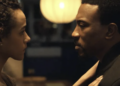
One of the most challenging personalities for her was the state of mind she was going to be in when she was herself but just in her room or the hallways of the testing rooms. For that, every scene was different, because you had to try to piece together what was going on with her. Why is she going to risk knocking this guy out? Has she done this before? We asked ourselves all those questions. Right before she entered the Christmas room I had Mark (Friedman) add the moment with her putting on the ring, so you could tell that that was messing with her head in terms of her own relationship. Then he comes into her normal room after that and leans into her with what he claims to know about her relationship with Mark now. Because he is also charged with what happens to Gemma outside of the severed rooms. We worked really hard to add all those details. Being able to do all that was really motivating and enlightening for me.
The Contending: I’ve seen online that you already said you’re interested in doing more directing. Is there anything in particular you want to work on or an idea you want to see to fruition?
Jessica Lee Gagné: I’m actually working on my first feature right now exploiting the theme of The Assimilation of the Shadow by Carl Jung. With me repressing this desire to direct, and now that it’s just come into my life and being something I have to deal with now. I feel like there are so many things that we hide deep inside of us and they find their way to us in these weird, sometimes dark, sometimes beautiful ways, and I want to explore that.
The Contending: Did your work as a cinematographer influence your directing?
Jessica Lee Gagné: One of the reasons I want to do this episode was I knew there was going to be a new language and world that was going to be added to the show and I really felt that I wanted to do that! It was hard in season 1. I couldn’t let any other cinematographer work on the show and had this feeling that I owned that part of it. Now I’m opening up and able to let other people work on it as cinematographers. But this new world I wanted. Before it was known that I was going to be directing it, the writer in his mind wanted this episode to move outside of time, he wanted the energy to be like it was a whirlwind. So when we were paired up, his knowing me from season one and what my skills were as a cinematographer, he asked me to help find the transitions together. Where he had these particular scenes and wanted to know how we could do this in a visual way that is interesting and captivating and pushes the limits of cinematic language. So that skill set of mine was something I was very comfortable in. I think visually and I can move past limitations of simple camera stuff; it is not a block for me, I can see automatically how to do these things. I think that was my biggest influence on the episode.
The Contending: Final thoughts?
Jessica Lee Gagné: I’m just grateful that I got to do this because it has really opened up my mind. When you step through a fear that you have, it really is true that it can open up a whole new life for you.