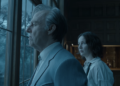

Anyone who has seen Sentimental Value knows how important the family home was in the telling of this story. That could not have happened without the work of the production designer Jørgen Stangebye Larsen. He has a special history with that house and a very interesting skill that allowed him to know this house better than most people would. He was deeply connected to the film themes and his own background gave him insight beyond just creating the set. The story and the experience of working on it meant a great deal to him, and the film wouldn’t have worked without his dedication.
Jørgen Stangebye Larsen shares his story here with The Contending.
The Contending: The family home is pretty much the fourth lead of the film. Is your approach to creating a set different when it is so essential to the storyline of the film?
Jørgen Stangebye Larsen: Definitely. The film asks the audience to pay extra attention to the tactile feeling of the house. You know you want to give it a lot of love and care. When I read the script for the first time I saw that we were going to see this house over 100 years in several montages. I knew it would be for a short amount of time but that it would be very important to make certain that we flow into them and are not taken out of the film. That you just believe and go through a journey with this house that feels natural and lived in.
That was the main challenge of the film for me, and it also is what took the most time to create. We did have the location of the house where we were shooting all the contemporary scenes. But even that site had different setups we needed to do to create different seasons and different stages of the house. There are the moments when they are packing the house up, when they have the wake, and Gustav has a lot of his readings there as well. So that was a different kind of work than doing the time period work. I even had to make the whole house on a stage, for a couple of reasons.
Then for those montages from the 1930s, 50s, 60s, 80s, we needed to build the entire ground floor with the living room and the psychologist office/library. Then we had to build the entire second floor of the house with the bedrooms because we did not have them on location. Those sets we went back to even further to 1918 and 1925 where we saw everything through the door. There we experience several major moments: a scene of death and also a scene of birth, and then a couple in conflict that leads to divorce. So every character is connected to the house at different times, which is a great way to approach everything.
The Contending: When we get to the end of the film, we see that they are completely gutting the house and they’re creating something that looks very modern. It doesn’t feel like just a cosmetic change, it almost feels like a psychological change of what the house represents. What went into creating the modern look for the house in the end?
Jørgen Stangebye Larsen: I think you’re right. It is very stunning because you’ve been seeing something with soul and pathos. That is the beautiful thing about that house in the film, when you live in a house where your family’s been living for decades it’s all there somehow. It’s with you in the material, like the scratches in the wall, and you see the things stored in the attic and in the basement. You have the feeling of the presence of the past and people’s feelings and experiences. Then, when you see it after Gustav has sold it and it is renovated, you don’t see a single sign of life. It’s completely converted, painted, plastered, and the floor is brand new.
How we came up with the look was I didn’t want to build a whole house version of it because the scene is so short and it wouldn’t make sense. One plan was we took different shots of the living room and the dining room and then used visual effects to have the changes be very connected to the actual house. But then we ended up finding a different location with a very similar house that was already painted white and so we just used that location, though we did still use some of those initial shots we took in the original house. That really ended up working the best because when you change a house that much by moving the kitchen or taking down walls you end up not recognizing it. So that worked really well.
The Contending: So this house had been discovered when you and Joachim Trier were working on Oslo, August 31st. This house has quite a history with you guys. What was it about it that means you guys decided that this was the place for this film?
Jørgen Stangebye Larsen: For me it was a very strange thing to discover. Because Joachim had made that decision before I came on while he was still writing the script. So when Joachin asked me to work on the film and read the script he told me we were going to shoot in that house. I was like, “Really?” because the first film I did as a production designer straight out of film school in 2010 was Oslo, August 31st, working in that house. So that movie meant a great deal to me. It was a beautiful film to work on, and the final shot of the film is filmed at that house in one take. Not very different from the one take we do at the end of Sentimental Value.
So, it really felt like a full circle moment, and it felt like there was some meaning in all that because this story is about the history of a family that changes inside this house. And that house had changed a lot since we had been there 14 years ago. I always remember houses perfectly; I can draw the plan of every house I’ve been in. So when I was reading the script I was thinking wait, the kitchen is not there? What are they talking about? Then when I came to the house I noticed some of the other changes like that the floor had been replaced because there had been some damage. That was also part of the reason I thought it would be better to do all the different time period work in the studio.
But it is a very unique house that stands out in its neighborhood. It has this romantic Nordic dragon style with beautiful wood carvings. It’s also an asymmetric house, which creates a nice feature for the film. It also was great that the people who live there are an actor and a musician who have a very chill lifestyle, and they have been seriously renovated like we see at the end of the film, which most of these houses in the area have been. So it has kept a lot of that charm and it’s very beautiful.
The Contending: Talking about the final shot in the film, I love that set within a set because it is a little more modern than what we saw in the house but it’s not the ultra modern of when the house gets gutted. It has somewhat of the same sense of space as the original house but it just feels a little different. What went into creating the design for that?
Jørgen Stangebye Larsen: We used the same set that we had built for all the other time periods on the sound stage. So that was the last stage we went through on this set, because we had to strike the second floor to make sure we had room for that big wide shot of the set from the outside. What we had the opportunity to do, since we were in a studio, was accommodate for the tracking shot with the dolly. So we created the door frame for the kitchen and had it on a hinge so with this tracking shot we were able to open the door and let the dolly through and created more room in the hallway to get the exact shot. When it came to the design I just wanted it to look like a family home, with toys on the ground and a little bit of color but still making it just a little bit sad and dark.
There was a major journey we took with this house from the 1930s, where we have the heavy wallpaper with darker green blues and pinks, and then going into the 1950s, which was more light and subtle with less furniture and more sun. Then Gustav moves in 1986, trying to start a new life with his family in this house that carries the death of his mother. He tears down the wood paneling and paints everything white. Then, with it staying white for the rest of the film, it makes it so you don’t make a huge statement with a design in the end scene, just keep it pure and simple.
For instance, in the last room where Nora ends up within the set of the house, we have Gustav just sitting there by the monitor. We had discussed should that room be something specific, should it be a guest room or a washing room? Then we just kind of decided it didn’t need to be anything and that was kind of beautiful. I think it can be really stunning to just see an actor’s face with no background distraction, her being in the white and him in the black. That was my main thought really.
The Contending: The other major set for this film is the theater that Nora performs at. In many ways it seems to be her real home. There are so many moments where she has some great emotional moments that we can’t tell if it’s part of the performance in the plays, or what she’s really going through. What kind of work did you do with the theater?
Jørgen Stangebye Larsen: Joachim likes to document different institutions in his films. So it is an interesting feeling to go and film The National Theater of Norway in the middle of Oslo right by the palace and the parliament building. It is a very historic institution, and we did a lot of research talking to the people who worked there, and collaborated with a theater director and lighting crew to make it work. We also were backstage when they were putting on their own plays, seeing how everything worked, which was important for Joachim because he wanted to make certain everything looked authentic.
It was a logistical challenge because we had to put up two stage designs at once to work around the theater’s schedule. Two days we filmed with a full audience and then the other days without an audience, so the sets had to be able to go up and down quickly, and get the lighting just right because we were only there for a little over a week. That was the first practical starting point of what I could design.
I wanted to make something iconic but also simple between the two plays. The first play that’s being performed isn’t clearly defined in the script, just that it has witch burnings and there was this black and white dress and a moment of time frozen. So we made the set monochromatic colors, keeping the actors that were going to be burnt on ladders so I could put them in different positions as Nora circles the men. Then we had burnt coal hanging over the witches, which gives us this sense of frozen time because she’s going around talking to them and they’re just silent and unmoving. We were also able to use the turning stage with the ladders that you get to see one shot of in the film. We’re all turning and she’s walking. That was something we were able to rig up and down very quickly. The second play was Hamlet, and the idea was to make an exterior landscape that could be interior, so I used some modern furniture with very clear color to be able to represent both. Then, as often happens with things that you worry about and put a lot of time into planning, it actually worked really well with no problems.
The Contending: This is only your second time working with Joachim Trier after Oslo, August 31st. What was it like coming back to work with him after all this time?
Jørgen Stangebye Larsen: It was very lovely, I have to say. We have been following each other’s work since that time, but we did go on different paths. What I love about Joachim is he really wants to make films about things he cares about. Existential problems like relationships and how difficult it is to communicate with one’s immediate family, finding a home, finding someone you love and staying with them, are things that really interest him that we all can relate to. I think why he wanted to work with me on this film is because he knows that I will understand the characters. I am single and working a lot in a creative field job, and I can understand how Nora sees the theater as more of her home than her sparse apartment. Where nothing is established and her sister has gone in the complete opposite direction with her life. I have a divorced family and an older sister who is doing very different things than me. Joachim was fascinated with how different siblings can become.
I also love how open Joachim is when we start to talk about all of the themes and the characters and then how to create an effective world around them. That, while realistic, could also be elevated in a cinematic way. This was also the first time that Joachim has done any kind of period filmmaking, which wasn’t a fear but just by being the first time you do it makes you wonder how it’s going to work. It was a lot about the authenticity, and I did a lot of research of real images from that time, including images from the house from the people who live there, but also my own experiences. My grandfather took 5,000 slides with his Leica camera from the 1940s to the ’90s. So all of these experiences were brought into all of our discussions.
Joachim plans out his films very well, and that also helps us a lot. Me, the cinematographer, and his AD team are with him at every location to block, storyboard, and take pictures of every scene. That also gives us time to talk about set dressing, how to approach every scene. It is a very carefully prepped film that is really wonderful to work on.
The Contending: Any final thoughts?
Jørgen Stangebye Larsen: The last thing I think was of interest is the virtual production. This is a film shot on 35mm, and in this portrayal of the hundred years we talked about having a special look for each decade that we went through that mirrors how films were shot at that time. They wanted to do a pastiche of the film stock shot on 16 mm. I wanted the sets to be more authentic and lived in and feel like part of one organism, even if it’s fragmented in how we go through it. In the search for authenticity when we were building it on the sound stage we had to use virtual production using LED screens and in-camera visual effects, to scan all the surroundings of the location house including the buildings around it.
We were then able to recreate everything in 3D and so, in that way, we were able to put in animated period cars, foliage changing through time, and of course just having the correct view from wherever you are in the house. It was such interesting technology to use on a project like this, which isn’t a big spectacle film but here is used as a narrative tool letting us tell the story through the eyes of the house (the windows). The house as a character is observing the people coming and going. I just found that very cool. It’s a bold choice to use technology that’s not new but was for everyone involved in this film.
Sentimental Value is now playing in theaters.