
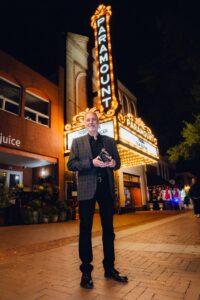
At the 2026 Virginia Film Festival, Todd Black received the fest’s inaugural Career Producer Award. Black attended the festival supporting The Social Reckoning alongside the film’s writer/director, Aaron Sorkin. Over Black’s 40-year career, he has produced projects such as Antwone Fisher, The Pursuit of Happyness, The Great Debaters, The Taking of the Pelham 1-2-3, The Equalizer trilogy, and the three (to date) August Wilson films.
The Social Reckoning represents Black’s first film with Sorkin, but he hopes it’s not the last. Despite the rocky reception from some critics and at the box office, Black considers it one of the best films he’s been a part of and is eager to defend its artistic merits.
In our conversation, we dig into the polarizing response to The Social Reckoning, while also covering Black’s long history with Denzel Washington, his fond memories of Chadwick Boseman, and the importance of diversity in front of and behind the camera.
The Contending: I like The Social Reckoning a lot, but it hasn’t gotten the response from critics or the audience turnout I’m sure you were hoping for.
Todd Black: I can never prove anything about (review) bots or what went down. What I do know is that when the thousand people who saw it the other night, the film got a standing ovation. So I don’t know what happened. And again, I can never prove it, but I do know people who saw it—not critics but the public, regular people—loved the movie and kept saying how important it is and that it’s going to stand the test of time, which I agree with. I think it will kill on streaming. But “reviewers” who I’ve never heard of, by the way–not prominent ones–anyone now can post on Rotten Tomatoes, and that’s the problem: they took shots at it. I think the public looks at that, and I think movies are affected by that. I said it the other night: I think we were the victims of an organization—people, a tech company—I won’t say who — and we got screwed.
The Contending: We’ve seen these kinds of campaigns before, whether it’s people who don’t like that there’s a Black Storm Trooper in Star Wars, or, more prominently this year, The Odyssey, with all the advanced grief over the casting, which was just silly.
Todd Black: We were the victim. I am incredibly proud of the film. I love the film. I think it’s one of the best films I’ve been involved with. I love that my name’s on it and I wouldn’t change a thing. I do think the beauty of cinema and films is that they have a long life. They’re going to be here long after we’re all gone. So I’m really proud of that, and I’m really proud that it’s going to have a second life on Netflix and on Amazon and on all the streamers, and that it’s not going anywhere. I’m holding onto that, and I’m so proud of Aaron for being brave enough to make that film. I think it’s what we’re living with today. I think that’s exactly where we are. Every time you look at the news, Facebook and Meta keep getting fined; another 25 billion last week. So we’re not crazy. It’s easy for people to say, “Well, David Fincher didn’t direct it.” We never said he was directing it, and we never called it the sequel. People tried calling it the companion piece. It’s not a companion piece. It is a standalone movie about what happened with Frances Haugen, Jeffrey Horwitz, and Meta. That’s what it is. Everyone tried to make it something that it wasn’t.
The Contending: Some criticism, to me, was lazy, especially in the reviews that weren’t kind to the film. Although there have been outliers.
Todd Black: The New York Times was wonderful. She [Manohla Dargis] nailed it—not just because it was a great review, but because she really got what the movie was and what we were going for. Do yourself a favor and read it. It’s a great review.
The Contending: The Social Network had a bit of a surprise element because it went back in time to reveal a person we didn’t really know. To a lot of us back then, Zuckerberg was a fairly benign, almost goofy sort of presence. He seemed unthreatening.
Todd Black: The Social Network was how it [Facebook] was created. Ours is how it evolved. You didn’t know who Mark Zuckerberg was, and you wanted to find out the history. Also, remember that was 16 years ago. Meta wasn’t around. Instagram wasn’t around. None of this stuff was around. There was a much different way of judging it, and it was a different movie. Trump wasn’t in office… It was a different time.
The Contending: I think what this film does is it goes into the relatively recent past to make sure we understand where we are now with this. Maybe that sense of discovery–”Oh, is Zuckerberg really like that?”–wasn’t evident. But the film really isn’t about Zuckerberg. It’s a crusading journalism film, which is one of the he best kinds of dramas there is.
Todd Black: That’s what’s crazy to both me and I’ll speak for Aaron in this regard, it’s a love letter to journalists. And it just makes no sense to me that journalists are killing their profession by going after movies like this. Critics are killing what are really good films. I want to say to those critics, “You’re putting yourself out of business.” They’re literally hurting themselves. I never understand it. I understand criticism of a film if it’s legitimate, and it was either lazy filmmaking, the script wasn’t developed enough, or whatever. But I don’t understand the mean kind of ripping apart of a well-made film for the sake of a critic getting clickbait. I don’t get it. And clickbait is really what’s taken over, and it’s a shame because it’s hurting all of us.
The Contending: The problem with so much criticism that I read, and I try to avoid this in my own writing, is that if something’s not the best thing ever or the worst thing ever, there’s this fear that people aren’t going to read nuanced review. When I was watching the film, I was just stunned that the reaction has been so harsh.
Todd Black: It doesn’t match, right?
The Contending: No. It doesn’t match. I think, at worst, people could say it’s a solid film. Are they attacking Aaron’s competence as a director? I knew what was going on the whole time. Incompetence as a director usually means I’m confused by what you’re trying to tell me.
Todd Black: We had everything covered. We got the pacing of it right. I mean, fine if you want to say you didn’t like the score, or fine if you want to say you didn’t like Mikey or Jeremy Allen White or Jeremy Strong’s performances. A lot of people went after Jeremy Strong, although it was very divided. Some people loved his performance, and some people did not. I get that. That’s taste, and I understand that. But the overall film, I don’t get. I don’t understand.
The Contending: This is Mikey Madison’s first film since Anora. She’s light years away in this film. She’s playing someone with nervous integrity who is deciding to be the best version of themselves, up against tough odds; that’s an inspirational story. But it’s not necessarily easy to play and be interesting. She’s just good. Did you expect her to be so different and so capable in this role?
Todd Black: I did. I actually remember this vividly. I met Mikey before I saw Anora, because we were both on this press tour. I had The Piano Lesson in the first festival, which was Telluride, and that’s when I first met Mikey. And I kept hearing about Anora. And then we went to Toronto, and we hung out, and I really liked her. She was quiet, lovely, and cool, as was the director (Sean Baker) and everybody involved. I met the young Russian kid (Mark Eydelshteyn) and everybody, and they were all really nice, and they couldn’t believe what was happening. They couldn’t believe that after every festival, their film was the talk of the festival. You could feel it gaining momentum. You could feel that this was going to be the film for the Academy. And then I saw the movie, and I was blown away by her performance.
She is not that person at all. Not even close. She’s a very quiet, lovely young woman, and smart. She has her three little doggies. She lives in the Valley in a little house. She’s close with her mom and dad, and she’s nothing like that character. So when Aaron, casting director Francine Maisler, and I started talking about actresses for the role, we kept circling back to her name. I said to Aaron, “Just go meet with her because she’s not who you think at all. Not even close.” He met her, and he called me on the drive home and said, “You’re 100% right. She’s wonderful. I think she can nail it.” And she did. She is so well-poised, did her homework, and was great on set. They were all great on the set. They revere Aaron. Everyone reveres Aaron, so it was just a totally well-run professional set. She was wonderful with Jeremy Allen White. She was a real pro. We’re really happy with her performance.
The Contending: I’ve been an admirer of Jeremy Allen White since Shameless.
Todd Black: Me too. When he was doing Shameless, his agent called and said, “Have you seen Shameless?” I said, “I have.” And she said, “Well, you need to meet him.” I think he was fifteen at the time. So he came in, and we had an hour-long meeting. And I was like, “This guy’s gonna be a star.”
The Contending: I remember the first time I saw him in Shameless, and I said, “This is like watching a young Sean Penn.”
Todd Black: Yeah. He was great on that show. I actually thought he was better on that show than The Bear.
The Contending: Really? Interesting.
Todd Black: Yeah, and I loved him on The Bear. Maybe because he was younger and more angsty, although he was pretty angsty on The Bear, (laughs) he’s a good actor. He’s a really good, solid actor.
The Contending: What he does in this film that I enjoyed is that he doesn’t appear to be acting at all.
Todd Black: That was Aaron’s whole thing. He’s a journalist, and he works for The Wall Street Journal, and he said, “Just be yourself. Don’t put any sauce on it. Just keep it straightforward. You need to find out the facts. You need to get her to tell you the information. Don’t let her off the hook.” That’s why in the scene when she says “I’m going to Puerto Rico,” and she leaves the hotel room, he goes “Fuck.” That’s his lifeblood, so he needed that to work. I thought he played that really well. I think he played the whole thing well. I think they were all good. Also, the secondary roles, they were all solid actors. Did you like Betty Gilpin?
The Contending: Yes. Talk about doing the most with not a lot—in terms of screen time.
Todd Black: Aaron didn’t have to direct her. She just came in and got it. It’s his writing. When you read the script, his dialogue and his characterizations are all on the page. You can come in and just kind of nail it. It’s all there.
The Contending: One criticism you sometimes see about Sorkin is that no one talks like this in real life. And maybe there’s some truth to that, but we don’t necessarily go to movies to hear people talk exactly like they do in real life. But what I think there’s a lot of room for, though, is for the actor to make the character not sound like the other characters. If you’re watching, all of them are doing Aaron’s lines, but they’re not doing them the same way, and I think that’s something people don’t appreciate enough about his work. He gives them these really intelligent words to say, but there’s space for them to be themselves.
Todd Black: This is going to be a big statement, but I think there’s a lot of jealousy, and I think there’s a lot of envy, and I think he is a standout person in Hollywood for his incredible dialogue and witty repartee, and I think there’s no one like him. You don’t have the career he has by having people not like you. The public loved The West Wing. They loved A Few Good Men, which is now on Broadway opening October 29th. On and on we can talk about his TV credits, his movie credits. You don’t get to be Aaron Sorkin without the public loving your talent. So I do think there’s some snarkiness and some envy and some jealousy. And reviewers—I don’t think they like him. I think it’s very personal to them.
The Contending: I did sense a desire to take him down.
Todd Black: Yeah, I did too. We all did. All of us were shaking our heads, still to this day shaking our heads, on why. Like, what’s the point? Why would you want to get rid of a really talented filmmaker? It makes no sense.
The Contending: I recently watched The Big Sleep for the first time in a long time, and the first ten minutes are just full of extraordinary dialogue. Just boom, boom, boom. And that’s how Aaron writes. If he were dropped into an era without rating systems, when you had to be nuanced and say things without saying them explicitly, he would’ve been spectacular in that space, too. There’s something that is both very particular and advanced in his writing, but there’s a level of old school that I think is unusual.
Todd Black: I think that’s really astute. I think you’re right. As I said on the stage the other night, and I’ll say it till I die, if I could work with Aaron the rest of my life as a producer, I’d feel like I won the lottery. I love his brain. He is great to work with. He is so great to be around. He’s also an incredibly gracious person. He doesn’t deserve what he’s been getting. He’s a really lovely person. He’s done a lot of good for a lot of people, so that’s also what’s frustrating for me.
The Contending: When you are a part of a film, and you put so much of yourself into it, and you root for it, and you believe it’s good, and then it comes out, and it gets this lukewarm or worse reaction, which The Social Reckoning has certainly faced, I feel like you are in a mode of wanting to defend the quality of the film. Is this one that you can go “Okay, that’s how people felt about it. We’re going to wait and let the world see it over time, and I’m going to move on to the next thing,” or does it still linger with you?
Todd Black: No, I have to move on. I’ve learned a long time ago that you have to move on to survive. Doing this for forty-something years and having eighty-something movies and TV shows, I’ve had to do the second part. I can’t get hung up on what doesn’t work. Because then I would be in a corner crying, and I would never come out of that corner. So I know that streaming and videos and everything that’s been around before streaming–DVD life–I’m so happy about that, because good movies will always have a life, and people will always see them. I can’t tell you how many times I hear from people about some of my best movies that didn’t perform well at the box office. A number of them did, thank God. But a number of them didn’t, for whatever reason. There could be a million reasons why. I hear about Antwone Fisher all the time. Probably every day I get some kind of a letter either about Antwone Fisher or about some other movies that I made long before that even, that three people saw, that people love: a little film called Wrestling Ernest Hemingway, another film called The Family Thing with Robert Duvall and James Earl Jones, movies that nobody saw.
But now people see them, and I’m hearing about them now, and it makes me really happy. I’m proud of those films. But to answer your question, I cannot get hung up when they don’t work, because then I can’t move on to the next movie and go on with my career. My career is not one movie or one TV show. I have to be able to shake it off, lick my wounds, and keep going. What am I going to do? I think that is the same for any producer, any director, any writer…that’s easy for me to say because I’m not Aaron. This was his creation in his head, both as a writer and a director, so he’ll get over it, but I’m sure he’s hurting more than I am. But he also knows he has to move on. You have to get back on the horse and keep going. You cannot let one thing take you down. I always say, “No one movie or TV show completely makes your career, and no one movie or TV show breaks your career.” So as disappointed as I am with the box office, I love the movie, and I love that it’s got a long afterlife.
The Contending: Antwone Fisher is a good segue to some of your work with Denzel Washington, particularly the August Wilson films, which I absolutely adore. I was a little bummed that The Piano Lesson didn’t get a bit better reception.
Todd Black: But again, it’s here, and people are seeing it now. But I love them [the August Wilson films], and I’m doing the fourth one now, Joe Turner. It’s being written. Debbie Allen’s directing it, and Ruben Santiago-Hudson’s writing it right now. I’m getting a draft soon. We’re going to start casting in a couple of months.
The Contending: I assume Denzel’s involved.
Todd Black: Denzel’s my partner. Or I’m his partner (laughs). The August Wilson Estate came to Denzel after he did Fences on Broadway in 2010 and asked him to steward and shepherd all of them as films; then he came to me and asked me to be his partner on all of them, to produce them. So I’ve been really lucky and blessed to get to make each one of those as a movie, and I’m thrilled to do that. Joe Turner’s the next one.
The Contending: Do you think, like I do, that Denzel’s directing in Fences was not nearly as well appreciated? I think people think of it as a performance movie.
Todd Black: I don’t get that either. When we got the nominations, we were thrilled: Best Picture, and Denzel, and Viola (Viola won). We got four or five nominations [interviewer’s note: Black also received an Oscar nomination for producing the film], so I was thrilled about that. But that he didn’t get a directing nomination, I don’t get that at all. I think he did such a good job, and it was hard to direct and make it cinematic.
The Contending: I think the scene where Denzel stands at the window and talks to Death, saying, “Come on, any time you’re ready. I’m gonna be ready!” is very cinematic. He seems to have a great understanding of his persona and his ability to project.
Todd Black: I thought he did a great job directing The Great Debaters. Even in our first movie, Antwone Fisher, it’s such a beautiful, simple film that he didn’t get in the way of it. And yet, for whatever reason, on Fences, the Academy just … I don’t know what it is. I don’t know if it’s because Aaron and Denzel are so popular. Oftentimes, populists—filmmakers, actors, writers, directors, producers—if they’re too populist, even Jerry Bruckheimer, he makes very populist films. He doesn’t get nominated. So I don’t know. Maybe that’s a misperception.
The Contending: Do you think it’s a “you’ve been rewarded enough” kind of thing?
Todd Black: It’s a different Academy now, but yeah, I think so. I think “You’ve had your time. Now let’s make room for somebody else.” I actually thought it was a travesty that he didn’t get nominated. But I am happy—huge result on that film, financially and critically.
The Contending: I can’t have a conversation with you without talking about Chadwick Boseman.
Todd Black: Chadwick was everything. I got to know him really well. The thing that I’m most sad about is he came to my office when we were done with the film, and I had given him a project that was near and dear to me that I had worked on for a couple of years. It was about a teenage boy losing his virginity to this teenage girl, and she ended up getting pregnant from the first time they slept together. And her parents and his parents had convinced them that they had to give the child up. You’re fifteen years old. The day of the birth, she lost her life when the baby was born, and the adoptive parents were waiting in the other room, and he said, “I’m not giving the kid up.” The movie is about him being a kid raising a kid, and how he figures out how to do that, stay in school, and graduate. It’s a great story. It kind of feels like my other film, The Pursuit of Happyness, and the struggle of that.
So I gave it to Chadwick when he came in. He read it, he came back to my office, and he loved it. I mean, he loved it. He’s like, “I want to direct this,” because he had directed in college. I was super excited to get to work with him again. We were going to get Viola to play one of the roles, and we were so excited. Then I called him to set up another meeting, and I had to get him to loop for Ma Rainey, but I couldn’t get him to loop. I just could not get him to commit to anything. We were getting ready to go to a party one night, and I got a call that he died. He never told anybody. He did keep getting thinner, so I thought something was wrong. I did ask him when he came to my office the first time after the movie. I was like, “Dude, you look so thin.” And he said, “It was for the role.” He just didn’t want anyone to know. It was terrible. It was so sad, and he was such a wonderful person. You’ll never hear a bad word about him.
The Contending: I saw Ma Rainey shortly after he died, and I had thought him to be such an inspirational actor and so gifted, and I think capable of so much more than we even got to see, as much as we did get to see. The scene when he is railing at God—the context of that, in light of his death…
Todd Black: You watch it differently.
The Contending: I barely made it through the scene.
Todd Black: Yeah, I know. I can’t watch the movie again.
The Contending: I believe that.
Todd Black: Viola talked about this a lot, and Denzel did a little bit, and George (C. Wolfe) did a little bit. When you watch it, you go, “Oh, that’s where that performance came from.” That performance was so pointed and so focused. You got it. You understood why. None of us knew.
The Contending: I hope this comes off right, but you are a white producer who has been involved with a lot of Black excellence.
Todd Black: But my last name is Black (laughing). A lot of people come to my office, younger black people, to meet me for acting or writing or whatever, and t they’re shocked that I’m white because I make so many black movies. Isn’t that funny? That was not my intention.
The Contending: Did you just kind of fall into it?
Todd Black: Yeah. I think Denzel, because I met him so early in my career, had a big part in that. Because those movies were good and they worked, I was able to kind of get into the cream of the crop of Black films. I often find that Black history is way more interesting than white history at times. It’s more complicated in many ways–not all ways, but certainly in many ways, the struggles and the injustice. Nazi Germany, the Holocaust, and slavery, Jews and Blacks have a lot in common: repression and so many things. But I’ve been lucky. I’ve been really lucky to get to play in the Black world.
The Contending: I get the sense on these productions that you’re protecting those films not just by who you put in front of the camera, but by who you put behind it.
Todd Black: That’s really astute, and I’m really proud of that. I try to do that with all my films. I am really cognizant of making sure all of my crew are mixed—color, race, straight, gay, trans; I really want representation. That actually started with Denzel. I remember really early on in the ’90s, he and I walked into a production office, and it was all white faces, and we were like, “You can’t have all white faces.” We were in the South. But you’ve got to have black faces, because we have to give everybody the opportunity. It can’t just be white people.
The Contending: It helps the movies, because additional perspectives are additive.
Todd Black: 100%. And if you’re not getting something right, and somebody sees that who is represented there, they’ll whisper in your ear oftentimes. That’s happened to me before. I was making a film in Louisiana, and somebody on the crew came up to me and said, “You know that’s not really what happened. What happened is—” they would say X, or they would say Y, whatever it was. I went up to the director, and we changed it because of a crew member whispering in my ear. Because you do want to get it right, I think it’s key for every producer to make sure their crew is diverse. You don’t want to hire people just because they’re diverse if they’re not good at their job, because that’s not good for anybody. They do have to be good at their job. But you also have to use the town that you’re in. You have to try to help those people. We’re moving into their town. We’re taking over their town. A movie crew is a big crew. I do that on all my movies and TV shows.