Last year, Óliver Laxe presented audiences with a truly bizarre, brilliant, visceral, cinematic and aural experience with the Oscar-nominated Sirât. It was divisive but its cheerleaders were quite vociferous. And I was one of them!
This year Tony Gilroy has crafted a highly ambitious film that can be described in the same manner. Behemoth! seeks to change the way music can be used to tell a story onscreen.
Pedro Pascal is the star of this singular, immersive filmic experience—and it should be seen on the big screen—in Dolby Atmos. And this is, by far, the best, most compelling performance of Pascal’s career to date. He’s also never been sexier.
Pascal plays Alex Sarian, a rather virtuoso cellist who is attempting to figure out his mess of a life where he’s managed to alienate most of the people in his orbit. Alex is a former child prodigy whose deceased father (Hank Azaria, in a tiny role) was a successful TV and film composer and whose walking disaster brother (Will Arnett) hosts a podcast about their dad, when he’s not selling family heirlooms. Mom (JoBeth Williams), a former harpist, is suffering from dementia.
The women that storm in and out of Alex’s life include married violinist Nadia (Eva Victor), young cellist Bronte (Kaya Ralls), whom Alex is coaching, and the tempestuous Carol (Olivia Wilde), a rich art patron who becomes obsessed with our protagonist. In addition, Alex becomes fixated on Nadia’s daughter, Viviana (an excellent Alexa Swinton), a young music sensation on the rise.
Mind you all of these relationships and stories collide in a non-linear fashion and are led and buoyed by the film’s dynamic use of music.
Gilroy tasked nine respected composters, billed as The Behemoth! Collective, with the monumental scores used throughout the work. They include Michael Abels, Emily Bear, Lukas Frank, Michael Giacchino, James Newton Howard, Henry Jackman, Nami Melumad, Brandan Roberts and Alan Silvestri. And they have created astounding work.
Certain critics have alleged that the plot is thin. I disagree. Yes on the surface it can be seen as a fairly simple yet heartbreaking tale, but each image, each sound, every gesture, every note, carries great meaning. And the story is told in a bold, operatic manner with the sweeping narrative bouncing in time and space from Boston to Dallas to Chicago to Los Angeles—usually set in these grand recording studios or wondrous philharmonic theaters.
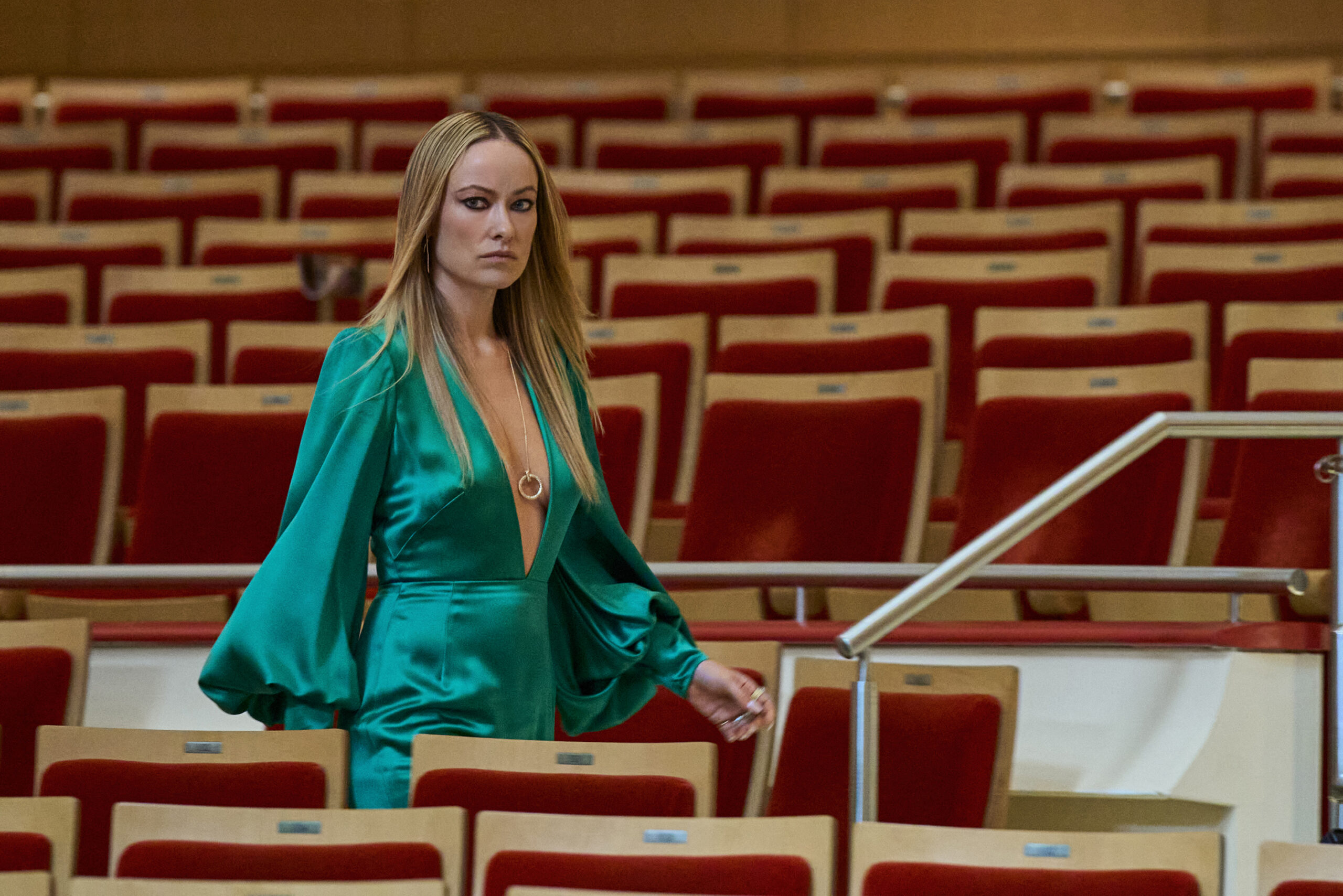
Pascal’s grounded and introspective turn as the tortured and conflicted artist, made even more potent by Gilroy’s frequent use of close-ups, is contrasted with several mega-diva performances, beginning with Wilde who has three dazzling and insanely dramatic scenes (and she steals all three) where she storms in and out with great tenacity and conviction. One sequence has her strutting up to Alex, while he is chatting with Bronte, and misconstruing their relationship, bellowing to the young musician, “Scamper back to your playpen.”
I could have watched her sashay and prance about for hours as she channeled Glenn Close in Fatal Attraction. What a year Wilde is having.
Thomas Kretschmann hams it up as a volatile composer who is replaced by the 15-year-old Viviana.
It’s been 14 years since Gilroy has made a feature; the last one was The Bourne Legacy. He’s been busy with the Disney+ series Andor. His two other directional credits are Michael Clayton (2007) and Duplicity (2009). But he’s been penning terrific (Dolores Claiborne) and not-so-terrific (Armageddon) screenplays for the last 35 years. With Behemoth! he’s crafted his best feature to date.
The film is gorgeously shot by Damián García and deftly edited by John Gilroy. But it’s the collective score, packing such a powerful, sensory and, ultimately, transcendent punch, that allows Behemoth! to achieve the euphoric and sublime.
Behemoth! World premiered at the New York Film Festival and will be released in U.S. theaters, via Searchlight Pictures, on December 4, 2026.