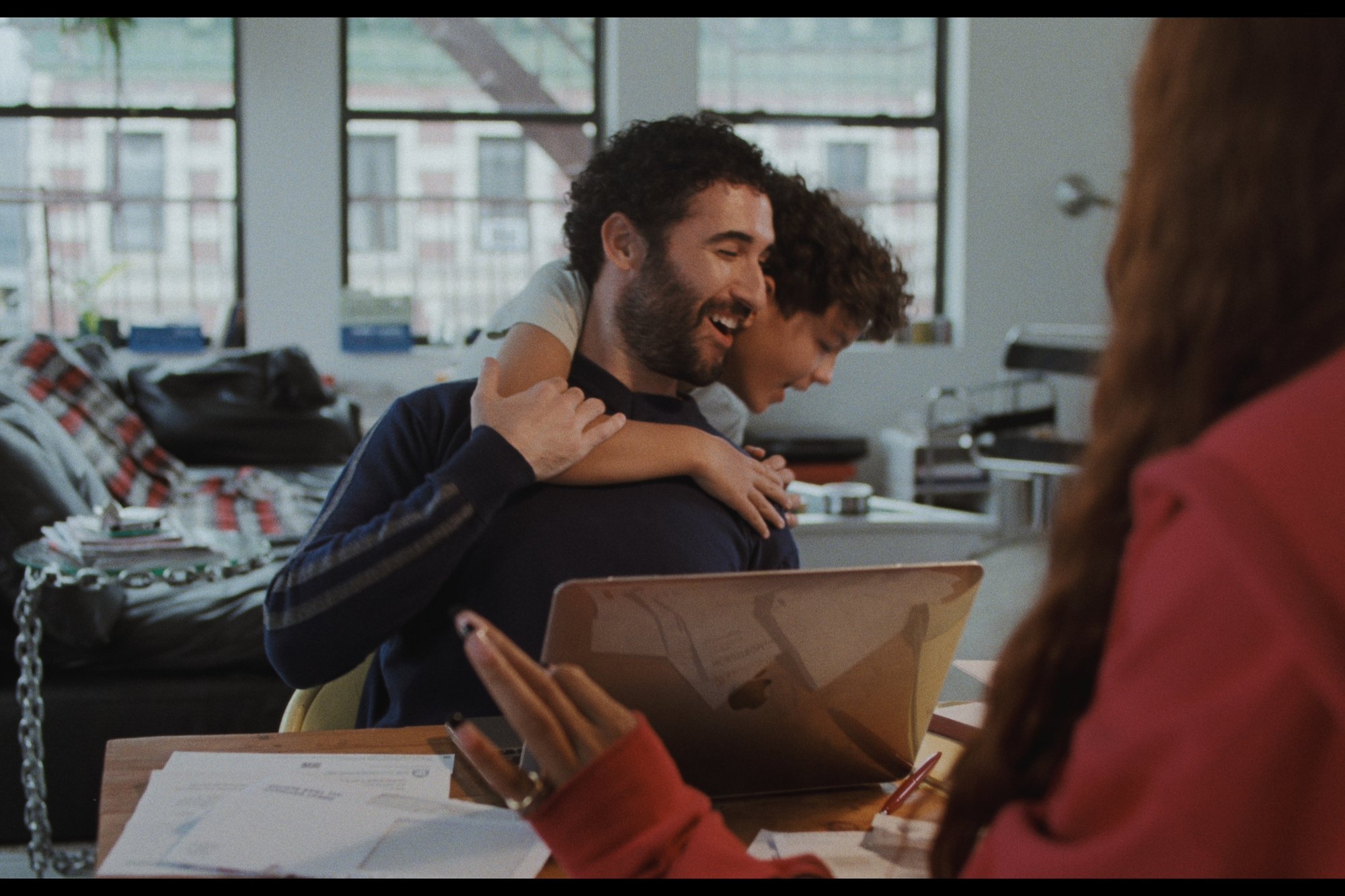
I keep thinking about everyone’s perspective of partying when I think about Jordan Firstman’s electric, heartwarming directorial debut, Club Kid. Do you judge those who revel in the night or do you secretly wish you could join in and take part? You cannot deny that Firstman’s film is unexpected, clever, and savvy, but it does make you want to stay and see what other kinds of troubles you can discover. We keep coming back to Club Kid, because we find something familiar with its story, its characters, and the love that we wish we had when we were growing up.
The wayward, reckless adult turned unexpected parent is a genre unto itself, and these films carry a certain level of affection when it comes to the audiences who love them. I originally balked at people comparing Firstman’s directorial debut feature to the Adam Sandler comedy Big Daddy, but, in a way, Club Kid could take that as the highest compliment (and certainly its title) We are all trying to do our best, aren’t we? The director admits to loving films where an adult is forced to grow up.
“I love Paper Moon, and those kinds of movies were something that I always related to,” Firstman admits. “I loved Uptown Girls and Charlie Chaplin’s The Kid. There are a lot of genres of films that I like, but I knew I wanted this one to be warm. I was happy to follow in the traditions of these kinds of stories, and I felt there was always a necessary space for a queer story in this canon. Once I kind of cracked the party-boy-who-can’t-grow-up into this genre, I feel like everything just fit, and that’s even more important right now because there’s so much crap going on. Gay parents have been around for generations and generations.”
Firstman spends a lot of time steeping us into the culture of club life, and not just because he was setting a film there. He loves the community he finds in these spaces, and that love has been transferred into the look and feel of Club Kid. The thump-thump rings in your ears like it’s merging with your own pulse.
“It being immersive was the number one goal while having it feel authentic and honest to the spaces that I’ve been in,” he says. “It was this weird, Charlie Kaufman-esque exercise to recreate actual moments that I have been apart of, and it’s not just the setting–it’s the people and the feeling. Adam [Newport-Berra] does such amazing work, but being in those live spaces does so much work for you because it’s more than putting extras in a cool costume and putting them into the space. I think having the people there and having that brings just the environment and the energy and the looseness to which party people come to a space for. There’s a rowdiness, there’s an openness. I think being afforded to have the queer nightlife community in New York really rally behind this film and show up for us, that’s the secret sauce. Absolutely.”
I joked with Firstman about how I would feel too old to hang with his character, Peter, but he quickly made me reconsider with some thoughtful words.

“I think Club Kid has multiple points of view, honestly,” Firstman says. “You can go up on a high balcony and look over like a voyeur. If you go to Berghain [-Panorama Bar], there’s 75 year-olds partying and dancing, and a lot of them don’t do any drugs. There are ways to experience the nightlife if you are craving it, and there’s ways to do it at any age. I do think the club could feel like an exclusive place, but, ultimately, it should feel very inclusive. That’s why we show up as queer people. I see the club as a microcosm for life and every part of life is represented.”
When I attended this year’s Telluride Film Festival, I kept running into and seeing Saturn Risin9 (who plays Saffron) all over town. Megan and I finally got the nerve to speak to her at an A24 party, and just being in her presence shifted the room. I felt silly not even realizing that Miss Benny (obsessed) was in this film even though her gorgeous face has been everywhere in promotional photos. If you’re going to make a film about nightlife, especially that of New York City, you have to include the dolls–it wasn’t a question for Firstman.
“When I started just thinking about the modern queer scene, it’s run by the dolls,” he says. “They are at the top of the food chain in New York right now, and gay guys worship at their feet. I have so many trans girlfriends that are the most charismatic, coolest people, and I wanted them to be in a film where they’re not without faults. I like that Saffron has a little selfish turn at the end, and even though you don’t know much about Alaska’s backstory, I made sure I went through who these people were. I didn’t want them to feel like a monolith either, and, at the same time, they feel like they’re in their own Powerpuff Girls/Mean Girls/Josie and the Pussycats vibe. There are so many iconic movies with three girls where they all feel distinctly different.”
Firstman doesn’t just round out the world of the club with deep details in the setting but also the people. There is something almost comforting about the notion of a nosy neighbor: we had them on television growing up (I see you, Gladys from Bewitched!) and we get a glimpse at Colleen Camp’s Evelyn as she pokes her head out of her apartment door whenever she hears Peter coming home up the stairs. Firstman knows that these characters exist out in the world.
“This film has an interesting thing where I wanted to have a classical feeling to it,” Firstman says. “I’m not afraid of tropes, if I do them honestly, because if it’s grounded, I can put my own spin on them. When you’re thinking about New York, you do have that neighbor who is very much in your business. They’re real. You do have the guy crashing on your couch. Hari Nef wrote this beautiful Letterboxd review where she said that most Peters have a Nikki, but they don’t have an Arlo. It’s a very real thing where you’re the 30-something and you meet a twink and then either something happens or doesn’t but you give him wha tyou have and you give him your home, your food, your drugs…and that’s our version of the family and beyond the chosen family. Colleen is just that woman.”

The final moment with Peter has stuck with me ever since I saw the film for the first time, and it’s the image that I was most affected by every time I have seen it since. We leave Peter in a place where we know he has changed and he is in another moment of rebirth and growing up–he’s still learning. We see him in the early morning light, grabbing food, as the sun begins to peek out into the crevices of New York’s streets. The camera stills and we watch Peter on his next path–always walking forward.
“It is just walking down the path of lights–it’s a simple thing–but Peter is not where he was when we met him and he doesn’t know where he’s going,” he says. “There are certain comforts that are going to help him push through this healing journey. He’s looking back and what his life was, and he knows it’s not that anymore and he’s okay with that. The only thing he can do is eat the bagel he just got and look ahead. It sounds like a good plan to me.”
Club Kid is in limited release now. It goes wide this Thanksgiving.