Nestled in the scenic, leafy hills of eastern Virginia, the Middleburg Film Festival always carries an excitement for those who gather. This is my third year attending the festival, and I am always delighted how individuals from the industry–including actors, publicists, and writers–can convene and have exciting conversations with each other and movielovers who come into town. The Middleburg Film Festival is, quite simply, a film lover’s paradise.
Since I had been fortunate enough to see so many films at this year’s Telluride Film Festival and Toronto International Film Festival, I felt like I could take the opportunity to attend more panels and international films. Last year, I was heartbroken that I couldn’t watch Paul Tazewell’s talk on his costume design for the first Wicked film, especially since he went on to win the Oscar for Best Costume Design earlier this year.
One our first full day, Mark and I got to the Salamander Middleburg early since we assumed that the Variety Creative Collaborators presentation, hosted by Jazz Tangcay, would be a hot ticket. Judging by the amount of pink and green sweatshirts and Elphaba glasses, we were right! Did I sport my Shiz alumnus sweatshirt with no shame? Absolutely.
In attendance were director Jon M. Chu, cinematographer Alice Brooks, and editor Myron Kerstein, and their talk really ended up being about how friendship is a strong component in the filmmaking of the Universal powerhouse. I didn’t realize that Chu and Brooks have know each other since college, and the presentation showed a clip of Chu interviewing Brooks before they started on their first collaboration, which also happened to be a musical film. If you were a fan of Wicked in the audience, you felt how their friendship was a baseline for working together on this humongous undertaking.
Brooks spoke about how the look and lighting of the first film differs greatly from its follow-up
“Some of the emotions we discussed for the first film were yearning, dreaming and the choice of belonging,” she says. “In the second film, we thought about surrender, sacrifice and consequence. As our conversations deepened, it becamse very clear that movie one would be effervescent and movie two would have weight and a density to it. In Wicked, the first hour of the first movie is almost all day exterior, and it lives, I’d say, around 80% in daylight. The last 40 minutes of the first movie is one long sunset where Elphaba finds her power and descends into darkness. That sets the tone for the second film where it’s almost all night or in the shadows of Oz. There’s a huge visual journey from the very beginning of the first movie to the end of For Good.”
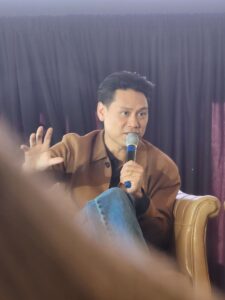 One of the most anticipated numbers in act two of the stage musical of Wicked is when Elphaba accepts her position and performs “No Good Deed.” We’ve heard snippets of Cynthia Erivo’s powerful voice belting out the song in every version of every trailer, but Chu assures us that we aren’t ready.
“Buckle your seatbelts,” he says, to an excited crowd. “Cynthia rips the roof off, and I’ve never seen a singular person on film tear it down the way she does. This is the moment where she declares that if you want her to be the Wicked Witch, she will surrender to it. She will be as wicked as you want her to be. This is where the musical form really comes, because she had to be singing live, in a harness, while flying and landing. She’s giving so much, and Alice is right there. We’re throwing dirt and wind at her, and Cynthia is powering through.”
“We had this intense light hitting her face, and it’s so emotional to see her perform like that,” Brooks says. “The entire grip team was in tears watching her.”
“She truly elevates it to another place,” Chu says.
“I remember cutting that song for the first time and thinking, ‘Well, this is classic cinema,'” Kerstein, who was nominated for Best Film Editing last year for the first film, adds. “I couldn’t believe that I got to do these films. I got the most beautiful images every day coming to me.”
Wicked: For Good his theaters on November 20.
_______________________________________________________________________________
I have never attended a concert at Middleburg. Last year, there was a concert honoring Academy Award winning composer Mychael Danna on the final day of the festival, but I had already left. When I met Mark and Clarence on my first time attending, they were just leaving the concert featuring music by acclaimed composer Michael Giacchino.
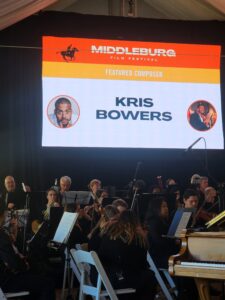 This year, Middleburg welcomed back Academy Award nominee Kris Bowers, and I couldn’t have been more floored. I spoke with Bowers and filmmaker Ben Proudfoot about their collaboration on directing Live Action Short Film winner, The Last Repair Shop, but I have never had a chance to talk to him specifically about his writing (fingers crossed that it happens this season or next). Bowers received his first Oscar nomination last year for Best Original Score for his work on the animated film, The Wild Robot. I will admit that I was nervous of how I would react if I hear my favorite track from that film, because it happens to be my favorite piece of music that Bowers has given us so far.
We ventured over to see the concert after our screening of The Secret Agent, and I am glad that we got there early. There was a lot of excitment in the air for this presentation, and Middleburg Film Festival founder, Sheila Johnson, expressed her gratitude and joy for Bowers’ return to this event. Between sections of music, Bowers was interviewed by Jazz Tangcay–this woman was everywhere! She engages with talent in such a genuine way it’s no wonder that Middleburg features her in so many talkbacks and panels.
Bowers told stories about how his parents were determined to get him involved in music, but my favorite story came when he revealed that when him and his wife had a fight, he went to play the piano to cool down and clear his head. His wife told him later that she felt like she understood his mood and emotions by hearing him play. It’s no wonder that Johnson expressed that she feels that music is tied to the emotionality of the stories we watch on screen. Bowers’ next project, The Eyes of Ghana, is currently seeking distribution. The documentary reunites him with Proudfoot, and you can read my review from TIFF here.
I didn’t have my phone out to Shazam every single song, because I thought everyone would kill me, but here’s the track from The Wild Robot that reduces me to a puddle every time I hear it.