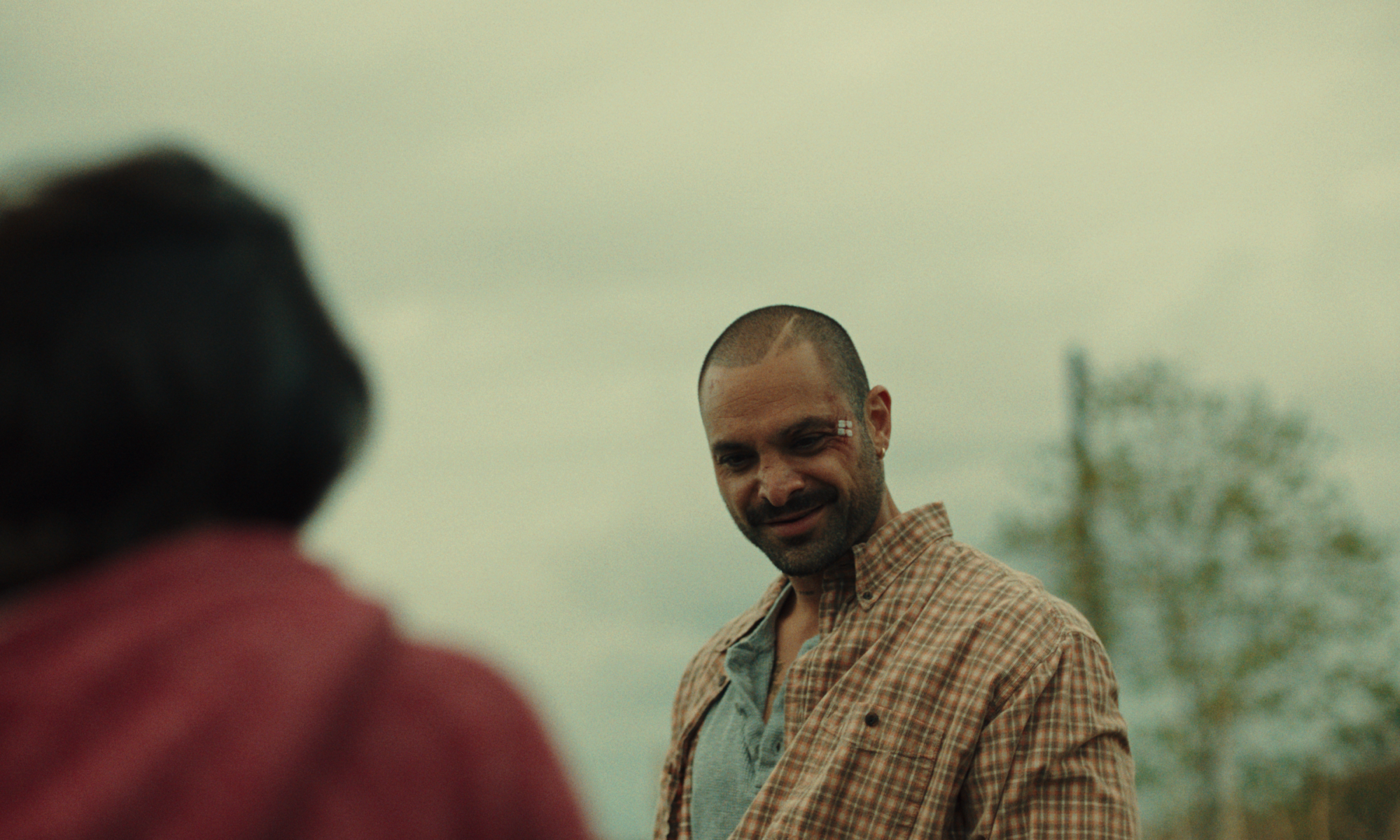
Julia Weisberg Cortés’ short film contender, Boyfighter, carries a dreamy quality, like a memory marred by tragedy. This is the kind of film where you can feel the filmmaker’s feelings being transmitted through the camera’s lens and into our chests. This is a story of family. Of how children idolize and admire their parents. Of how violence can tear a family apart. Weisberg Cortés’ vision is singular and personal.
When I hopped on a chat with Weisberg Cortés, we naturally started talking about her lead actor, Michael Mando. The filmmaker captures his face so elegantly even if his fingers are bruised or have dried blood on them. His character, Diego, spends a lot of time alone in his truck while he smokes to relax and think about the past and his family.
“I worked with an amazing casting director in New York, and we created our lists–he was at the top my mine,” Weisberg says. “This is somebody that doesn’t need to do a short film since he’s working on major films and television, and he has a beloved audience already. I wanted him because I read and watched interviews where he talked about his audition for Far Cry, which is a very famous video game where he plays the villain. When he went into the audition, they wanted him to play it in a traditional, antagonistic way, but when he got in the room, he did the opposite. He played it very charming and charismatic, and the writers of the game rewrote it because of that audition. Something that excited me about him was that he’s a person who shows up with his own ideas and his own interpretation with a lot of passion.
I really wanted this character to be both father and mother to his son. I didn’t want him to be afraid to show that vulnerabiluty, especially physically. There are a lot of moments with his son where it was important to break away from particular masculine tropes and notbe afraid to, for instance, cradle his son or take him into an embrace.”
I was particularly drawn to the scenes of Diego in the front of truck for how that space becomes his whole world when he is in there alone. He finds comfort in that tight space, but Weisberg Cortés reveals that that wasn’t the initial location for those scenes.
“We actually lost our main location, and because of that we had to shoot it in the car,” she admits. “They were supposed to take place in his home, in all the different rooms in his house. I wanted it to be more about him trapped and facing this new reality. We couldn’t get a new house after we lost that one, and we weren’t allowed to drive since we had to do everything by the book and didn’t have the proper licenses for it. That actually lent itself to the character’s journey, because, in that moment, I found that this character is trapped by his grief and his regrets and the feelings he’s made. He’s frozen by all of it. We’ve all had moments in our lives where we are like a deer in headlights, and I think that’s what he’s experiencing.”
As Diego ponders the choices he’s made in his life, we see him interating with his son, Paco. In the film’s opening moments, we hear him telling Paco about a warrior whose bones were made of stone. It’s a yarn that we hear later on under very different circumstances. Since Weisberg Cortés’ film has moments up to interpretation, I wondered if she wanted to tackle masculinity in the home. Do the actions of our fathers and uncles automatically become burdens for our sons and nephews? There is a lot of introspection for the characters and the audience alike, and you cannot help feel affected by the mixture of Boyfighter‘s sound design and cinematography.
 “I never intended it to be a film that explores that theme necessarily, but since we are dealing with the spheres of fathers and sons, masculinity is going to be part of the conversation,” Weisberg Cortés says. “I lost my brother in 2023 from the same thing that killed our grandfather, our uncle, our great grandfather and some of our cousins in the same way. I wanted to make a film about cycles, and how we are burdened by the way that we feel loss. These are scars that we all inherited, and I wanted to honor my brother’s lefacy and my brother’s tragedy, as well as the men in my family. I wanted to be unafraid to look at the most painful parts of it, but be able to shape it in a very vulnerable, beautiful way.
I wanted to define that nature might mean to this man and what these sounds might mean. When you go in and see his son’s feet, it’s a horrific, tragic image, but it’s accompanied by these comforting, sweeping sounds of nature. These moments of tragedy, that we all feel, can be accompanied by something positive. It reminds us of our memory of each other and to love. Ultimately, it was more about exploring generational trauma through the male lens and point of view in memory of my brother.”
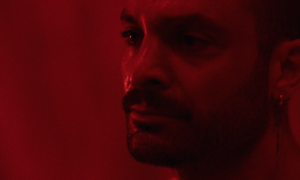
Weisberg Cortés’ film carries a lot of feeling in its color palette. The many shades of blue inform so much. Baby’s blue, little boy blue. In a fight scene, the camera is drenched in bold red like blood, fear, or anger. She wants you to be swept away by the visual context as much as the story.
“We didn’t want to be muted,” she says. “We played a little bit around with color temperatures for the two different timelines, so in the present day, when he’s in his car and he goes into the morgue, it’s shaped by more blues. It’s definitely cooler. The past, though, it’s warmer since he’s with his son. We wanted it to feel a bit more vibrant while not being on the nose. We weren’t concerned with differentiating the timelines too much because we were talking about cycles. In a way, whole this man is experiencing his most deepest, profound grief, he’s also experiencing true happineness in his life. Time can move together, and the timelines can move at the same time.”