Johnny Han, Nathaniel Larouche, and Adrien Saint Girons served as some of the main VFX players on HBO’s The Penguin, which details Oswald “Oz” Cobb’s (Colin Farrell) rise to power in Gotham City. Here, in an interview with The Contending, they dig into some of those big moments of the show such as the massive flood and the many explosions. Yet, there are increasingly intimate and unobvious visual effects that really helped make the show what it is. They were able to help create the grimy watery look of Gotham City, and from talking to them, I now have Easter eggs to look out for when I rewatch this show.
The Contending: Johnny, you have done a lot of work in the comic book world: Smallville, Spider-Man 3, Superman 3, just to name a few. So what was it like being in the world of Batman?
Johnny Han: It was quite a dream. To be in the world Matt Reeves has created was really special because, like you mentioned, I did Smallville back in 2003 when I was 22 and I was the right demographic for that show. So what I thought looked cool matched the look of that show. Now it was great to reenter the DC Universe because Matt Reeves is famous for being subtle and having Incredibly grounded and realistic tastes. I feel that comes with maturity over time and I feel like now, as an adult, it is similarly that I have the right taste and instincts for a show that is as mature as this is. It’s like going to fine wine after having lemonade with Smallville. It was quite a treat for me.
The Contending: With the show being so grounded, does that change the way you guys approach visual effects?
Adrien Saint Girons: The great thing about this is that we were able to add a lot more detail and complexity in building these environments. Sometimes you are faced with an art direction that is more bland, but that didn’t happen here because it was so rich in its base we could really lean into it. The detail that was being asked of us I think came through. For example, the walls were to look like the water had stagnated on them for sometime leaving a salty deposit on it. Just small things that maybe people wouldn’t notice at first, but it’s there to add to the complexity and backstory of the environment.
Nathaniel Larouche: To add to that, the city of Gotham itself is supposed to be hundreds and hundreds of years old and is almost a collage. The way that we approached VFX work in post became this hybrid of making CG renders and taking photographic imagery and putting all of them together in one single shot. There was never just one approach that gave it that grounded realistic look. We approached it with a let’s try this, let’s try that, approach, and whatever the best looking sections were of those different approaches we ended up just keeping that and tying them all together. I think the textured nature lends itself really well to that approach.
Johnny Han: For example, a lot of the subway trains that you see throughout the show that are moving were actually subways near the locations that we were shooting. We would say, Hey, I can hear a train, let’s go over there. Then we would take one of our cameras just to get trains moving. So now, all of a sudden, we have something we can use that’s quite real and textural and from New York, yet we can put it into a custom 3D City that Nathan made.
The Contending: At the end of episode three, “Bliss,” we get Vic impulsively driving Oz’s car into a goon, crushing him against the van and saving Oz’s life. I love how quickly that movement was shot in the show and it’s a great emotional moment for both Vic and Oz. What went into capturing that shot?
Nathaniel Larouche: That impact shot was quite complex; it ended up being four different plates being stitched together. We had our base plate, which was just the gunman being pulled back by a rig into the back of the car and getting all the natural shattering of the glass falling over him. Then a plate of the car impacts, and then those two put together, and then some instances of Sophia and Oz in the foreground and her diving away and Oz just reacting to it. Those are also different plates as well. So it was all very orchestrated for this quick moment, but every single frame was meticulously directed. I think at one point we even changed her performance?
Johnny Han: Yeah, we needed a bigger dive for Sophia so we shot a performance on green screen. That is another thing–all those plates he just mentioned, due to schedule constraints we shot them all on different days. Normally you shoot that all in sequence, but because of having to rig the stunt or the availability of stunt doubles versus the actors on location we had to do it this way. That’s the kind of stuff no one will ever know about and that should not matter to us. Because we as artists know that whatever we get it’s not about how hard it was, it’s about making it invisible to the viewer.
The Contending: One of the biggest surprises coming into this show was that we see the flood that happens in The Batman. What made you all decide that you needed such an epic moment in this show, and what went into creating it?
Johnny Han: The script was always going to have this call back to the events from the movie because it is such an important part of Victor’s backstory. So visually we took a look at the film and we knew that it had to be different. In fact, early trailers for the show were showing clips from the movie of the bombs going off, not that we were going to reuse clips in the show but we were just going to do similar shots. We had done some early previews of bombs going off somewhere downtown, then Matt, Lauren (LeFranc), and I reviewed it and we realized it wasn’t working because we realized it needed it all to be from Victor’s point of view.
Because the movie already did the job of showing objectively what was happening to the city. In the film we see the bombs going off near the arena, and in Midtown, which is a very business area. But we really wanted to see what it was like for Victor, this young teenager who never asked for this. So we made it all from his point of view on a rooftop from angles that only he could see so we didn’t do any kind of flying helicopter or any cutting down to the street level. It all had to stay with him because it all led back to just supporting the character. This flood was not to show us about the events happening in the world, because we know what happened already from seeing the movie. It was about how this event affected our character. We really honed in on Victor’s trauma and tragedy.
The Contending: One of the other big visual moments of the show that everyone was talking about was the explosion in Oz’s lab. Which leads to the collapsing of the street above him. What went into creating that gorgeous shot?
Adrien Saint Girons: I think something that made that shot work was that it was not over the top. It is just the right amount of explosion and is grounded to what you would expect if there was an explosion of that size in that area. I think first just the design of how this was meant to be filmed was discussed early on as being very important and needed to be grounded and realistic. So what we did was we rebuilt the area of the plate photography using a mix of different techniques for photogrammetry to get the exact area in a place we shot in Chicago. We built everything with material properties so concrete versus wood versus metal. All of these things are known to our system Caronte which is an in-house dynamic demolition tool. It can give different properties to different materials and it does just a really good job putting that stuff together. So as the concrete fell down the metal would bend so it was all this small stuff that would combine together that pushes everything to where it needs to go.
What was also very important is that because the explosion happened in Victor’s neighborhood and lots of people are living there, we really wanted to feel that the aftermath really affected the inhabitants. We added a lot of props to tell the story but the audience knew this event was hurting people in the area. That it was a very emotional thing.
Johnny Han: We had a mailbox, we talked about putting a baby stroller in; I don’t remember if we did though. But there was a bus stop and shopping trolleys, things that spoke to everyday life of ordinary people. That can be the trap when you’re making one of these big disaster shots, that if you go to over the top it just feels like something you see on TV but not anything I would endure.
Adrien Saint Girons: The way we tried to keep it grounded was we looked at shots of sinkholes, and explosions that happened underground, to see what actually happens in real life to see what happens. It is not what you see in movies.
Johnny Han: A little on the production side, we initially did not have these shots scripted in the show. It is implied but it happened off camera and we knew that was partially for budget. But you know we really loved the show and we were always looking for ways to improve on it. We knew that if Matt and Lauren could have that shot they would want it. They would just think it’s out of our reach. That’s when the ingenuity of the visual effects team comes into play. Where we said, we must have some unused footage of a helicopter shot somewhere in The Batman movie dailies. And we found one! The car explosion in the show was never shot for that, we just found a wide shot where we could remove a bunch of people and just use it for the car. Then, when we proposed that to Matt when it was just a rough version, the first thing Matt and Lauren said (which is why they are so good), they asked for a reference of what a real one looks like. That’s when we got all that reference to real sinkholes and collapsing concrete cuz, like everything we’ve been saying, the show has to be based on reality and what could happen.
Adrien Saint Girons: The helicopter shot is another good example because actually in the shot it’s a very small little area, and we had done other versions where it was a much bigger radius or the camera was filling up the frame. I remember Dylan Clark the producer telling me “Jeez, Johnny, it looks like Godzilla is going to come out. That is not our show.” Those constant reminders from Matt Reeves, Dylan Clark, and Lauren LeFranc that we have to feel like this is something we could experience. So, we kept shrinking it and shrinking it and now it feels much more incidental. The way I see it now is if a news helicopter might have just accidentally caught the explosion. That kind of realism is what we shot for across the whole show.
The Contending: You guys mentioned it’s not about if you get credit for the shot, but was there a particular shot that maybe people wouldn’t notice that you were impressed with?
Johnny Han: One thing that I think is subtle, but it is there, is that there is a geographical continuity to all of the shots. A lot of times you would think we could just put a random skyline in the back, but Gotham in canon is three islands. So, depending which island we were on in the story, we did try to tailor the skyline to tell us which island we were on. Because we knew Wayne Tower was in Midtown, so if we were downtown that would be something we would see in the distance. The Gotham City Police Department, which was shown as a clock tower in the movie, was downtown, and so was the Apex Club where the car crash happened. So we knew we needed to see that clock tower in some of the shots there. You know that no one will pick up on that, but it actually helps us as filmmakers to give us boundaries. When we are given a task to just put in a skyline that is actually more frustrating, because you can do 100 things. But if you give yourself a little rationale then it is decided for us. We know when the Clock Tower or Wayne Tower needs to be present.
I would add that, across the show every shot, even if it’s inconsequential, that a lot of energy went into making it look good . Gunshots and blood spurts, all that kind of stuff, there was a lot of crafting in those shots. Adding contrast, making them look interesting, pretty, and impactful. I think across the show you get a constant amount of that kind of care. The other thing I thought was kind of cool was the griminess that gets added throughout as a layer that you may not notice but it is always there. For example, these wet flares that were introduced where the idea was that the lenses would have a bit of wetness on top of them and so, as light shines onto it, you get these amorphous wet flares that had a style that worked quite nicely across the show.
Nathaniel Larouche: In episode four, we did a lot of visual makeup work on Sophia to showcase the inner turmoil that she was going through. If you were to compare what she originally looked like versus where we pushed it, it is night and day. There is grime, bruising, chapped lips, dark bags under her eyes, dirt under her nails. All of that was added, and it brings a lot to her performance.
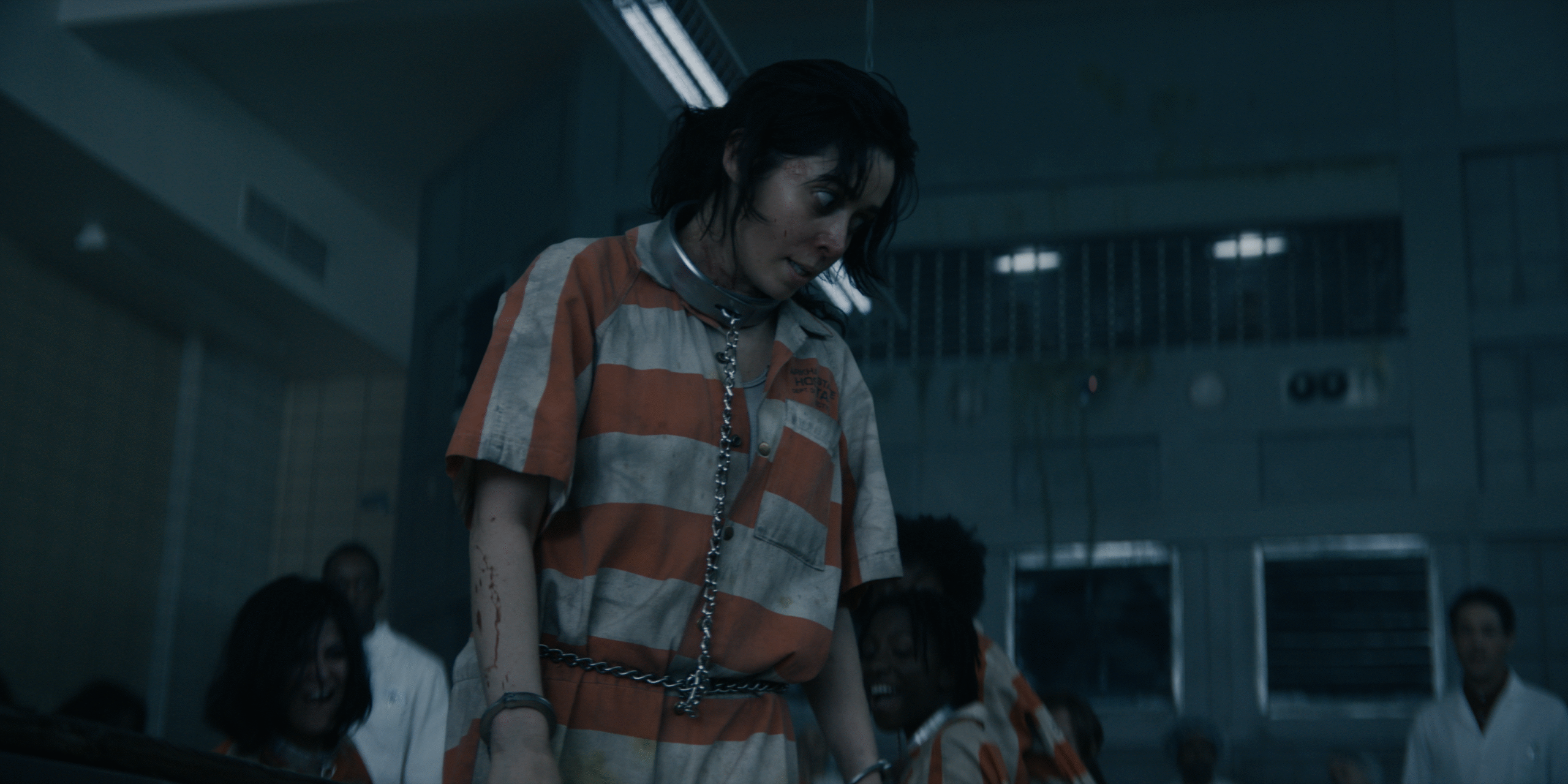
Johnny Han: Just a little more on that, I think we don’t get to talk about that episode much because people don’t think of it as an effects episode. Cristin Milioti’s performance was fabulous, and it is such a treat when that is all there already so all that we have to do is push it for the things that you can’t do in production. So what Nathan was saying is we had to show an escalation of the worn out abuse she has been through with the slow deterioration of her face and her body. Things where we’re meeting at the other half, she took care of the performance all the way and all we had to do was accentuate that with all these physical things we couldn’t do on set because makeup-wise it would have been too hard to shoot in a way where you can keep touching up the makeup more and more. That episode I think summarizes so much of what we intended to do on this show, take great performances and honor that by doing everything we could to bring our game to the level of these actors.
The Contending: One of the other big special effects of the show was when Oz lights two people on fire. But, in addition to that though is that we also have a gunfight in the same very enclosed space with a lot going on. What were the challenges in creating that?
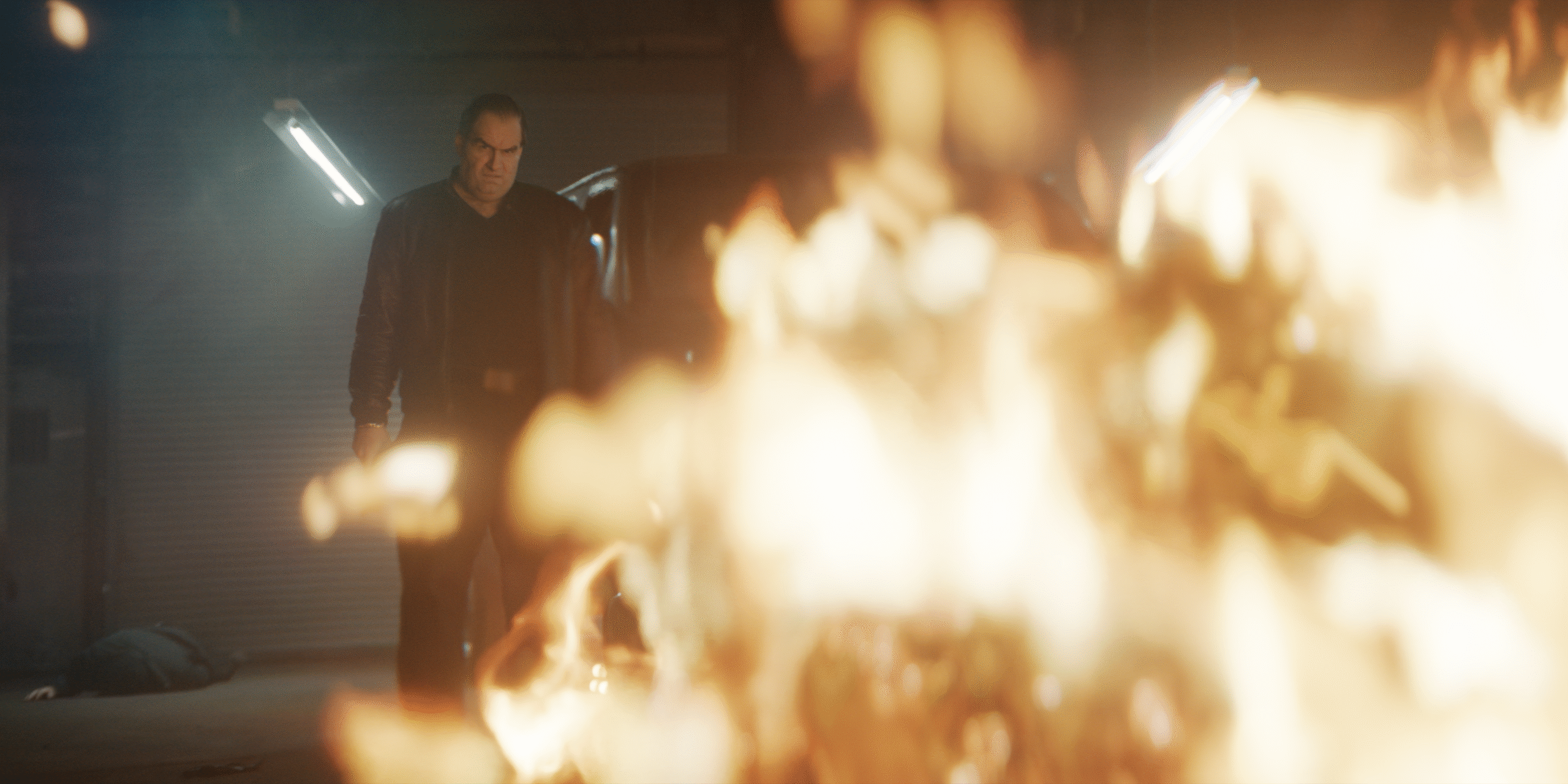
Johnny Han: There are ways to set two stunt people on fire; it has been done many times. But it is always a matter of logistics; in this case the location, the schedule, the safety of where we were, we knew that we couldn’t have people on fire. So those kinds of filmmaking challenges are what shape our methodology. We had seven iPhones hidden around the characters that we call witness cameras. We do this so we’ll have seven points of view of the actor’s performances so that our animators can then animate digital versions of the characters as accurately as they can. We also had these orange lights that were just off of them like a meter away, to give what is maybe the most important part, which isn’t the fire itself, it is the light from the fire that we call interactive light. If you saw the original plates you could see the light poles that we had in frame, which many people would think we were being silly leaving them there.
But that is the case of us knowing the value of that light affecting the actors is more important than the task of having to take them out. It is worth it to digitally remove the poles of light if it meant that the performance of the actors was as good as it could be. Even for the actors themselves to feel that light helps them believe they are on fire. If we had done that with a normal dark set with no orange lights at all it would look silly. Anything we can do to support the actors and help them believe in what is happening, and then the camera can capture that.
Adrien Saint Girons: As far as the shootout, we had a great system with what we are calling flash guns, which fundamentally somebody shoots. There is a very bright flash from the base of the gun and a bang sound so that everyone can understand the timing of what is happening. We had a really good interactive plate, and sometimes the time would work out perfectly and sometimes you’d have to modify it, but it gave us a good reference of just how bright that had to get. It also helped add a lot of energy to the gunfight scenes. So we played with the amount of light on the faces and on the environment, then doing a lot of iterations, getting the blood spurts in the right places, and at times having to change the timing of the guy falling back just to make it as dynamic as possible.
Johnny Han: The flash guns were born out of a need because our show is going to be so moody and dark and we were not going to use any blanks on this show for safety reasons. So then all of a sudden we didn’t have the light you would get from blanks, so we made these flashes happen on set and then it just became maybe that’s the look of the guns in this show. We light up the room a little bit that is just otherwise dark and it adds an excitement, the actors can react to it, the director knows when people are firing and in that scene in particular a lot of that is happening off camera. That is because we are looking at other characters trying to believe that a gunfight is happening behind them somewhere. Those guns that have flashes on them even if they are off camera are providing the atmosphere and tone for the whole scene. The actors could also see it out of the corner of their eyes that these gun flashes are happening. So it’s similar to the fire in that it lets the actors work in an environment where they believe what is happening around them.
The Contending: Any final thoughts?
Johnny Han:To go back to your first question, this was a master class in fine wine tasting and understanding subtleties, detecting them and communicating them. I think we all grew as filmmakers and maybe that is the best part, knowing that it wasn’t just a job. It was like we went to film school for free, and I always hope every show is like that where you can just grow more and more.