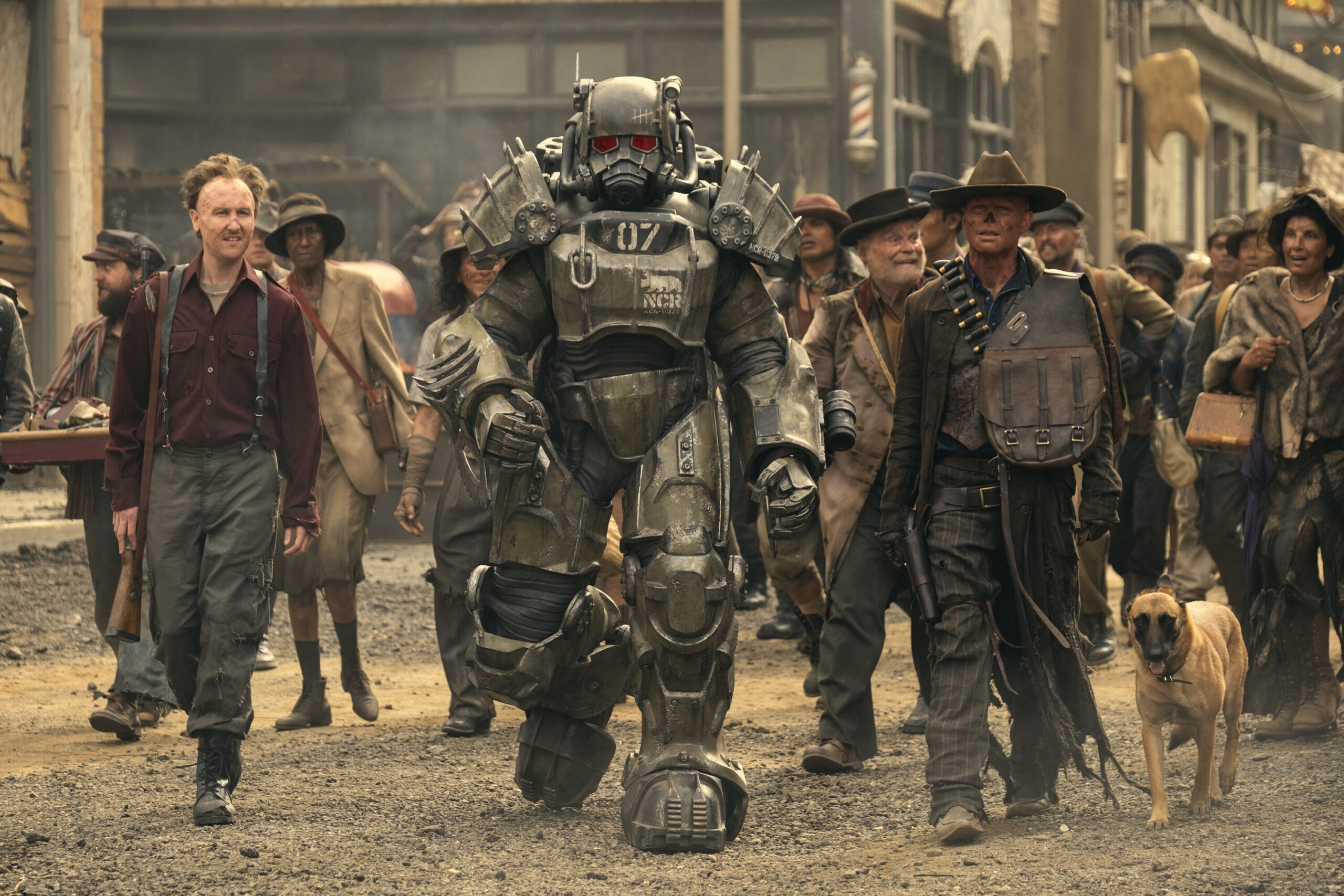
Fallout returned last December for its second season, expanding the action into the eagerly anticipated New Vegas. With that progression comes a whole new sonic landscape. Here, in an interview with The Contending, Steve Bucino, the sound effects re-recording mixer, and Daniel Colman, the supervising sound editor / sound designer, take us on this sonic journey. They reveal how they adjusted and added to the iconic sounds from the games as well as crafted the sound storytelling in this season’s battles. The sound design team was on top of everything, including creating the sound of the menacing and memorable Deathclaws.
Here’s how they did it.
The Contending: The Deathclaw appearing in this season was a big moment for the fans. What went into creating the scream of them and just their movements?
Steve Bucino: The sound design of the Death Claw was a combination of sound design by Daniel Colman and Joseph Fraioli, which went through many iterations before it even got to the mix stage. Once it got to my mixing console the exploration continued. I had a mix session inside my mix session that was just for the Death Claw with its own compression, reverbs, delays, and harmonic saturation / overdrive. Even during the mix and up until the very last day I was still moving and editing sounds and articulations based on the show runner Geneva Robertson-Dworet and Jonathan Nolan’s creative reaction to each scene. There were several animal elements ranging from seals, alligators, elephants, pigs and lions among others. Tiny emotional vocal articulations from these sounds were cut and morphed by the sound designers to create a language for the DC’s. There were also human vocalizations from a heavy metal singer included which were also pitch shifted and morphed to match the new tonal framework of the animal sounds. All of these were mixed and matched and blended to create a communicative language of the DC’s. And each individual DC had its own DNA of sounds and was treated as a separate character.
One of my directions from the clients was to make the DC the “scariest and loudest thing anyone has ever heard”. I used a combination of various LFE (Low Frequency Generator) effects to impose size and power, as well as upper and lower frequency harmonic distortion to have the screams cut through music and feel even louder than they were by occupying more harmonic space on the frequency spectrum. We also needed to communicate to the audience that these creatures were all around us at times even when we didn’t visually see them on the screen. Mixing in the Dolby Atmos 9.1.6 format was a huge help because I had a wide range of speaker placement I could use to tell that story. I would key off of the actors’ movement and the camera angles to decide where each DC sound should come from, keep the audience and characters surprised and impose a sense of being trapped from escape or blocked from reacting to their target location.
Daniel Colman: One of the biggest challenges in designing the sound of the Deathclaws was that through all of picture, editorial, and most of our sound work, we were looking at practical puppeteers in blue suits wearing large Deathclaw heads on backpacks rather than the final VFX creatures. That setup was incredibly helpful for the actors and gave everyone a strong sense of scale and physicality, but from a sound perspective it meant we had to anticipate a lot of the creatures’ final movement, timing, and emotional expression before the visual effects were complete.
The producers and picture editors gave us valuable direction about how they envisioned the finished creatures, and in some cases we had a few completed VFX shots from trailer work that helped establish the tone. From there, we built the sound language for the Deathclaws while staying flexible as updated visual effects continued to come in throughout the process. It really wasn’t until we were on the dub stage for episode 204 that we began receiving shots that closely reflected the final behavior and performances of the creatures, which allowed us to fine-tune many of the details in the vocalizations and movement sounds. Even after the mixes, additional VFX updates continued to arrive, so the process remained very fluid.
Joseph Fraioli created the vocalizations for the Deathclaws, while I focused on their physical movement and impacts — footsteps, fight sounds, bites, drool, tail movements, body falls, and, of course, a tremendous amount of blood work. We maintained separate sound banks for each Deathclaw, which gave us the flexibility to update individual performances while preserving Steve Bucino’s panning and mix automation as revisions came in. Steve and I continually passed the mix sessions back and forth during the update process, coordinating closely to keep everything aligned with the latest VFX and the producers’ direction during the mix.
The Contending:.At the end of episode four the Brotherhood of Steel is in a state of civil war with the air ships fighting each other in the distance while Maximus and Thaddeus running away. What went into finding the right balance of noise for that battle?
Steve Bucino: The fight leading up to that was all about dynamic mixing. What I mean by that is sound effects came in big to announce an event and then got out of the way for music and dialog. Leading up to the airship crash we have gun fights in the mess hall as well as a gory face stab, a laser gun shootout between Maximus and Quintus, Thaddeus breaking through a door to escape with Max, and an escalating off screen battle of epic proportions – all while some serious story points are being communicated through dialog. Sound effects needed to keep the stakes high and the emotion tense whilst allowing space for the story to move along. The culmination of the scene while Max and Thad are running in slow motion is mostly music driven. We already communicated the intensity and size of the battle both literally and politically / sociologically for the characters. In the final moments of the scene the distant air ships are faintly heard engaging each other with some high frequency trace ammunition as well as a descending howl for the main airship going down and finally a low impact sub hit for the crash accompanied by some high frequency fire. All of this plays significantly under the music but tells the story nonetheless. The combination of low frequency effects and high frequency fire and bullets assure that the audience gets a full sonic experience regardless of the quality of their playback system.
Daniel Colman: Epic battle scenes like this always present complex challenges in terms of what sounds to feature at any given moment. It’s very easy to get bogged down in the nuance of every action on screen and end up with a muddy sonic mess. One thing I always keep in mind on this show is that Jonathan Nolan and Geneva Robertson-Dworet are both incredibly instinctual producers, and the focus of a scene can evolve significantly during the mix. Sometimes that aligns with what was emphasized in the picture editor’s temp mix, and sometimes it shifts in a completely different direction, so every detail needs to be fully fleshed out and meticulously edited in advance of the mix.
I find the best process is to build out all of the elements first, and then begin isolating sounds by muting others and balancing the various layers against each other. That gives Steve the flexibility to quickly adapt the mix to reflect producers’ notes and allows the team to explore different ideas and perspectives during the playback process.
The music in this battle also evolved considerably throughout the mix, so each time music editor Christopher Kaller and dialogue/music re-recording mixer Keith Rogers adjusted the score, Steve likewise had to rebalance the sound effects around it. We ended up with a number of alternate mix concepts that were muted and saved so we could revisit different approaches as the relationship between music and effects continued to evolve.
In the end, it’s all about communicating both the story and the emotional experiences of the characters. There’s never a fixed rule that music leads and sound effects follow, or vice versa. This sequence in particular moves through several locations within the Brotherhood of Steel base, and the characters in each area are experiencing the conflict very differently. The cafeteria scene with Thaddeus has a comedic element, while Maximus’ scene in the office with Elder Cleric Quintus is much more serious and tense. Our job was to support the tone of each individual scene while still maintaining a cohesive sonic flow across the larger sequence.
The challenge at the end of the sequence, as the airship conflict rages in the distance while Maximus and Thaddeus are running away, was making it feel like a full-scale civil war without getting in the way of the music that is carrying the emotional crux of the scene. A lot of the work went into carefully controlling the perspective and density of the sound effects we chose to cut through.
The Contending: The game has several iconic sounds to it. What opportunities and challenges does that create?
Steve Bucino: Like millions of other gamers, our EP Jonathan Nolan has played countless hours of Fallout and has personal, vicegeral reactions to certain game events and characters that are also in our show. We want to be authentic to the game and fulfill the audience’s emotional and nostalgic connection. This can be identified in our work when we hear literal game sounds being used as the DNA for objects, characters and creatures. Vault doors are much more complex sounding in the show, but each door has elements of sound effects provided by Bethesda from the game. The Securitron was one such character that Nolan had a clear recollection of its characteristics. Those scenes in the show were approached in a variety of ways both with voice options / alternative dialog lines and various arrays of sound effects both from the game and from our unique design. We shaped the character of the securitron until it not only satisfied our unique storytelling but conveyed the same familiarity to Jonathan Nolan as he remembered it from gameplay.Similarly, the car explosion in the No Vacancy Kahn motel in the beginning of S2 episode 1 is an event that Jonathan Nolan remembered with perpetual frustration from the game. He couldn’t recall an exact sonic signature, but he certainly recalled his frustration of being blown up by exploding cars. Our team again continued to creatively craft that explosion until it was as unique sounding to our show as the feeling is that it imparts onto gamers.
Daniel Colman: When we started working on season one, Bethesda provided us with a limited sound effects library pulled from the various Fallout games for us to use as reference material, and play in the series if we wanted to. Jonathan Nolan’s directive from the start was that, for anything in the show originating from the games, we should begin with the game sounds and see if they could work within the series. At various points during the mix process he would ask to hear the original game elements within the edit, so I always color-coded those sound files so Steve could easily isolate them.
Most of the time, I found that the actions in the show were much longer and more dynamic than they are in the games. In those cases, I would isolate specific elements from a game sound that could serve as a foundation and then expand on them, or design something new that still communicated the same emotional feel and sonic character as the original. Since we’re not retelling a story from the games, but rather creating a new story within that same world, we do have some latitude to reinterpret things while still trying to remain familiar to longtime fans. People have been playing these games for decades, so we absolutely wanted to honor what players emotionally remember about Fallout while also making the sounds work cinematically for television.
Certain elements that are consistent across all of the games, like the Pip-Boy, needed to sound as close to the source material as possible. Other sounds required us to start from scratch because they were either original to the series or because the way they functioned in the show was different enough that the game sounds no longer supported the storytelling or visuals. With almost all of the creatures, we would start by listening to what had been done in the games, but ultimately needed to create new designs because the television format required a much more extensive and dynamic sound palette for performance and behavior.
There’s one sequence in season two where a Vertibird docks on a dirigible, and Jonathan Nolan was very specific that he wanted it to be “exactly how it sounds in the game.” The original game sound was a singular fully constructed design sequence, but it was much shorter and contained elements that occurred in a different order than what we needed for the scene. I went into the original game sound and used various noise-reduction tools to pull it apart and isolate individual elements that I could then incorporate into my edit for the sequence. The goal was to preserve the familiar emotional experience of the game sound while adapting it to the pacing and storytelling needs of the show.
The Contending: In the battle of the Legion you have swords clanking, gun fire, explosions, soldiers screaming and we can still hear the body of Caesar being dragged. How did you craft all of that?
Steve Bucino: The majority of mixing is taking things away in order to shift focus. At any given time there is one event on screen that needs to do the majority of the story telling. This is true not only in a scene but in each individual shot and camera angle. We go to great lengths to make sure every sound element in a shot is prioritized by its story telling capabilities. You hear what we want you to hear and what we intentionally shift sonic focus to all while maintaining the detail of the world by dulling, lowering, panning and otherwise adjusting the level and perspective of all elements from moment to moment.
Daniel Colman: When you work on a sequence like this, where you know a quieter sound — in this case dragging Caesar’s body — needs to be the focus of the scene rather than the louder sounds happening around it, it’s important to start by editing and establishing that sound first. From there, all of the other elements need to be built around it while continually listening to how they affect the primary sound. Anything that obscures it, even if it sounds great on its own, ultimately doesn’t belong in the mix.
There are a lot of different ways to create that kind of clarity. Some of it comes from shaping the louder sounds so they don’t linger too long — for example, hitting an explosion hard and then fading it down very quickly. Some of it comes from EQ, carving out frequencies in the louder elements so they don’t mask the softer sound. Some of it can be achieved through panning. If a large explosion is primarily living in the left and right speakers while the quieter detail is focused in the center channel, the audience can still clearly perceive both.
And of course, a lot of it simply comes down to careful balancing of levels. It really is all about editing and mixing with the intention of telling the story as clearly and effectively as possible through sound.
The Contending: In that same episode we have a battle with gun fights, battle armor, rockets, the Deathclaws, and just all the destruction going on. What was that like to put together?
Steve Bucino: One of the most unique things about this show and the producers we work with is the emotional reaction that drives our sonic storytelling. This is an example where the initial sound build and mix was fantastic and well received upon initial presentation. Then, as we dive deeper into our process with Geneva Robertson-Dworet and Jonathan Nolan, the scope of the weapons and the emotional changes the characters and creatures are going through begins to expand in real time. For example, during a playback of that scene, Jonathan Nolan came up with a hypothetical measurement of the thrust and propulsion of the rockets from Max’s Armor and what that should feel and sound like. This new feedback meant we needed to adjust the sound and mix. As we shape the sound of each scene the story telling importance of each element becomes clear and we make sure that each moment is focused appropriately to convey that story and achieve maximum emotional impact.
Another example is the malfunction of Max’s power armor while fighting the DC. We needed to arc that story point from the top of the scene to the moment he makes the character shaping decision to exit the suit and fight the DC by hand. The sonic story telling of the failing power armor suit was a major building block of achieving the “Dark Night of the Soul” moment for Max.
Daniel Colman: It’s all about thinking about each moment in the battle as part of a larger progression. It’s not just a series of fight sounds, but rather a story unfolding over time. There was a period in film sound history where sound designers often focused on “hero sounds,” where, for example, the hero’s punches would sound largely the same regardless of the action surrounding them. That methodology can work very well for shorter or more straightforward fight scenes, but when a battle continues over a long stretch of time — especially in a case like this, where we repeatedly return to Max fighting the Deathclaws throughout the episode — it becomes important to shape an entire sonic performance that evolves over time.
I think about sequences like this much more in terms of a musical composition than as a collection of individual sound effects. There are movements, crescendos, quieter passages, comedic bridges, and large emotional peaks. The challenge is to create a cohesive overall sonic experience while still keeping it dynamic and interesting from moment to moment, all while supporting the storytelling and emotional perspective of the scene.
Fallout Season Two streams exclusively on Amazon Prime.