I guess it’s time to recognize that the first season of Monster (Dahmer) wasn’t a template, but an anomaly. The three subsequent seasons have abandoned the sober approach of Dahmer in favor of a more theatrical, campy take on infamous murders. Perhaps that shouldn’t surprise anyone coming from a Ryan Murphy production. After all, he is the man behind American Horror Story, Glee, and Feud. It’s just that every now and again, he moves into the realm of the realistic (as with Dahmer, The Normal Heart, and American Crime Story).
Season two of Monster focused on the Menendez Brothers, and never found its footing. That season failed to find a point of view, and if it was going for a Rashomon effect, the whole production owes Kurosawa an apology. Save for one remarkable episode, the brilliant one-shot of number 5 (“The Hurt Man”), which put Cooper Koch as Erik Menendez and Ari Graynor as his lawyer in a claustrophobic prison meeting room, the whole of the season was neither effective as satire nor as drama. Season three with Charlie Hunnam as Ed Gein was even more problematic. The central story was mostly dull, except for Susanna Son as Gein’s girlfriend of a sort, and the subplots ranged from garish and revolting (as in the case of the telling of the story of Ilse, “The Bitch of Buchenwald”), or, even more fatally, of greater interest (the dramatization of the making of Psycho, which drew inspiration from Gein’s ghastly deeds).
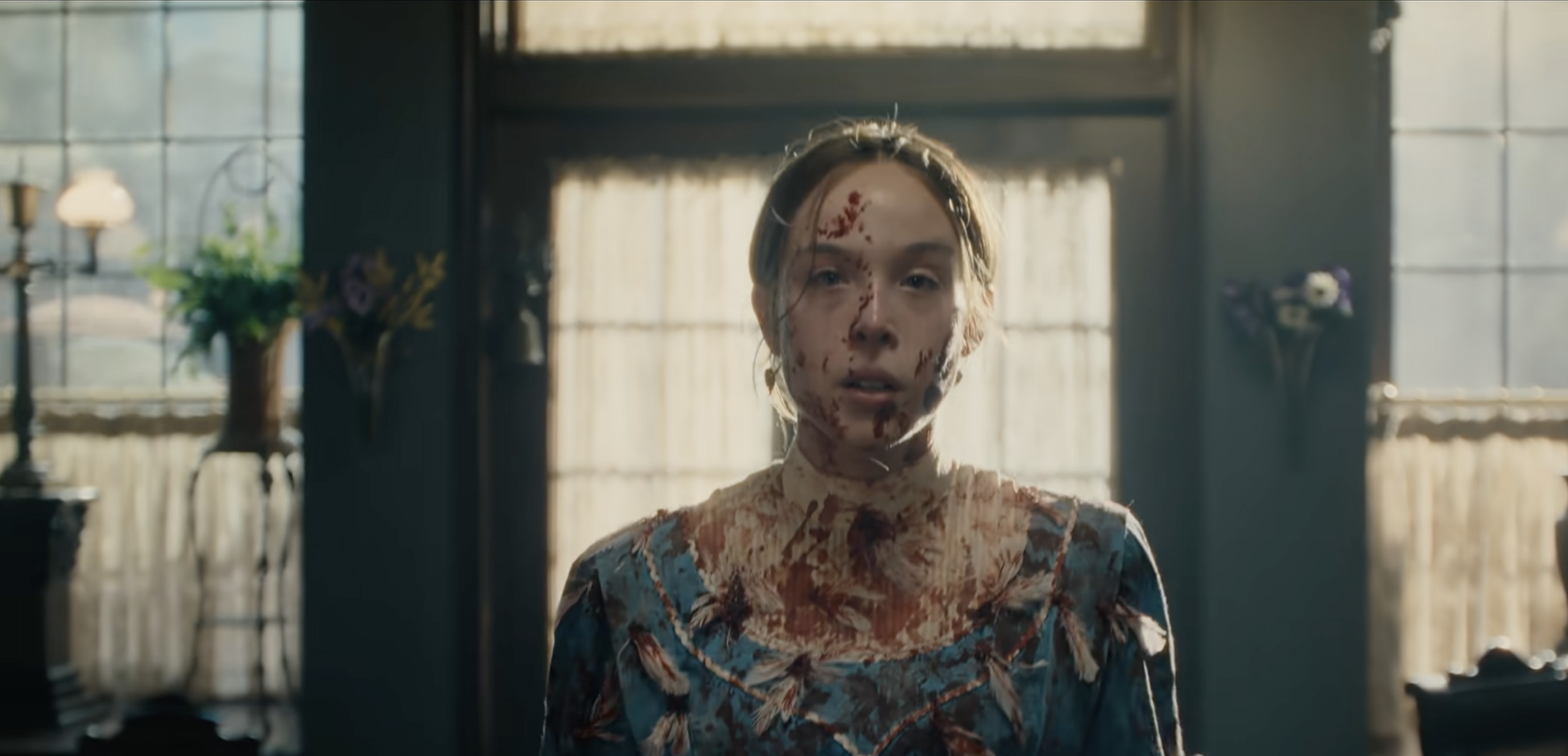
That brings us to the latest iteration, Monster: The Lizzie Borden Story. If Ed Gein leaned into the theatrical and garish, Lizzie Borden embraces those “attributes” completely. From the first moments of episode one, when a cheery Lizzie (Ella Beatty) chooses an axe from her father’s workshop to kill both her parents, set to a jaunty score, it’s clear this season of Monster is to be steeped in the sensational.
While there’s little point in charting all the artistic liberties the show takes with the true story of Lizzie Borden and her presumed hatchet work on her stepmother and father, a couple are worth noting. First, Lizzie’s parents were 69 and 64. In Murphy’s show, they are played by Charlie Hunnam and Rebecca Hall—two beauties who defy middle age, let alone senior citizenry. The father was a miserable miser, forcing the family to live in squalor despite his remarkable wealth. Here, the Borden house is opulent and beautiful, with every room looking like something out of a Victorian museum. There is also a depiction of animal cruelty that has no basis in fact.
Of course, the show wears its wide license on its sleeve, hitting you with anachronistic needle drops from The Runaways, Kate Bush, Wet Leg, and The Doors. If The Lizzie Borden Story had fully committed to satire and sensationalism, maybe this approach would have worked in some bonkers way. But in trying to make a feminist statement about how women have been treated for centuries, the show undermines its excesses and its more serious themes. For some reason, the series tries to tie Lizzie to both Elizabeth Bathory (perhaps the first known female serial killer, circa the 18th century) and Aileen Wuornos, who was put to death in Florida for the murder of seven “Johns” in 1989 and 1990. The Bathory story lets the show add more grand guinol spectacle, but the Wuornos subplot stops the show cold every time it’s introduced.
Sarah Paulson is an outstanding actor, but here, her take on Wuornos borders on the cartoonish. Perhaps it would have been less so if this were The Aileen Wuornos Story, but by dropping her into Lizzie’s story in bits and pieces (no pun intended), she becomes a complete distraction. Depicting her character as fascinated with Lizzie is neither helpful nor historically accurate. So much of what’s in The Lizzie Borden Story feels like an “Oh, what the hell, why not?” kitchen-sink toss-in. Maybe the better question would have been “Why?” Why is this necessary? Does this help illuminate our central story? If either of those questions had been taken seriously, it’s hard to imagine the answer wouldn’t have been a hard “NO,” but here we are.
The shame of it is that there’s plenty of story to hang a series on as it relates to Lizzie Borden. This odd, 32-year-old woman caught between two loveless parents who (as it is often told, but not proven) took matters into her own hands, committing parricide on August 4, 1992. A feminist argument can be made about how women were treated in the 19th century. Their marriages were often arranged, their bodies not their own, and their voices silenced in a world of men. Monster: The Lizzie Borden Story is not that story, no matter how hard it tries. All of the excesses showcased in the series trivialize Lizzie’s burdens and her purported homicidal rage.
Charlie Hunnam and Rebecca Hall receive little help as the “villains” in this piece. Hunnam’s Mr. Borden is first shown as somnambulant, but then as his character becomes more loquacious, he reveals a speech impediment that seems to come and go at random from scene to scene. After the “weird voice” complaints regarding his portrayal of Ed Gein, one wonders if it might have been best just to let Charlie speak in his normal voice and cadence. Hunnam can be a compelling actor, but he is thus far zero for two in the Monster universe.
Worse yet, Rebecca Hall, one of the finest actors alive, is written and directed shrilly as Mrs. Borden. It’s as if the Murphy pointed at an image of Cruella De Vil (only her hatred is for doves, not dogs) and said, “Do that!” to Hall. Only in episode four, when Hunnam and Hall face off over Mrs. Borden’s marital unhappiness, do sparks fly. A second scene between Hall and Beatty is nearly as good, as Mrs. Borden and Lizzie lash into each other over the heretofore barely contained contempt they have for each other. Hall is dynamite in both scenes and, for the first (and only) time in the show, registers as something close to human.
Beatty, as Lizzie, is quite good. Even if her noted plain and unsightly appearance isn’t believable in the slightest (Beatty is quite lovely). Every scene between her and the Irish maid “Maggie” (played by the great Vicky Krieps), as they grow closer romantically and in the plotting murder, is out-and-out terrific. In the first half of the series, the relationship between Lizzie and “Maggie” (real name Bridget, but Mrs. Borden calls her by the last maid’s name because she can’t be bothered to learn a new one) provides all the best scenes up to the close of episode four. Bridget/Maggie is a worldly-wise housekeeper with a libertine streak who takes advantage of Lizzie’s innocence, Mrs. Borden’s desire for excellence, and Mr. Borden’s carnal desires. Early on, Krieps’ Machiavellian machinations carry the show further than it deserves, as we wonder what her angle is and whether she cares for Lizzie or sees her as an easy mark. To Krieps’ great credit, the answer could be “both.”
Unfortunately, The Lizzie Borden Story is more interested in an undertaker who cuts off the legs of the dead to make them fit in a coffin, splattering blood all over the curtains, carpets, and drapes, and, in a scene so ridiculous it might play better in a teenage comedy, having the master and mistress of the house vomit all over the dining room like their mouths were attached to a fire hose.
For reasons I can only describe as fatuous thrust, The Lizzie Borden Story is pretty watchable for about four and a half episodes. But after the murders take place, we are left with three episodes of aftermath covering the trial, Lizzie’s new life, and her involvement (also made up from whole cloth) in the suffragette movement. Here, The Lizzie Borden Story commits the cardinal sin of filmmaking: it’s boring.
The result of The Lizzie Borden Story may not be a deadly human tragedy, but it is an artistic one. I’m not sure who this series is for, but given the audience the previous seasons have garnered, I suspect it’s a lot of people. All I know is we are a long way from the sensitively rendered treatment of Dahmer’s victims in season one, and that season as a whole. If this is your world, welcome to it. The rest of us will just be over here, shaking our heads.