Cinematographer Michael Fimognari has worked with Mike Flanagan on several of his projects, so it is no surprise that he did most of the episodes of Amazon Prime’s Carrie. Here, in an interview with The Contending, Michael describes how their relationship works. Since they’re very much in sync, they learn together and want to learn new things in each project. This includes the intense final prom scene where he discusses the color contrasts before the fire, the camera work they did to capture the cellphone explosions, and the slow motion moments. All of that contributes to the frenetic and chaotic scene this story is known for.
The Contending: I wanted to start with just sort of a small part. Carrie’s house and the way it’s shot gives us a sense of the space. It’s not a large space, it’s not exactly a small space either, but you kind of sense the claustrophobia that goes into it as well. Can you talk about what you did to arrange the house?
Michael Fimognari: Yeah, Mike’s a very meticulous planner, and so is his design for the blocking. He really likes to play with the architectural layouts. So, at first it’s simple drawings on whiteboards, and what’s great about that is that he’ll work out the behavior first, which is a big way for us to design shots and start to see how characters relate to each other in the space. Especially in the case of Carrie’s home, seeing where the prayer closet is in relation to the table, or where Ralph’s empty chair sits in relation to the space where they make dinner. It’s creating a home where Carrie would have been raised, almost entirely without much life beyond the boundaries of the property. It needed to feel like a place that could all at once be warm, welcoming, educational, and full of life. But then later translates into something that’s a bit of a prison for Margaret. So Mike and our designer, Tony Wohlgemuth, ultimately did a really nice job of allowing that space to transform over the course of this one year.
From a lighting perspective we wanted it to be a warm space, where Carrie feels loved, but that changes for her as she realizes her powers. We wanted it to always feel like a place that could be a home, could be warm. But Margaret violates that trust when she installs the cameras, and so the house does change for Carrie.
The Contending: One of my favorite shots was Peter showing Carrie the library and just the way it’s lit up, like it has sunlight in there, and the way the camera moves to show the space, and it’s not a huge space, but you see how it just immediately makes her feel like the world has gotten bigger. And I’m kind of curious what went into that one.
Michael Fimognari: Yeah, that’s one of my favorite sequences in the entire show. It’s where she goes to his office and talks about missing her dad, and feeling like something might be wrong with her, and he really hears and sees her. That she’s someone who could benefit from knowledge. In the library exposure to space and to light and to information is like looking at the universe in front of you. Mike did a beautiful design for just that simple camera that travels around her. And we hadn’t seen anything like that in her home, that space doesn’t really allow it. So that’s a new expansion of her world.
The Contending: I read that you shot it in an aspect ratio to give the high school and the town kind of a very expansive look. What went into that, and what was behind those choices?
Michael Fimognari: We chose lenses that didn’t feel too far in a heightened cinematic world. We wanted it to be grounded. Mike felt strongly that this needed to feel like a town you would know, looking like schools you’ve been to. So that you could connect with someone in this world and feel like you understand it, that you’ve lived it and you’ve seen it. So optically, we shot with spherical lenses.
Once we settle on a color palette and start to figure out in our heads what it is, we’ll go have a couple days at ARRI and just play with lenses. Just put up everything we can. They are super supportive of what we do, and usually we’ll have this game where I’ll put up lenses for Mike, and we’ll do the eye test, and it’s like, is it A or is it B? And then we’ll sort of define what it is, and we’ll play with it. Then once we settle on that, we’ll do the early phase of camera tests to define what we want for color, and then we’ll bring that to our colorist, Corinne Bogdanowicz, (who did a beautiful job) and we’ll design our look for the show. So we’ll have a LUT that acts as the show LUT every time we go to set, that’s how we’re viewing it and that will change the palette sometimes, depending on what your eye sees versus what the camera will see, so it’s important that we define those color choices.
From an optical perspective, what we did was we mostly chose wide lenses close to the subject, so that you could have a close-up, but you could still feel the space, you could still feel the classroom. The hallways felt deep and expansive. We did a lot of symmetrical framing, so you had a vanishing point. So when you got outside of Carrie’s home the world would feel big. We traveled with her through hallways, there’s a lot of movement, a lot of linear movement and when you get to the street, when you get to her walking to school, you’re seeing Main Street in depth.
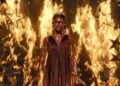
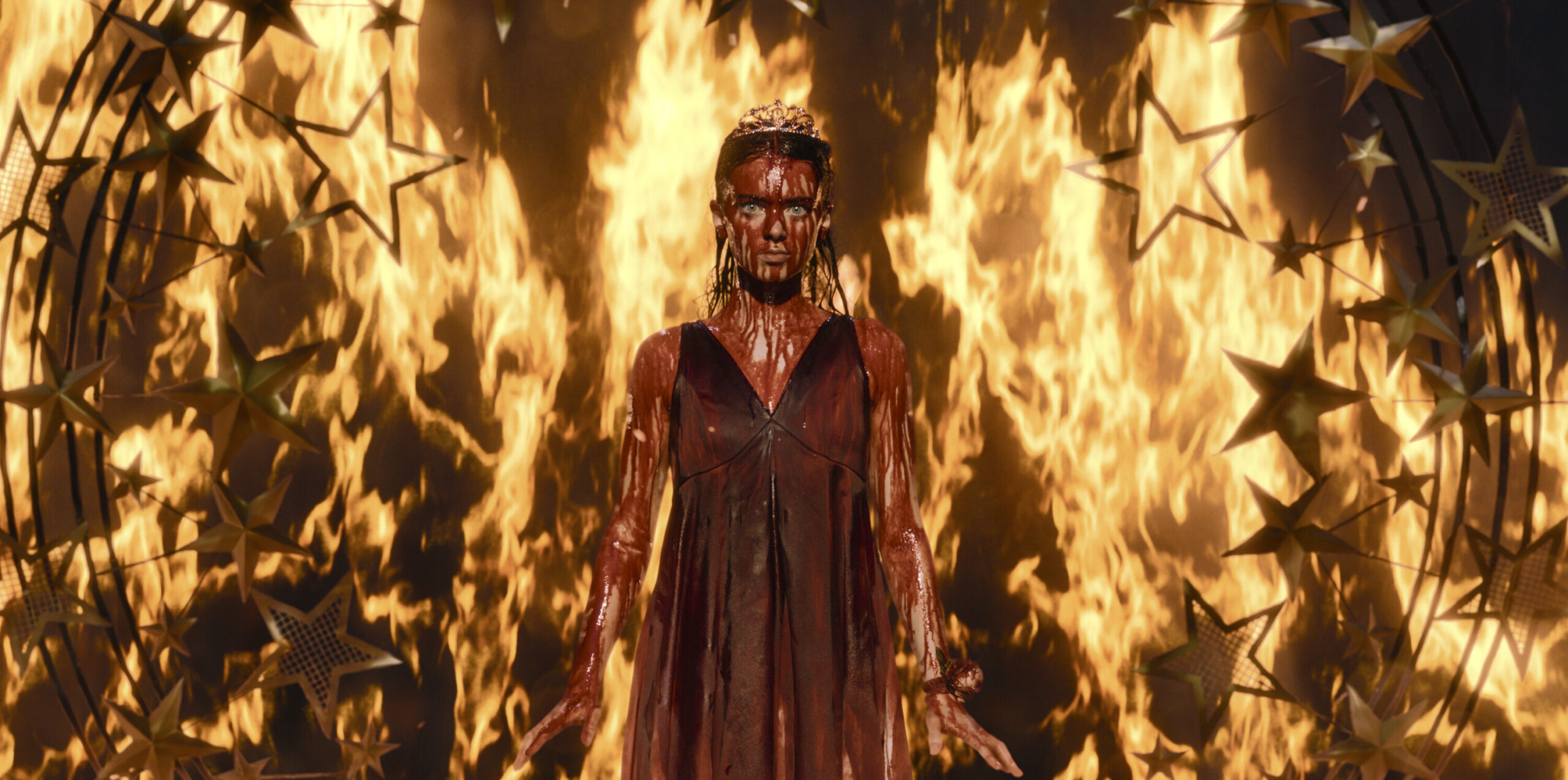
The Contending: The big moment for the show of course, is prom. And I read in a previous interview that you guys purposely made it very blue inside there originally and created a star motif to call back to her star gazing with her father and with Tommy before we go into the red of the fire and blood. Can you talk about the process there as well?
Michael Fimognari: Yeah, you summarized that well. We decided to go with blue as a counter to the red of the blood and the red of the fire. We wanted those two to collide in that one blood drop moment. And the stars, as you said, were a choice to also allow a little warmth to the blue, you know, so that you could feel the blue as long as you have something to stand against it. Stars were something that were deeply important to Carrie, the moments that she would stargaze with her dad, and when she shares that story with Tommy who has a similar story.
That moment for both of them stargazing is then paid off in how Tommy dies on stage. You have this floating star pattern after the blood drop, and as the fire’s about to begin that brings all these deeply personal moments together in tragedy. We didn’t have a lot of blue in the story, but the school has some blue in the lighting and there are some colder tones in the winter. But when we got to prom, we really wanted to almost desensitize you to the blue, so that when you get the red, it’s shocking, and then the town gets taken over by the red.
The Contending: When chaos breaks out we have a lot of shots that are slowed down or sped up. How did that affect the way you were taking the shots?
Michael Fimognari: We built the lighting plan for the prom, knowing that we would have a speed ramp on her entrance to really make it magical. We designed that lighting so that it could be at a high enough value for the high speed, and then a low enough value later when all the phones explode. Because of the luminance from the phones there’s only so much you can get a phone to do, but we wanted that pop of light for that moment, and we wanted those little phone lights to be aggressive. So when Carrie looks out at the sea of people, what you get are all these little dots that are all looking at her, and for those to be bright enough, we had to bring all the prom lighting levels down. So we had two different levels for the prom. We had the high levels for slow motion, and then we also had to use those high levels for fire, because to get enough detail out of flame, our light levels had to match the flame. So we had the high level for that, and we had the low level for the phones.
The Contending: You’ve worked with Mike Flanagan in so many different projects. Is there anything about working with him so much that makes it easier at your job, or something about this project in particular that was different?
Michael Fimognari: We’ve been working together for 15 years, and what we do is a challenge. But how we do it is just a good time! There’s a lot of laughter, we like a lot of the same films, and like a lot of the same comedies. Sometimes we have a contest when we’re working in our meetings where we’ll have soundtracks playing while we’re shot listing, and then each of us will try to be the first to guess the track. We really enjoy the work and we also enjoy doing it together.
It’s a detailed process and we know what our details are, so as we’ve built our features and our shows together, we’ve learned what works and we’ve learned what doesn’t. We each try to refine that so that we are getting better, and the process is allowing for the cast to have more time, or for us to try something new. It’s been many years since we’ve done those single shots in the sixth episode of Hill House, which at that time was a real challenge for us, and probably would still be today. But each time we take on a project, we do something new we hadn’t done before. The prom scene was certainly up there with the midnight mass in Midnight Mass. These are sequences that take days to shoot that evolve and have emotional consequences that you don’t want to go back to. Like, once you cross it, you want to keep going in sequence, and building them.
Mike has a really specific process, because he thinks with the edit in mind, which is a dream, because he knows where the shot will be used, and how it’ll translate to the progression of the story. And when we’re building a plan, we don’t spend time on the shots that you don’t need later so our execution of it is specific enough that you can say to the crew we’re gonna look this way until this moment, and then we’re gonna look this way on this moment. You can actually have the prom play out with multiple cameras in different places, and characters will run in and out of one shot and into another, and we know we have what Mike needs.
The Contending: The scenes when they’re doing those interviews with the cameras at the beginning, and we don’t quite know what it’s about, but you sense something’s unnerving has happened. What went into creating those?
Michael Fimognari: You do wonder where these interviews are coming from while it also sets the expectation that something terrible is about to happen, and you’re waiting for that to occur. But then there’s something very ordinary about those interviews. That’s important, because it shows that the casualty of all of this, as Sue says, they were just kids trying to do their best. And when you say that in a tiny little room where the paint is chipped and you just have one light in your face, there’s something obviously tragic about why we’re talking about that. And so we really wanted that to be as ordinary and simple as it could be, almost to the point of losing its style. You know, like it needed to feel melancholy, so that when you drop into these other parts of Carrie’s world, you can feel the joy of it, or you can feel the different despair that might be associated with going to school and having a traumatic event in a locker room. But the balance of those two things are very important.
And then, in the final episode, after you’ve seen the blood drop and we return to those interviews, you’re again reminded that there were consequences to everything, and that people have been affected by this and will probably carry it with them forever. Then having these cut to that ordinary space with simply one light in somebody’s face talking about a night that will haunt them forever. And then cutting to the prom, where you can still see the blue lights, and you can still see the stars, and it’s surrounded by fire, it’s jarring in the appropriate way, in the way that we’re not glorifying the violence. But it’s beautiful, but it’s not for a good reason. And by cutting back to these characters talking about it while their faces are still bandaged, and you can see them struggling to even address it, is an important part of what makes investigating Carrie as a story in 2026. You know that there are real consequences to the potential pain that people can inflict on each other. And hopefully, that’s what people take away from it.
Spread the Word!