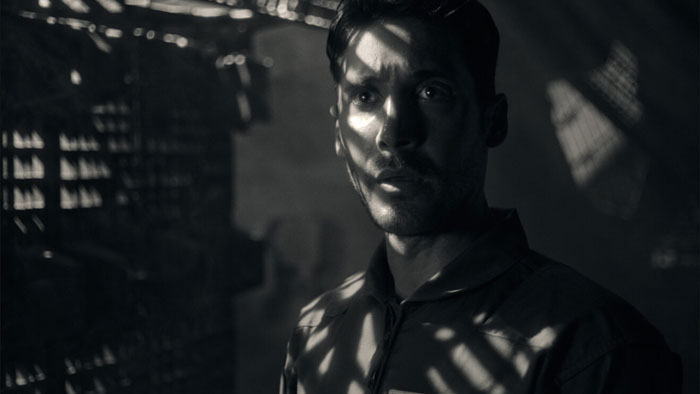
“Don’t go up there…don’t go…” says a raspy, mysterious voice over the phone early on in Angad Aulakh’s spellbinding, ambitious Aurora.
The peaceful night sky of space is seen briefly through the window of a ship in the opening montage of Aulakh’s film, even if that is interspersed with the treacherous rocking of the journey upward. Once we get there, though, that peace is unlike any other: white dots freckling the vast blackness and a disquieting space scape. The difficulty to accept what you don’t understand is an undercurrent handsomely threaded throughout Aulakh’s short, but that theme takes a double meaning when you think about the unknown in the sky and what you may not have been told by people you are supposed to trust. Visually stark but urgently intelligent, Aurora is a dazzling experience.
Guy Kent’s Freddie Ballard has trepidation before his next mission into space even though his partner (played by Jennalyn Ponraj) assures him that his feet will be back on the ground in no time. “It will be the fastest eight months of our lives,” she tells him. Ballard isn’t so sure, though. He thinks that the higher-ups aren’t revealing the truth about everything. We see it physically in Kent’s body language–he’s physically unnerved by the notion of returning to that vastness.
Ballard’s next mission will take him to L2 to locate and explore a strange signal that no one seems to understand. The eight-person mission capsizes immediately when an explosion kills everyone but Ballard, and he is left alone on a lonely, dark ship as his dreams take a confusing and alarming turn. Do his superiors have an ulterior motive for sending back with little explanation? Time seems to bend in Aurora as Ballard reckons with his present and his purpose. Even with a film as driven as this one, it asks us to look inward as Aulakh invites us to look at a space-set narrative removed from the kinds we have been watching for generations. This is not Gravity or Apollo 13 or even Event Horizon as this filmmaker allows Ballard’s grief and disorientation to become tactile.
Aulakh uses costuming, language, shadow, and light in refreshing way, and he wants to tell a story while exploring his faith and lineage while crafting one of the most striking films set in space that you will ever see. The images almost melt into one another as dreams plague Ballard’s mind and his time on his ship becomes more dire. There is one shot of a body on a gurney covered with a sheet that becomes an image of something else so smoothly and calmly that it has haunted me ever since I tuned into Aurora.
A tale of renewal and purpose, Aulakh’s film is something entirely and wholly unique: lyrical in its beauty and boundless in its scope.