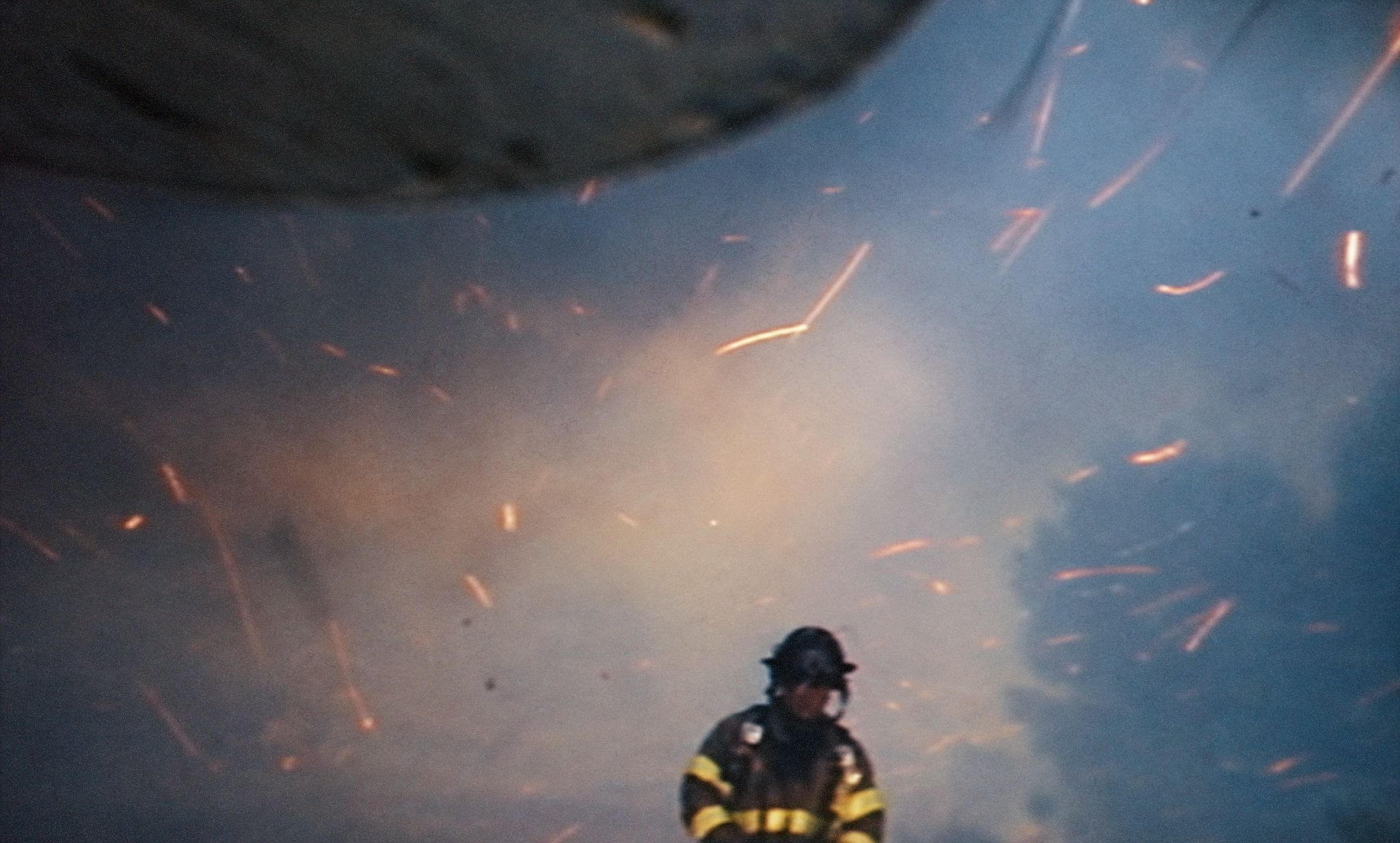
What would it take for you to give yourself permission to grieve or realize that you needed help in order to mentally and physically heal? Would you be able to confront the stigma of the practices that are necessary for you to find peace? How would you able to extend those revelations to the ones you love? Brandon Kapelow’s Under Fire may focus on the struggle of a firefighter, but it’s not the story you might think it is. It’s an unexpected and overwhelmingly emotional ride about how many of us need to look inward in order to project the goodness back out.
Under Fire opens with a horizon lit by golden flame. From a distance, it may almost seem beautiful even though we know that the destruction will haunt many. Violence comes close to us several times throughout Kapelow’s film, but it is never about the acts themselves but more about how they can live within our cells and how that trauma takes a life of its own. We are introduced to Fire Captain Rob Christensen, a man who lives by the guiding principle that our “sacred responsibility” is to help others. “If I wasn’t existing and not helping others, I wouldn’t want to live” he says.
In order to alleviate stress (and stress that his body feels more than his mind), Rob undergoes experimental ketamine-assisted therapy. With remarkable intimacy, Kapelow watches Rob in these sessions where he can then express his concerns and he can react to his dreams–it’s intimate and feels like we are watching something being unlocked in another human being in exceptional ways. When we hear the word ‘ketamine,’ though, does an opinion automatically lodge into our brain? Do we have stigmas or biases even though this therapy can clearly do wonders for those who respond to it? It’s worth noting that Kapelow resists aggressive confrontation. His hand is observational, gentle, and encouraging as we witness Rob unravel his experiences, and the filmmaker
Under Fire does not solely focus on Rob’s exploration of his mental health, but we witness his relationship with his mother while Rob’s daughter, Keylie, has her own discussions about how she feels about her daily life. Perhaps each generation recognizes and confronts their feelings more head-on as we become more comfortable with communicating about the importance of our mental health. That intergenerational dynamic is something we can all pull from, whether we know it in the moment or not.
One of the final images Kapelow uses focuses on the point of view of a firefighter as they battle to extinguish a fire, and we are left with something rather stirring to consider. We can look at what was destroyed and run away from it, or we can run towards it in an effort to acknowledge that we can grow and change because of what we have been through. Rescue comes in all different forms.
Under Fire is currently playing as part of DOC NYC.