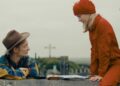

“Who are we?” Is the question at the heart of nearly every Martin Scorsese film. Who are we on the inside, at our core, and what darkness are we capable of? Rebecca Miller’s five-part series on Apple TV aims to uncover who Martin Scorsese is, and it comes about as close as any film or series could. Even at just under five hours, Mr. Scorsese isn’t quite enough, but how many hours would we need? Fifteen? Twenty? The width and breadth of Scorsese’s career is so remarkable that I don’t know that you can put a number on it. Hell, any number of his films (Mean Streets, Taxi Driver, Raging Bull, The Last Temptation of Christ, GoodFellas, The Departed, The Wolf of Wall Street, and on and on…) could support a ninety-minute to two-hour documentary themselves.
Miller’s production is doomed to leave you wanting more, but what’s notable is that everything that’s here is choice. Seldom have I sat through any five-hour production so rapt with attention. Miller maximizes value at all turns. She even gets the most out of Robert De Niro’s pregnant pauses and incomplete sentences by cutting perfectly and moving to a sequence that supports what we believe De Niro was trying to say. Miller, the daughter of playwright Arthur Miller and partner to Daniel Day-Lewis, has lived a life deeply rooted in the intellectual pursuit of the arts, and it shows.
The early portion of the series focuses on Scorsese’s youth, his NYC neighborhood, and his Italian-American heritage. There is extraordinary footage of Scorsese’s original storyboards, as well as revealing commentary on the dangerous people who populated the streets surrounding the family home. We learn early where Scorsese’s fascination with the underworld began. It began right outside his door. We also learn a great deal about an undersized boy with such a problematic case of asthma that his dad took him to the movies all day long because the theaters had air conditioning. As one childhood friend states, “Marty’s life depended on going to movies. That’s where he could breathe.” Or, as Spike Lee jovially states, “Thank god for asthma!” Without asthma, Scorsese might not have become a filmmaker.
One of the great services the series provides is undercutting the notion that Scorsese is just a “gangster film director.” Scorsese has made 29 feature-length films, and only five of them are true gangster films. By covering Alice Doesn’t Live Here Anymore, The Last Waltz, Silence, The Age of Innocence, and so many others, we can see the depth of Scorsese’s work. He may be the greatest maker of gangster films in history, but it’s only a corner of his career; it’s not the whole block.
Mr. Scorese also dispels the notion that any of this has been easy for the fabled director. Hollywood never accepted Scorsese, fought the ratings board numerous times, needed FBI security at least twice in his career, and even his most successful films were a bear to get made. The studio wanted to change the ending of The Departed to allow both leads (Matt Damon and Leonardo DiCaprio) to live so they could create a franchise. The Wolf of Wall Street was financed independently through sources DiCaprio connected with. Casino might have been shut down if Sharon Stone hadn’t fought for her director.
As one might expect, Scorsese and DeNiro’s abiding bond is well covered here. What is also revealing is the importance DiCaprio has played in the latter part of Scorsese’s film history. At a time when Scorsese needed a white knight to help finance the films he wanted to make, DiCaprio stepped in, bringing not only his talent but also his bankability.
While the series does miss contributions from Harvey Keitel and Joe Pesci, the input from longtime Scorsese collaborators and friends, including Nicholas Pileggi, DiCaprio, Day-Lewis, Spike Lee, Spielberg, Blanchett, Stone, and De Palma, makes up for a lot. Miller even gets Jodie Foster to speak on John Hinckley Jr.’s Taxi Driver-inspired assassination attempt on Ronald Reagan—something she has heretofore been loath to do.
All the episodes in the series are gems, but it’s four that really flies. Starting with the controversy that surrounded The Last Temptation of Christ before moving into a deep dive into the “pure montage” artistry of GoodFellas, to the emotional “savagery” of The Age of Innocence, the failure of Kunduun and Bringing Out the Dead, and ending with the beginning of the Scorsese/DiCaprio partnership, Gangs of New York, the hour is a locomotive retelling of cinematic history, and how Scorsese began to find balance in his own life.
The fifth and final episode attempts to cover too much ground, but again, every tidbit is delicious. What’s particularly fascinating about the series as a whole is how joyful it is. Despite the pain and suffering of a true artist, the substance abuse, and the often grim subject matter of his films, viewing all this cinematic bounty through Miller’s astute assembly, interviews, and direction is a stone gas. More than even that, the series marks the passage of time over eight decades in America through Scorsese’s lens. It is nothing less than exhilarating.
It doesn’t hurt that the man himself is so naturally entertaining, effusive, and open. Speaking in his rat-a-tat staccato rhythms, Scorsese is a font of boundless enthusiasm. I took note of how his shoulders heaved every time he laughed. I don’t know how one doesn’t respond positively to him as a person.
Mr. Scorsese is a comprehensive (or at least as comprehensive as it can be) look at the greatest, most accomplished filmmaker the United States of America has ever produced. I don’t know how anyone can argue otherwise. Seldom have I ever seen a docuseries so adroitly capture the essence of its subject. It is a series worthy of the man it attempts to illuminate, and mostly succeeds at doing so. It is an absolute gift.
Mr. Scorsese is streaming now on Apple TV