One of the most transortive, transfixing short films of the year reaches back to the creates we may have known growing up. Mermaids have been implanted in popular tales for children for generations, but Ali Cook’s film, The Pearl Comb, takes the alluring song and twists it to create a cautionary tale so steeped in lore that you might pause before stepping into the ocean. Cook’s film meets us at the intersections of science, fantasy, and gender politices as it questions whether our belief systems can be compromised.
On the surface, The Pearl Comb is a story about a man succumbing to a siren’s song, but it begins with an investigation. Set in 1893 in Cornwall, Betty, a fisherman’s wife, is questioned about an incident involving an alleged cure for consumption after it’s reported in the British Medical Review. When she explains that it isn’t a treatment but a gift from her late husband, our story begins, and we can sense that Cook spent time letting his lore brew.
“I am a professional magician originally, so that’s where my fascination with folklore comes from,” Cook says. “I love old myths and the history of real magic is something that I always found interesting. I was on holiday in Cornwall, and there’s a storyteller there who takes kids around to tell all the old legends of the area. It was there that I first heard how horrific the mermaid tales of Corwall were, and I thought it might be cool to do a mermaid story but rather than have a Disney princess, I would make them absolutely brutal killers. When I started writing around that, I looked at a few different legends and I had the beginnings of a story, but it wasn’t enough. I needed more of an endng. An ex actually said that women who were healers back then, even if they were doctors, they weren’t allowed to practice. Suddenly, I had this whole new drama, but basically it was a debate going: is she saying a shaggy dog tale to keep this doctor away from her real practice or is it real?”
The first image of Cook’s mermaid is seen from behind. She is reaching out to the sea, her back to us. When she speaks, it feels like her voice is enveloping us, like a snake wrapped around our body. We can hear it from every angle. Not only is Lutey, Betty’s husband, being seduced, but we are as well.
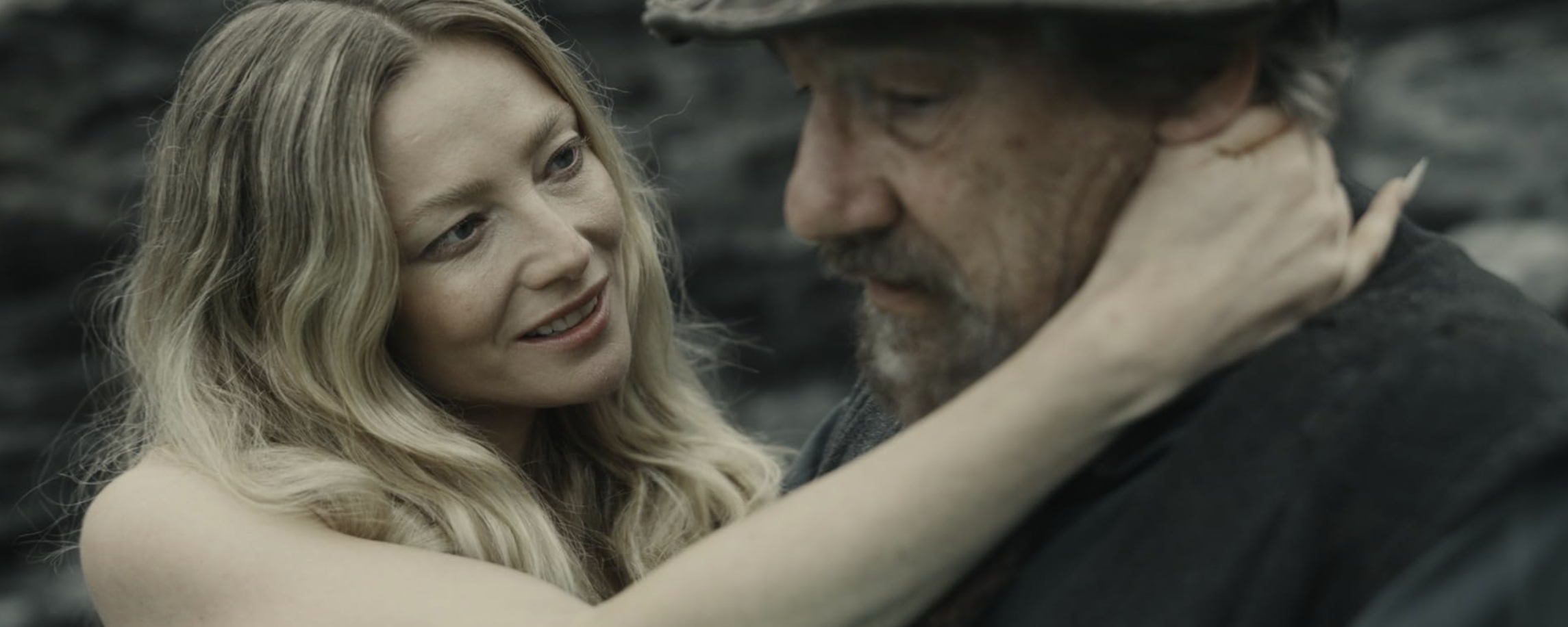
 “The original start of the story, when we first see her calling out, she’s reaching for her merman husband,” he says. “At that point, she really is stranded, but I had to cut all that. With the voice, that was a deliberate choice. Normally, the tradtional mermaid tends to have red hair with pale, white skin, so I wanted to subvert the normal expectation of that, but, at the same time, we were looking for an actress to play a mermaid, which is much more difficult than you think. It was very hard to find somebody who had that supreme alluring factor mixed with the feeling that she could kill you at any moment. I am not sure how Clara [Paget] managed it, but she really did. When I saw her self-tape, she really stood out. We gave her some hair extensions since we used her real hair, and we didn’t want to give her a bikini top. We thought that would look too modern, but my whole ethic of the design was [that] if she were real, they would look like a fish. She would shimmer and be kind of blue and green with some iridescence.”
Not a lot of props are given their due, but for Cook’s film, it was quite integral to the plot. Like everything in his film, it’s handsomely designed.
“The comb was an absolutely nightmare,” Cook says, with a laugh. “I came up with the teeth design where it’s kind of sharp and spindly and then the two at the end come in. A friend who read the script had the idea that the comb could be lethal, so in the earlier drafts, the comb wasn’t actually that sharp. It could act like a knife. With the merman design etched into it, that came from a real antique comb that my production designer found. It took ages and ages, but it’s a mixture of three different people’s thoughts. It’s a lot of pressure for a prop.”
There have been a number of short films this season that have raised the bar in terms of production design and visual spectable. Because it feels like an allegorical horror, every inch of the frame had to be meticulously designer. The costumes are distressed beautifully, as if the wind has effect their quality. The hair and makeup design is well researched, and the production design is top-tier.
“If you are watching Game of Thrones and the swords don’t look right, the illusion is shattered,” he says. “The real story is about how a woman is not allowed to practice, so, in that way, there’s sort of a grimness to Victorian life, which is why everything is overcast and washed out. If you portray things like that, when you then show the mermaid, it somehow feels a big more believable rather than when you’re watching a Marvel film and the VFX are fantastical. We wanted to merge it so it feels like that everything is real within the world. I learned this doing theater, but the moment you put something in the past, it seems easier to suspend your disbelief.”
There is so much beauty in how Cook captures the water of the sea. In one scene, Lutey and Betty are in a boat when The Mermaid arrives. The water is calm like glass before it erupts, and it almost feels like it was shot in black and white. How Cook uses light throughout his film should be commended for how it evokes mood and dread, but he admits that working on so much water was a particular challenge.
 “That was the most difficult scene, but in an unexpected way,” Cook admits. “We filmed it using black screen after a big debate, so it’s essentially a big, black box but under the boat it’s blue screen. We have two men covered in blue material rocking it, and I have to commend them since they were rocking it all day. We had a school desk that Clara would go from kneeling to standing, and we have two fire hoses behind us spraying her back to create the water before we mix it all with VFX. It sounds simple, but, my god, was it hard work. We had a stunt double who was our underwater guy, and he would stand in in a full wetsuit. We were literally spraying him from different angles to see how much of a spray we could get off his back. Clara has to step in and be really demure while being kind of Jesus-like. I was so impressed.”
Without spoiling anything, one of my favorite shots of the year involves a large water tank and the color red. As the scene unfolds, it feels like the shade deepends in threatening and disturbing ways.
“I worked wirh Dave Miller, my cinematographer, on my first short, so we established this look together,” he says. “They put this LUT into the actual camera itself that gives it this very washed out feeling, but it really hinged on getting tanks of water with different food dyes. In the grade, we can alter it a bit, but not that much. What we did is we got just the right hue and had a lot of practice with different water tanks. Finally, when we shot it from above, we had four lights in the tank. If you imagine we’re backlighting the red to make it even richer.”