Building an entire neighborhood was just one of the many creative challenges that production designer Denise Pizzini had working on Apple TV+’s Pluribus.
Production designer Denise Pizzini scouted locations in the Canary Islands and in Las Vegas for just the right space on Apple TV+’s Pluribus, and then she would build an entire ice hotel and Peruvian village from scratch. All these details made the world of Pluribus so distinct and lived in, even when no one was around.
The Contending: One of the big things for this show set-wise was the whole fact that Carol’s neighborhood was built from scratch. What was behind that decision, and what was it like to create?
Denise Pizzini: The decision was made because Vince knew from his previous experience on Breaking Bad and Better Call Saul that going into a neighborhood over and over and over again is disruptive to the community. And he was concerned that we had so many things to do in Carol’s neighborhood: flying helicopters, explosions, fires, and a lot of other stuff. He knew from the very beginning that he wanted to build it. So, we found a piece of property that was able to be leased to us for several years. One of Vince’s requirements was he wanted Carol’s house to have a view of all the city lights of Albuquerque.
So, we found this piece of property, and then we began laying out the neighborhood. We knew that we would see cars coming up into the cul-de-sac and cars leaving the cul-de-sac, but we also had to have the right kind of curve, so it looked like there was more neighborhood beyond just our seven houses. Then we were able to customize Carol’s house that works for the story. She needed to be able to look out her window or stand on her front porch and see every garage and every front door of all the houses in the neighborhood. It was a huge project because this was empty land: There were no trees, there was a lot of lava rock. So we had to plant all the trees and do all the landscaping in Carol’s backyard. Then we had to customize each house to make it not look like a cookie-cutter neighborhood like so many in Albuquerque. We wanted to level it up a little bit and make them all look like custom homes, and we had to actually build a road that went into this neighborhood. With all this work, we had to go to lots of meetings with the city of Albuquerque because they weren’t quite sure if we were building houses or building sets. Because we want these houses to stand, hopefully, for many seasons. So we ended up laying the whole thing out, pouring proper slabs and using real roofs. Now all the houses are done all the way around but the insides are empty, except Carol’s and the house that Manousos is living in at the end of the season. But all the houses are different and have their own personalities. So it was quite a project.
The Contending: With Manousos’s house, both Paraguay and Albuquerque have many contrasts with Carol’s home. What went into their creation?
Denise Pizzini: We went back and forth on where Manousos was gonna be. We knew Carol was going to put him in one of the neighbor’s houses. And that house was already designed at the beginning of the show. We knew that Manousos was gonna come, but then the question was, are we building his interior on stage somewhere? So we followed the design aesthetic of the house that we chose and what would work for the action. You know, he has to go in, and he’s working on all his little projects. We didn’t want it too big or too vast because he just moved from the ambulance to this house. Plus, that house was also close enough to Carol’s, so I guess in Season 2, there’s going to be a lot of neighborly interaction.
But his own home in Paraguay, and his office, that was very intentional because it had to look very different from anything we’ve seen in Albuquerque. So, anytime we designed anything that was supposed to be another country, I turned up the color palette and made the colors much more intense and went with a lot of bolder kinds of decisions. So his office was built in Albuquerque at an actual storage facility, and we reworked that storage facility to work for him, and we added a second story. So he can look out, and he can see the Joined bringing the food at the gate.
Then we found his garage and his home when we were filming in the Canary Islands, which was great because there are so many details, like light switches and electrical outlets and stuff that is very authentic to other countries. I was fortunate enough to be able to scout those neighborhoods before we even got to that episode. So, going back to designing his office in Albuquerque, I could pull from all those reference photos and all those scout pictures and tie the two together so it looks like all one place.
The Contending: One small but important set for me was Quechua’s village. The Joined keeps it looking authentic for her till she joins and then abandons it. What was that like to build?
Denise Pizzini: Since that was one of the last episodes, it felt like I came full circle because now I needed to do a Peruvian cul-de-sac. That also was all built from scratch. We found some land that would work, with enough landscape in the distance where we could VFX the Andes in, and I noticed when I watched it, they added a few more huts way deep in the background.
The land was a grassy field so we had to clear everything to make it feel lived in, and there was a lot of research involved to be sure that it looked authentic. It was all about the rocks, thatched roof, the textures, and colors. I had some amazing plasterers and painters that really worked hard, using vacuform skins, that looked very real. They went into great detail of aging the roofs and putting the right kind of debris and everything on there. Also, a lot of research went into how they made their fences and corralled their animals. Plus, what they did in each of their huts: So we had a weaving hut, a hut for food, a central area that had a well and fire pit. It was fun and took quite a bit of research, but I was pleased how that actually came out.
The Contending: You also got to create some very luxurious places–the Las Vegas area, the interior of Air Force One. What was the vibe you were going for with these places?
Denise Pizzini: With Las Vegas, we wanted it to be a little bit over the top because this is where Mr. Diabaté is, and he’s a little eccentric and dressing a bit over the top. But in Las Vegas, we were actually at the Westgate Hotel, and we didn’t change a lot, but enhanced it. We brought in portraits of Diabaté that we had customized and made this fantasy for him where he’s starring at the Westgate, so there’s all kinds of stuff like that all over. The Westgate worked perfectly for that, and we were able to use two different suites when he and Carol were spending their time together.
For Air Force One, we built that completely from scratch on a stage, and I have this theory that, once this event happens, that everything becomes a little calmer and cleaner and more austere, and it’s just not so chaotic. So, Air Force One is almost like a model airplane. It’s just kind of perfect, everything’s shiny, everything’s clean, there for Mr. Diabaté to use. We took a little bit of license with the color palette, but it is Air Force One, so it can be whatever the president wants it to be. In my mind, whoever the president was had this richer and more tasteful palette than the usual more militant or dated look you see.
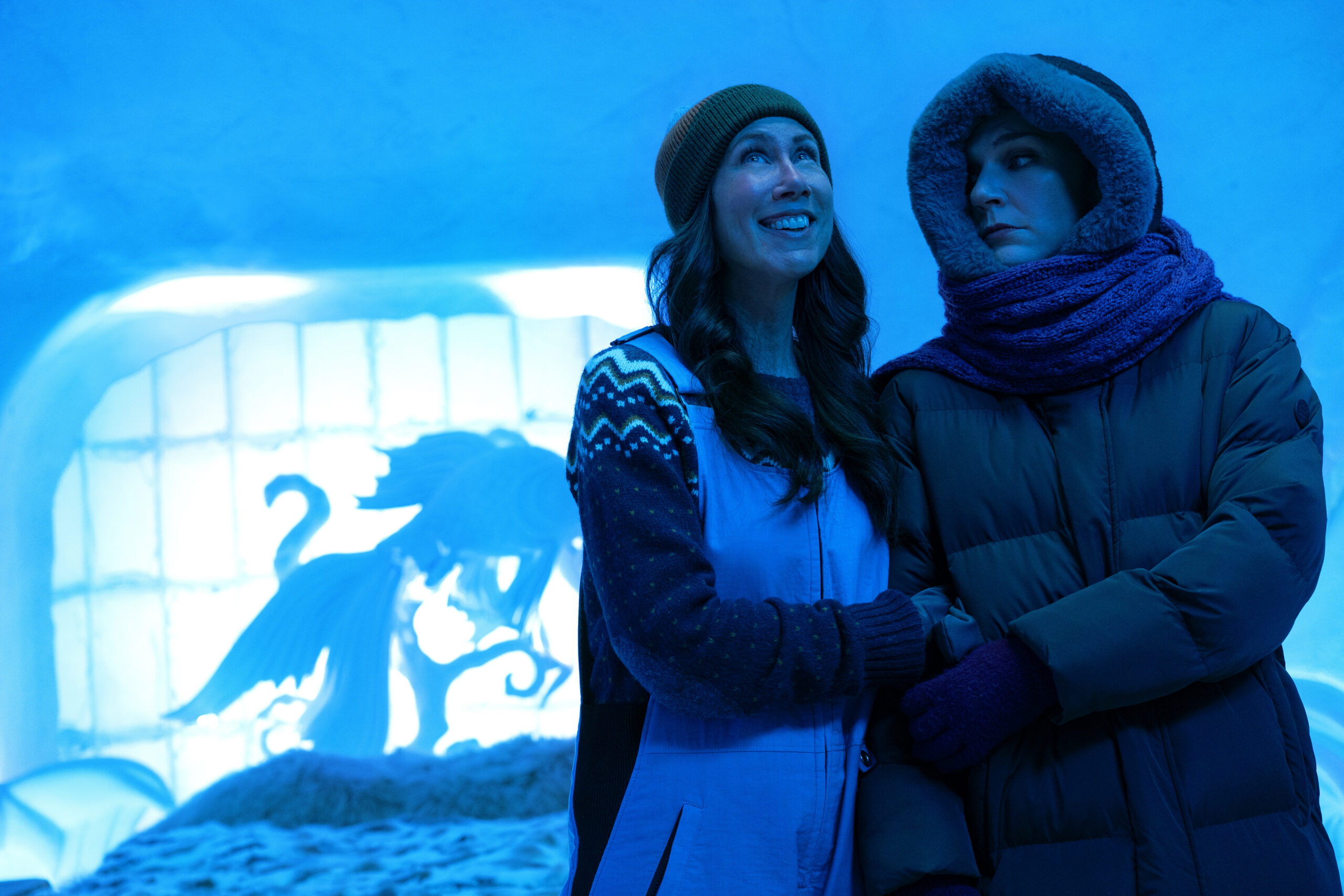
The Contending: You made an entire ice hotel for this show. What was behind that creation, and what went into making it?
Denise Pizzini: Well, it was in the script, and that’s the thing about our scripts: They’re so detailed that it is a blueprint for what we need to do. How we execute it is my problem. We did a lot of research on ice hotels, and what happens with these ice hotels is they’re seasonal in these different regions. So they hire different artists or architects and they’re able to create their own hotel. I mean, it’s fascinating how many different themes there are. So, I came up with we’ll just pretend like they’ve asked us to do an ice hotel. I came up with this kind of nature theme, so in the hallway we had a butterfly and some flowers and trees filling that space. Then, you have these wooden doors, which almost feel cabin-like. But then when you go into Carol’s room, it’s like a koi theme, and it has these Japanese waves, and since the room was round, we had to have these skylights up there where they can sit on the bed and look at the northern lights. I thought these waves gave it a nice congruent flow through these big koi fish in there. Then we used real ice blocks for holding up the bed. We sculpted all of it, so we had people, you know, carving for weeks doing it, and they were super talented.
The Contending: I read that you used different buildings for all the hospitals. What did you use?
Denise Pizzini: When she goes to the emergency room, that was like a high school community center. The second one was a community college and downstairs, where she’s meeting the DHL guy in what was their library. So we just had to clear everything out and make that the waiting room. Then the Paraguay Hospital was actually a facility they used in Albuquerque for hospitals as a set. The important thing was they all had to look different. You had to believe that they were in different places, which they actually were.
The Contending: Is there anything else you want our readers to know?
Denise Pizzini: Yes, the Darien Gap was a bit of a challenge, because there’s no jungle-type place in New Mexico. The initial scout that went to the Canary Islands was looking for places that could shoot as the Darien Gap and would go to these canyons with these giant cliffs, and the scale of them was so big. Plus we knew we had a scene where we had to burn a car and so that would be difficult to do in the Canary Islands. So, we created part of that Darien Gap in New Mexico. So I had to create these cliffs, and our greens team brought in all the right kinds of plants and stuff, so we could do a lot of the night things that Manousos was going through.
We found a section in Albuquerque that we could use for the car burning scene as well as a place that had cliffs. Then we cut to the Canary Islands for him hiking through these deep canyons, but we made all the rocks and Chunga Palm in Albuquerque and shipped them to the Canary Islands. But again, I had already scouted it and researched it, so I was able to create what we did in Albuquerque first, so it all kind of came together after that.
Pluribus is streaming on Apple TV+.