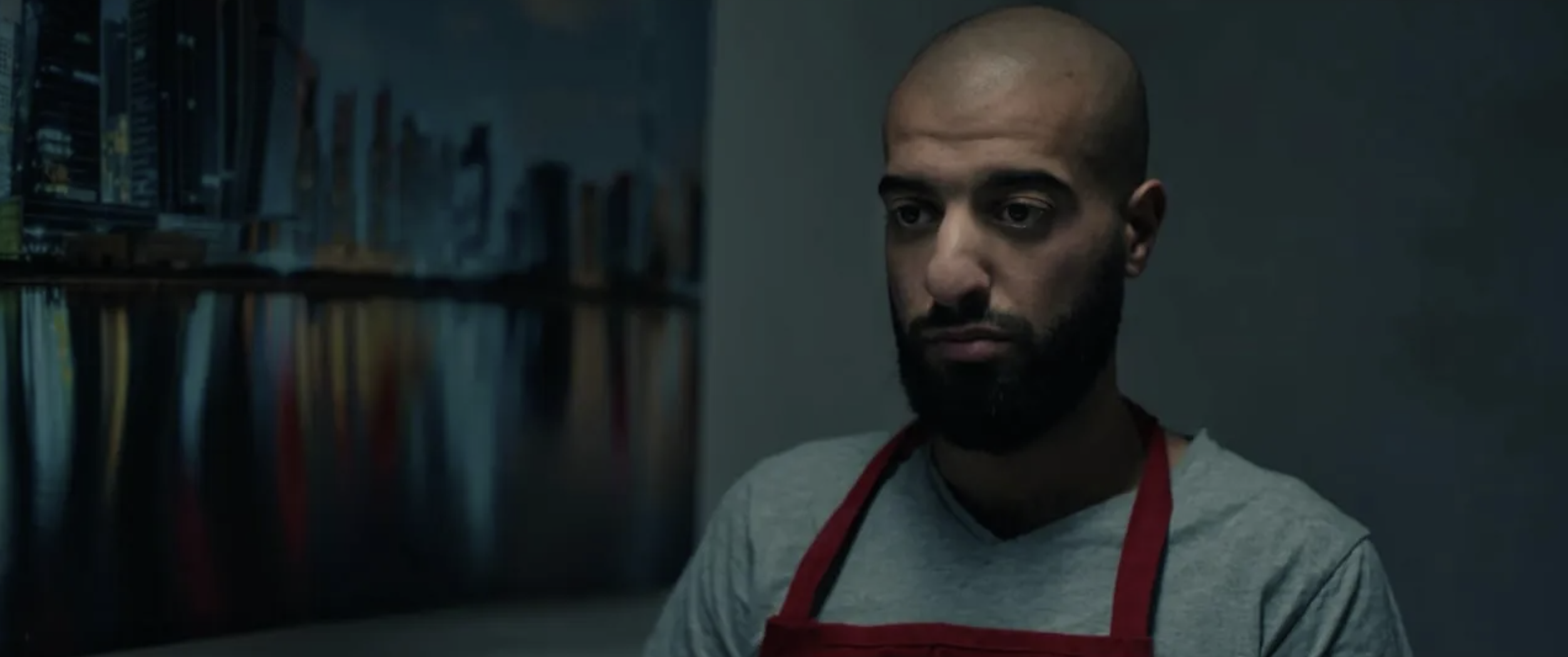
There is a restrictive feeling that comes over you as you watch Meyer Levinson-Blount’s Oscar-nominated Live Action Short Film, Butcher’s Stain. It feels like an embrace that feels unsettlingly firm around your torso or not unlike the feeling of a snake wrapping its body around your most precious extemities. This is a film about unexpected paranoia that sinks into you and how you defend yourself and lay claim to your own identity. It should not go unmentioned that Levinson-Blount is one of the only Student Academy Awards to make it to cinema’s biggest night. Butcher’s Stain is skillfully constracted and never allows its high emotions to fully evaporate from the screen.
Samir, a Palestinian butcher, works at a bustling Israeli supermarket. I cannot help but think about how the job takes a toll on his body: he bends his tall frame down into the case and stands on his feet all day. When his direct supervisor, Michal, pulls Samir into her office, she informs him that someone witnessed him tearing down posters of Israeli hostage that were hanging in the break room. She cannot tell him who accused him, but she mentions that she knows that he stays later in the afternoon and that he is always early in the mornings. We can feel the warmth leaving Samir’s body. ‘Why would I do this?” he asks, his voice low.
Levinson-Blount strings tension throughout his film in a variety of ways. During the accusation scene, he explains how he blocked the exchange like a break-up scene between two young lovers. Anyone who has been blindsided by a relationship ending will know that catching in your throat or how your pulse seems to race. That tension is entirely different from when we see Samir trying to figure out his finances when he considers how he might have to find other work, and there is a scene where Samir spies on a coworker thinking that he might find his accuser.
Basing this film off of a personal experience, Levinson-Blount cleverly uses his dialogue that will make you re-evaluate the story’s structure upon repeat viewings. In the film’s most dramatic moment, Samir yells out, ‘I’m in pain!’ in front of his co-workers, and we feel how that must have lived inside his body for days after everyone’s glaces turned nefarious. Omar Sameer displays such raw power in this central performance.
Once you have been told that people view you in a certain way, can you shake that accusation off of you? Towards the end of the film, Levinson-Blount stages one shot where all of Samir’s coworkers are assembled in the frame, and we cannot unsee how their collective judgement literally feels on this butcher’s presence. In that moment, he might feel alone, but he stands tall.



![Theo Rossi Trifecta: In-Depth Chat About His 3 Fab New Films: ‘Bruton,’ ‘Come With Me,’ & ‘The Saviors’ [VIDEO]](https://thecontending.com/wp-content/uploads/2026/07/Bruton-120x86.jpg)