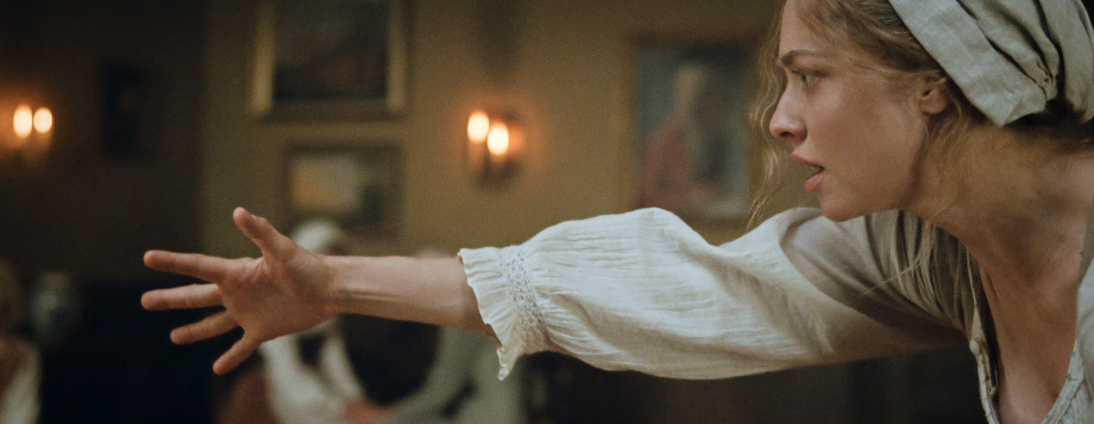
The Testament of Ann Lee production designer Sam Bader describes designing for Mona Fastvold’s dance sequences.
In Mona Fastvold‘s The Testament of Ann Lee, the Shakers move around A LOT — both with their dance movements and shifting their community from Manchester, England to America. That brought about some challenges for production designer Sam Bader.
“Aesthetically, we were transforming as few locations as we could to tell the widest, most sweeping story,” says Bader. “For the Shaker stuff, we built it all, or we shot in the real Shaker Village. Towards the end of the film, you almost have to do a second-by-second pause as you do those montages and point out what was done in the Shaker Village in Lee, Massachusetts, versus what we built in Budapest.”
Bader says he and his team took over spaces and skinned them, erasing as much modernity and the Central European look as they could, with the outdoor scenes bringing their own challenges.
“We largely were in pre-existing backlots all around Hungary that had that Jacobean English look. And then, on a Viennese set, we knew if you really look at the key-ons and the windows and the casings on the street level, it does actually work. If you paint everything up and add all the Georgian colonial detail, then it’s a total win. More than any other spaces in this film, William Rexer (cinematographer), Mona, and I were designing to shots for those, for like every beat you felt when you’re walking around Manchester and when you’re walking around New York in particular.”
Not only did location affect his choices, but so did Fastvold’s dynamic filming style, especially those sweeping dance sequences.
“They’re fully dressed spaces, and you don’t want to feel like, okay, we gave the director and the DP three rooms that don’t go to anywhere. There has to be that connective tissue, and the camera has to be able to wind into a corridor, turn around, do a 180, and move back through. Having that ability to explain the entire floor of an estate, for example, with a townie home was a huge challenge. And it just meant working out a logic to the whole interior rather than, okay, we’re in this room, but we’re really only covering this angle. Like that’s a big difference.”
When it came to the Shaker dance work, Bader says they wanted to represent what those meeting houses were like in reality and adhere to it as tightly as they could.
“How can we provide an expansive meeting hall that can have 80-plus people moving concentrically? That was more of an engineering and a construction challenge because we were going to be building that. We had explored all of these scenarios early on about what it would have meant to build a freestanding interior exterior in an arboretum, what it would have meant to try to build it even as an interior-only set as a freestanding structure.”
When troubleshooting this issue, a large 1900s warehouse full of cinder blocks and columns provided Bader with an aha moment when they discovered its expansive vaulted ceiling.
“You looked up, and you’re like, wait, that’s a pretty perfect ceiling that does everything we wanted to do. So then it became a negotiation with the location. We knocked out every wall that wasn’t load-bearing, so we could have windows and door openings. And then we built an entire set into it as a shell, basically. Just having that superstructure pre-existing, freestanding allowed us to throw up a very expansive set in a very tight time frame.”
The Testament of Ann Lee is in select theaters.


![James Cusati-Moyer On the World Premiere of ‘Sacred Creatures’ at Edinburgh International Film Festival [VIDEO]](https://thecontending.com/wp-content/uploads/2026/08/SC_MicRay_10_Courtesy-Nicolas-Villegas-H-120x86.jpg)