One of the many perils of formulating a “best of” list so close to the year in consideration is there’s no way you’ve seen everything worth viewing within the year in question. Such is the case with the year 2025 and my viewing of Netflix’s documentary on the legendary New York Times and New Yorker Magazine investigative reporter Seymour “Sy” Hersh.
Directed by Laura Poitras (thrice Oscar-nominated documentarian for My Country My Country, Citizen Four, and All the Beauty and the Bloodshed) and Mark Obenhaus, Cover-Up is not only a contender for best documentary of the year, but it’s also one of the best films of any kind in the last year. For more than twenty years, Poitras had been attempting to get Hersh to participate in a film about his career in journalism.
Hersh is no easy subject, though. Flinty, contentious, and reluctant, Hersh pushes back against Poitras throughout the film. Some of his concerns revolve around protecting his sources. He’s also a man who says he doesn’t like talking about himself. While both of those statements appear to be true, there is an element of paranoia at play. Hersh has spent his entire life talking to people in the shadows before bringing the truth to light. There is a protective nature about the man that isn’t hard to understand. After all, it’s not paranoia if they’re after you, and at multiple times in his life, the not-so-mysterious “they” have been after him.
Cover-Up gives the viewer some solid background on Hersh’s youth. Coming from a middle-class background, Hersh began his working life at his father’s dry cleaners, where his dad employed primarily people of color. There is a moving anecdote regarding a Black man in Hersh’s father’s employ who took the young Hersh to Negro League Baseball games and told him that he would never be so constrained, but that his chaperone to the ball game would forever be cleaning clothes. The moment is not overemphasized in the film, but it is an undeniable factor in how Hersh came to view the world.
The Dugway Sheep Incident & The My Lai Massacre
The first story of significant import that Hersh broke is a long-forgotten case known as the Dugway Sheep Incident, in which the U.S. Army killed more than 6,000 sheep owned by ranchers and farmers while conducting the open-air testing of nerve gas. Hersh not only broke the story, but his dogged reporting ultimately revealed that the obfuscating branch of the U.S. military was responsible.
As damning and revealing as the Dugway story was, Hersh was just getting started. His coverage of the Vietnam War was integral in exposing the folly of U.S. operations in the Southeast Asian country where the conflict took place. No reporting by Hersh, or possibly any other journalist, was as significant as his exposure of the My Lai massacre, in which American troops opened fire on civilians in a small village, killing more than 400 men, women, children, and infants. Hersh’s exposure of My Lai played a significant part in turning Americans against the war.
The horror of what Hersh saw and learned affected him deeply. Even though the massacre occurred more than fifty years ago, the wounds are still just beneath the surface. Hersh is a tough man, but in recalling the details of My Lai (a variation of the massacre was dramatized in Oliver Stone’s Platoon), he drops the reporter’s veil and struggles with his emotions.
The New York Times & The New Yorker
After My Lai, Hersh left freelancing and became a top reporter for the New York Times. Among the revelations in the film is how significant Hersh’s reporting on Nixon’s Watergate scandal was. While Woodward and Bernstein are given the bulk of the credit for undoing an American presidency, and received the distinction of being played by Robert Redford and Dustin Hoffman in All The President’s Men, Hersh’s work in the Times supported Woodward and Bernstein’s reporting in the Washington Post, playing a key role in keeping the story alive as the Post’s editors were getting nervous about the implications of the story.
Despite his success at the Times, Hersh would find his employment there untenable as he began to investigate major corporations. One of the film’s ironies is that Hersh was attempting to expose corporate misdeeds while working for the publicly traded New York Times. To many at the Times, the call was coming from within the house. Struggling to maintain what he considered his journalistic ethics, Hersh left the Times and landed at the New Yorker.
At one point in Cover-Up, Hersh states that censorship from above is not as concerning to him as “self-censorship.” The application of that statement can be seen very much in our modern day. Newspapers have become increasingly safe. Headlines and articles have been softened to avoid offending readers and the subjects of their articles. In recent weeks, as we have seen, Bari Weiss, the editor-in-chief of CBS News cancel a fully vetted, well-sourced, and legally compliant segment on the CECOT prison in El Salvador to avoid pushback from the Trump Administration over their favorite landing spot for expelled immigrants. Once again, the call is coming from within the house, only the dialer is at the peak of the corporation.
Abu Ghraib
Having covered Dugway, My Lai, and Watergate, one might think that lightning, having struck not once, not twice, but three times, that Hersh, who had become a very unpopular figure with the government and corporations, would struggle to break another story of such breadth. Hersh was more than a pebble in the shoes of the Pentagon and corporate America; he was a boulder on their shoulders. Then came Abu Ghraib. Hersh was at the frontline, exposing the torture, rape, and even murder that took place at the U.S.-controlled prison in Iraq.
Hersh’s reporting was essential in breaking the story of the soldiers who humiliated and harmed prisoners under their watch—many of whom committed no greater crime than being in the wrong place at the wrong time. The images that were revealed, along with the supporting words and context, once again turned public opinion against another war of American choice, not necessity.
“You Can’t Look The Other Way”
Hersh’s career is among the most remarkable of those who have committed to his vocation. That it was even possible seems like nothing less than a minor miracle. That Hersh’s growing renown didn’t make his work impossible is a surprise in and of itself. Why did people continue to talk to Hersh? The venerable reporter has an answer to that question: “People want to talk about stuff they did that was wrong and stupid. Time after time, I’m told things that turn out to be right.”
What is necessary is someone to be there to ask the questions. As journalism continues to descend into clickbait and the self-censorship Hersh speaks of, two questions came to my mind: “Who will fill these shoes? Will anyone be allowed to fill them?”
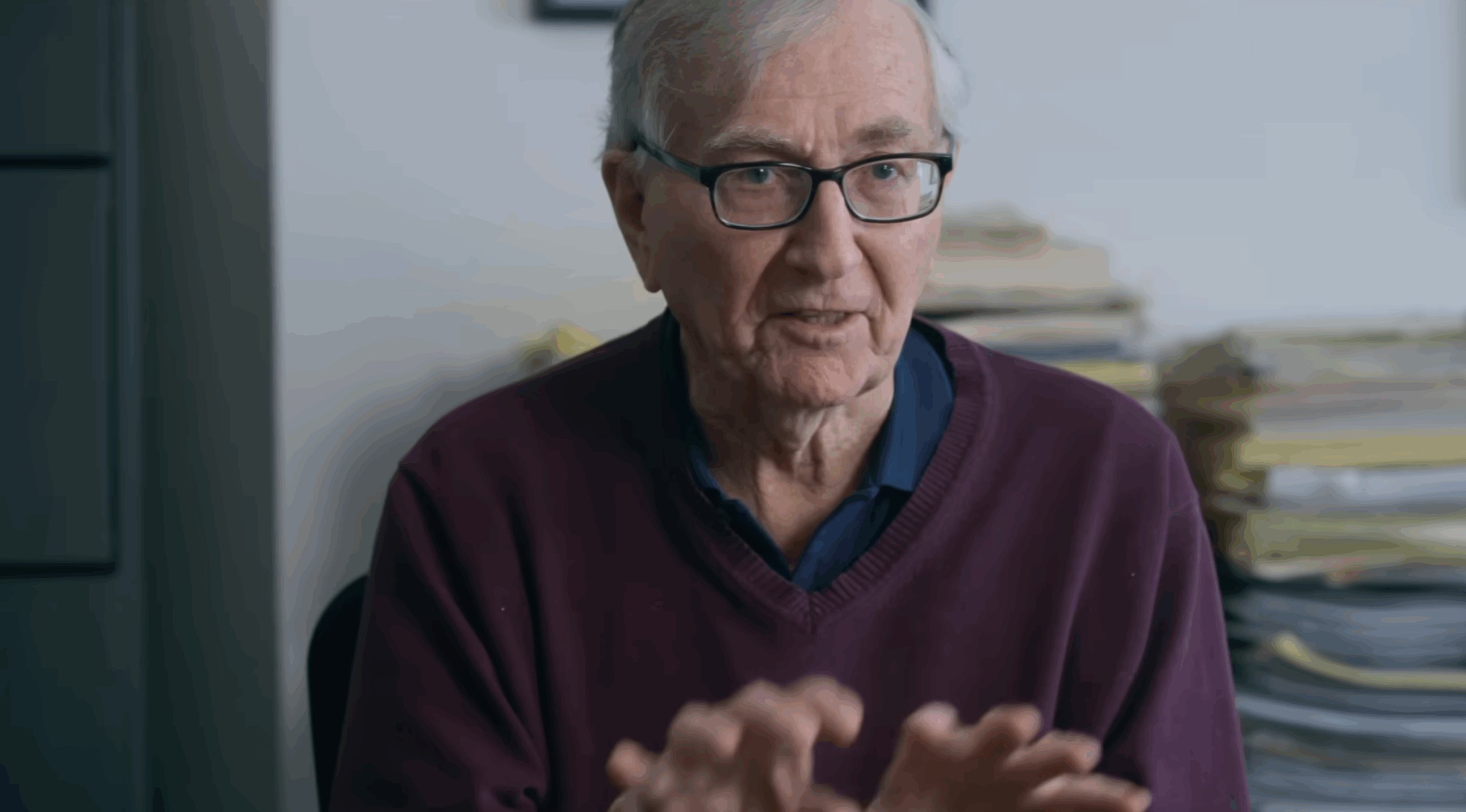
Seymour Hersh is now 88 years old. He’s still working. He’s still digging. Once again, he is a freelancer, and when his stories can’t find purchase in the papers of the day, he turns to Substack and pours out his words there. He is a man devoted to the pursuit of the truth. He cares so much about the quest that the weight of covering these stories is evident in his eyes.
“You can’t look the other way,” he says. But as I viewed Hersh in the final moments of this superior documentary, with stacks of files and newspapers surrounding him, I couldn’t help but think that this old Lion may be the last of his kind. That, to mix metaphors, Hersh is the last dodo bird. After him, there won’t be another.
In that way, Poitras and Obenhaus’s film, which often plays like one of those great paranoid thrillers of the ‘70s, is more than a documentary. It’s a tragedy on the pending fall of a once great republic. One that was never as great as we thought it was anyway.


![James Cusati-Moyer On the World Premiere of ‘Sacred Creatures’ at Edinburgh International Film Festival [VIDEO]](https://thecontending.com/wp-content/uploads/2026/08/SC_MicRay_10_Courtesy-Nicolas-Villegas-H-120x86.jpg)