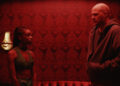
Megan McLachlan provides awards analysis on Lance Oppenheim and Nathan Fielder’s You Can See Everything. **Spoilers ahead!**
It was both the best- and worst-kept secret.
Over the past few weeks, many people speculated whether a certain actress who played Elizabeth Holmes would appear in Lance Oppenheim and Nathan Fielder’s documentary You Can See Everything. The actress in question, Amanda Seyfried, even stayed mum, acting as if she had no idea about what would happen in the film.
Now, the cat is out of the bag, and audiences have learned that Ms. Seyfried does not only indeed appear in the documentary but actually plays an integral part of it, performing reenactments as Holmes (again!) and even infotaining her muse’s husband with co-director Nathan Fielder.
Of course, Seyfried is wonderful in it—as both herself and as Elizabeth Holmes. In the scene that surely has garnered her awards attention, she tears up, with dry, chapped lips, as she reenacts the prison confrontation between Holmes and Fielder. It’s a remarkable achievement, surpassing a typical documentary dramatization.
Blurred Lines Between Narrative and Nonfiction
But just as You Can See Everything blurs the line between narrative and nonfiction, empathy and Stockholm Syndrome, Seyfried’s performance also becomes complicated because she also appears as herself in it—an arguably likable representation of an actress confronting what it is to receive accolades for playing a “fictional” version of a real-life person.
Fielder shows Seyfried the early footage he has from You Can See Everything, including Holmes watching The Dropout and subsequently crying from the depiction. Seyfried feels conflicted about it, even though she believes Holmes is still guilty of fraud. And when she tells Fielder she thinks she can get Holmes’ husband Billy to admit wrongdoing at dinner, Seyfried immediately crumbles upon seeing the children and hearing Holmes’ voice on the phone. “You’re wonderful,” she says.
Even though she and Billy have a heated argument over social media and Charlie Kirk (yes, really), Seyfried never gets him to show vulnerability or let his guard down.
Best Supporting Actress for Amanda Seyfried…Playing Amanda Seyfried?
And this is where Amanda Seyfried’s Oscar talk becomes complicated.
Part of the reason why Seyfried’s portrayal of Holmes is so affecting is because of how audiences get to know Seyfried the actress. While some detractors online have argued that she comes off negatively, I would argue that her flawed, “real-life” experience humanizes her. She’s not perfect, and she’s trying to figure that out. And in the end, she uses art to work through her misgivings, ultimately playing the most authentic version of Elizabeth Holmes she can—not from a team of writers in a writers’ room, but from the documentarian who had been following Holmes around for years, even living with her at some point. Seyfried’s prison scene is both an artistic triumph for her as an actress/human and also for Holmes, who finally got an authentic representation.
But does that make it feel like an Academy Award for Seyfried is an Academy Award for…well, being Amanda Seyfried? It’s a complex situation. The only kind of situation you could get from working with Nathan Fielder.
You Can See Everything is now in theaters.