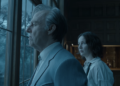
László Nemes’ stark, bleak look at human nature, Orphan (Árva), is the first essential film of 2025–provided it secures a release this year, and it must!
The film opens five years after the end of WW2. The camps have been liberated, and a young Jewish boy is reunited with his mother and awaits the return of his father. Cut to 1957 Budapest, the now adolescent boy, Andor (Bojtorján Barábas), is living with his mother (Andrea Waskovics), still waiting for his father.
The now Communist, antisemitic majority seem free to shout their feelings from the rooftops (sound familiar?) and Andor notices a fat, bald man on a motorbike who seems to be stalking his mother. It turns out the brutish oaf. Mihály (Grégory Gadebois), helped his mother survive being sent to the camps in exchange for money and sexual favors, despite the fact that he, himself, had a wife and child and he’s found her and wants to reinsert himself into her life.
There is also a compelling subplot involving Andor’s young friend (Elíz Szabó) who is helping to hide her teen brother, wanted by the police for being anti-regime.
A stunning reveal changes Andor’s life and sets him down a terrifying path where he must decide the kind of boy he is and man he wants to become.
The captivating Barábas dominates the screen as the curious, headstrong and determined young protagonist. He’s like a Hungarian Huckleberry Finn caught up in a world of bullies—even when they’re defeated they seem to come back in a different form. And as much as he adores his mother, he never quite seems to understand her intentions. This is Barábas’s first screen role and he is remarkable.
The engrossing narrative, screenplay by Nemes and Clara Royer, is never cloying or melodramatic and told from the POV of young Andor. The ending, though, will divide audiences.
The film is shot flat (1:33:1) and the cinematography, by Mátyás Erdély (who shot Son of Saul, Nemes’ last film) is absolutely stunning as are all the tech aspects. Nemes captures the period flawlessly.
Orphan is a reflection on identity, trauma and survival as well as the complexities of human nature. Though it is set predominately in the 1950s, after a true genocide, the plot frighteningly resonates with today where antisemitism is on the rise, despotic bullies are in power and those that follow them like lemmings, feel the freedom to wave their hate flags.
It brought to mind last year’s Venice entry The Brutalist, which was also unsparing in its storytelling, but this film is more potent and disturbing. It’s also strangely hopeful.
In Hungarian and Yiddish, with English subtitles.
Orphan is being shown In Competition at the Venice Film Festival.