
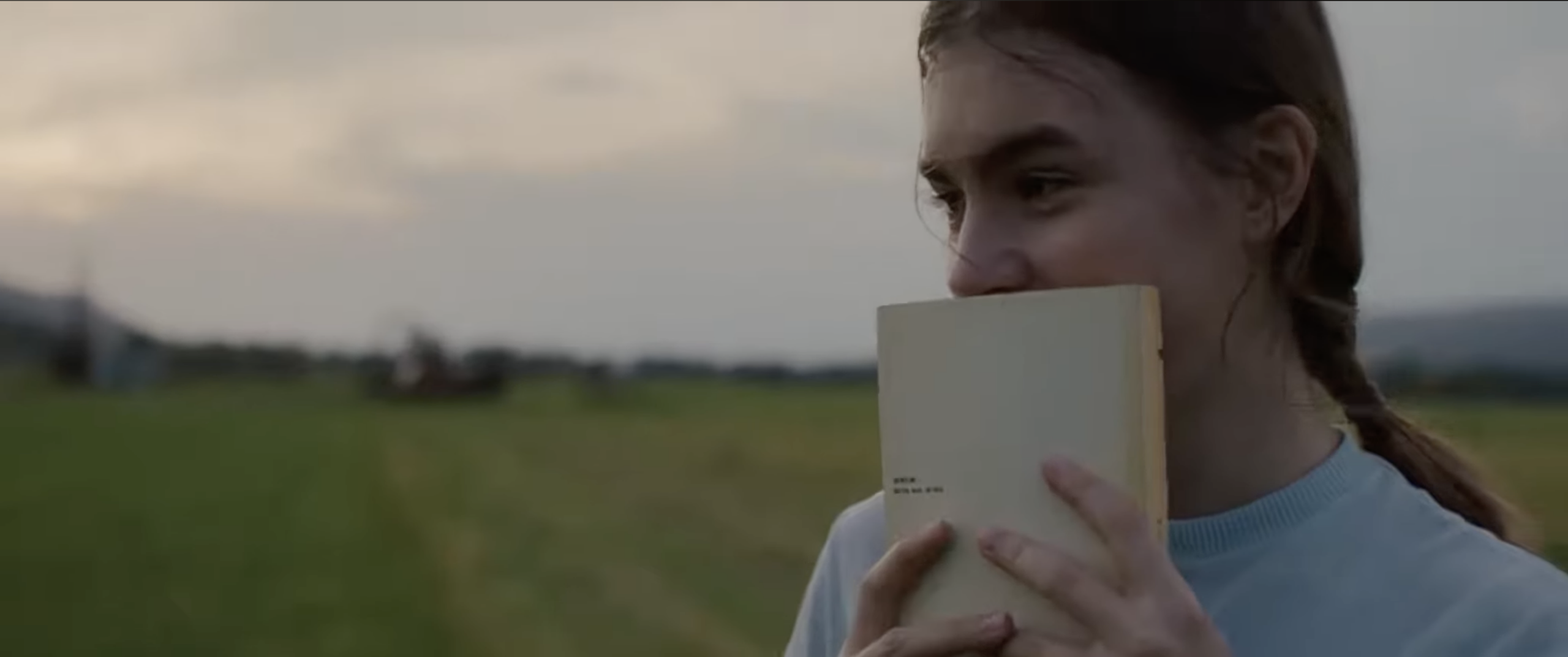
Little Mara needs to fly…in more ways than one. Mara lives in the tiny Czechoslovakian village of Ruske. The year is 1980. Progress is coming for Ruske, but whether it will benefit the village or sweep it aside remains to be seen. The powers that be are building a reservoir that will create a water source that will run through the village. It may eliminate the village altogether, or merely leave it forever changed.
The people of Ruske lead such a rural existence that they often operate like people dropped in from another century. Electricity and indoor plumbing are a house-to-house affair. Some may have one, the other, both, or none. Every home is a farm of a sort. Early in the film, we see Mara and her father bundling sticks to make into brooms. Rustic broom making is part of the economy, along with agriculture and a shoe factory.
Teen-aged Mara has dreams beyond the village. Her mother passed on years ago, and her dad is intransigent when it comes to considering her future path leading anywhere beyond the farm and the factory. But Mara needs to fly. She sneaks into a program for future pilots. If she scores high enough on the entrance exam, she will be admitted to the next class.
Her father will not hear of it. This is his land. He believes it should be Mara’s land, too. Whether she wants it or not. And she does not.
The push and pull between father and daughter is the personal story that plays out against the macro story: what happens to the people progress leaves behind. If the reservoir takes the whole land, the villagers will have their homes razed, their livestock sold off, their dead exhumed from their funeral plots, their church pulled apart. It is a great indignity for these people who have called this place home all their lives.
But for Mara, this is an opportunity. She roots for the village’s ruin. She’s ready to be relocated to the city. As for her father, he will be the last to go. First-time actor Sára Chripáková plays Mara. I can scarcely recall a time when I saw a newcomer so confident in a film role. Mara is in nearly every scene. The movie is her story, and Chripáková must carry the film on her tiny shoulders. She does so with aplomb.
If you grew up in a small town, you probably knew that fellow student who, one way or another, was going to get out. They see beyond their surroundings, despite almost no exposure to anything beyond their exceedingly modest homeland. They are struck, or afflicted, as Mara’s father might say, by ambition, and a fierce understanding that they won’t get many opportunities to fly away from home. Maybe that someone was you. Mara’s desire to fly planes is an undeniable metaphor for the freedom flight offers the earthbound, whether that bondage is physical or psychological.
As much as we hope Mara achieves her aspirations, she is not a perfect person. She deceives her father. She says words she can’t take back. She soon learns that with harsh words come painful consequences. But when Mara climbs into a two-seater plane and takes flight behind the pilot, we see and feel her joy. Now that she knows the air, it becomes clear she will do whatever she can to take flight again and again, for as long as she can.
Sensitively written and authentically directed by Martin Gonda, Flood is a deceptively simple film. There are no major plot twists. No moments of excess or flare. But beneath the basics of the plot and the predicament for Mara and the villagers, Flood asks significant questions: How bound are we to land? How bound are we to family? How bound are we to duty? And does the desire to take to the air, to leave, outweigh those binds?
The film makes the villagers’ hardships plain throughout. Before the reservoir threatens their land, we see the people managing a spartan existence. It may not look like a life many of us would want, but it is the life they know and believe in. It’s hard not to respect that. The question of whether the father can respect a determined daughter’s aspirations is dealt with honestly and with great difficulty. This is a very fine film.
As the film reached its well-earned, bittersweet ending, I thought of Mara and the year 1980, in which the film takes place. Mara would be about sixty now. I wonder what she would be doing. I hope she is up above the clouds, looking down on the cities, the fields, and the people. I would hope that she is flying.
Flood made its United States debut at the 2026 Virginia Film Festival on October 24, 2026