
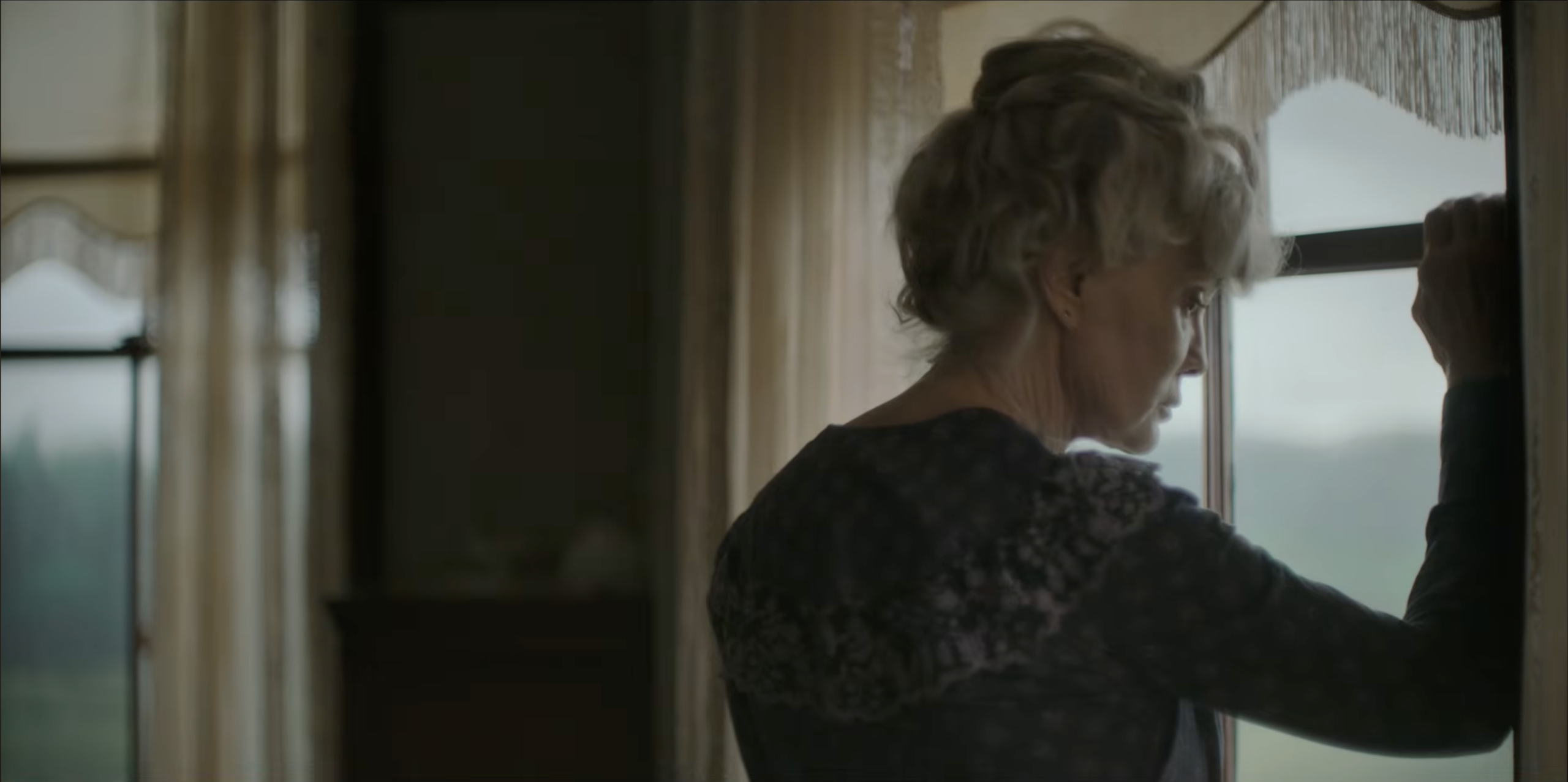
Jessica Lange has been playing Mary Tyrone in Eugene O’Neill’s Long Day’s Journey Into Night on and off for the last quarter of a century. First in a 2000 revival of the fabled play on London’s West End, earning an Olivier nomination in the process. She played Mary again on Broadway in 2016, this time winning a Tony Award for Best Actress in a Play. Long Day’s Journey Into Night is one heavy and lengthy play. Performances typically run three to four hours, and the emotionally draining story of a family of four crumbling before your eyes is no light lift for the cast. The characters keep repeating the same fight over and over. Nothing is ever resolved. No higher plane is reached. They are lost at the beginning and remain so to the very end.
Mary Tyrone is one of the great dramatic creations in the history of the stage. She is a terribly lonely mother of two boys whose mental health is hanging by a thin thread. Her life has passed her by. Her marriage to James has long soured. All of the men under her roof are alcoholics. The older boy, Jamie, is a disappointment, and his anger is barely contained. Younger son Edmund is suffering from consumption—a condition Mary denies. In an attempt to cope, she attempts to salve her pain with morphine. While her addiction persists, the drug no longer serves her grief.
The four main characters in O’Neill’s play are like living ghosts. They haunt each other. They haunt themselves.
Adapting the play to the screen invites folly. A 1962 film version directed by John Frankenheimer and starring Katharine Hepburn and Jason Robards is an honorable but unwieldy effort, even after cutting more than half an hour of text. This latest screen adaptation cuts about half of the text. Screenwriter David Lindsay-Abaire wrestles O’Neill’s beast of a play to the ground, and renowned theatre director Jonathan Kent (who guided Lange in the 2016 Broadway production) makes his feature film debut behind the camera.
Lange is joined by Ed Harris (her co-star in the 1985 Patsy Cline biopic, Sweet Dreams) as James, Ben Foster as Jamie, and Colin Morgan as Edmund. All four actors perform their parts fearlessly. It must be said that Long Day’s Journey Into Night is a relentlessly (and appropriately) grim film.
Lange appeared before and after the film’s screening at the Virginia Film Festival. She revealed that on the second day of the shoot in Ireland, the film’s financing fell out from under it. Weeks passed before additional funding could be secured to complete the film. Now that the film is out in the world, there isn’t enough money to properly distribute it.
Hearing her speak of the trials the production has faced makes it clear the film is a labor of love and suffering. However troubled the film’s birth may have been, it is well worth seeing. To say that the play is a challenge to adapt to cinema is to traffic in understatement. The play is set in only one location—the Tyrone house. The characters exist in a constant state of misery and denial. The dialogue has no levity. The fact that the play is O’Neill’s most personal and autobiographical is a brutally sad thing to acknowledge.
The words exit the mouths of Lange, Harris, Foster, and Morgan as intended. Long Day’s Journey Into Night is no good time, but it is a rewarding one. Any film version of the play will battle staginess. Kent moves some scenes into the front yard, and changes rooms with frequency. An exterior shot shows the home being consumed by fog, reinforcing the characters’ haunted state. There is a sequence where Kent goes from empty room to empty room in the house, as if to expose an absence of hope.
For all of Kent’s efforts, the film rises and falls with the four actors. Morgan plays the doomed Edmund like an open wound the family looks away from, deepening his shame. He demands to be seen by his mother and father, but no matter how great his effort, they turn away. Foster has long been a great practitioner of barely controlled rage, and the part of Jamie fits his natural gifts perfectly. Harris is the least forgivable character. His patriarch is cheap to a terrible fault. He tells Edmund that he will pay “whatever is reasonable” to care for his illness. The line results in a dark, dry laugh from Edmund. Despite being a wealthy man, his father is unwilling to stretch his wealth to save his son. Harris leans into James Tyrone’s pathetic nature without a second of vanity.
Unsurprisingly, the film ultimately belongs to Lange. Still glamorous at 77, Lange strips away any movie-star veneer in portraying Mary Tyrone. Mary is manic, disheveled, needy, and broken. She takes morphine to push away the failure of her life, but you can see in her eyes that she knows. She knows that what has been lost can never be recovered. Lange’s ability to switch from anger to grief to strained pleasantries from second to second is breathtaking. She gives a fully committed performance. How she has lived in Mary’s skin so often is almost frightful to consider.
I realize that, in describing and analyzing the film, recommending one see such a bleak affair may seem counterintuitive. So why should one see it? Beyond the extraordinary performances and O’Neill’s brilliant dialogue, the production has the ring of truth. Maybe the Tyrones can’t face it, but we see it. There is something valuable in bearing witness to the saddest of stories. In doing so, we recognize the human condition. We might relate to it more than we would like. We might view it as a cautionary tale.
As the characters in Long Day’s Journey Into Night whisper, scream, and seethe, we can practically see and hear the warning:
“Don’t let your life pass you by. You only get the one.”
Long Day’s Journey Into Night screens on October 23, 2026 at the Virginia Film Festival