There is always a bit of a respite after returning home from the Toronto International Film Festival. This was the second year that I did Telluride right before TIFF, and I usually put a lot of stress on myself before I head out at the beginning of festival season. If you are familiar with the podcast, you know that I hate flying, and the running around from theater to theater can be exhausting. I know, I know–a privileged thing to complain about. I saw more this year than I did at least year’s festival, so let me give some thoughts about some of the other films that I didn’t review…and then end with a story about two-time Oscar winner, Dianne Wiest.
Since TIFF reduced the number of showings for press, there was an anxious air to the festival as people ran around to different screenings. I dubbed my first day at TIFF as “an unofficial Cannes catch-up” in order to watch some films that played earlier this summer. The only film that was new on day one was Siân Heder’s Being Heumann (which you can read the full review here). I only had one chance to catch Ryusuke Hamaguchi’s All of a Sudden, so I knew that I wanted to start off the festival there. It’s been a slight tradition for me to catch an International Feature contender as my first flick (like with Flow or the still-talked-about double feature of Anatomy of a Fall and then The Zone of Interest), and I know that a lot of other members of the press were looking forward to catching it.
With so many people curious to discover how packed these press and market screenings were going to be, I think a lot of audiences got to their respective theaters quite early–at least until they worked out a groove for themselves. For instance, my screening was scheduled to begin at 9am, and I got to the TIFF Lightbox at 7:15am–there was already a cluster of people waiting outside. A friend DMed me on Twitter late the night before, and he revealed that he was going to get to there by 6:30am. To each their own!
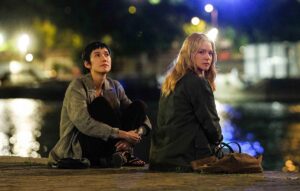
You will not find a more patient or more emotionally adventurous film than Hamaguchi’s latest–which is Japan’s entry for International Feature. We meet Virginie Efira’s Marie-Lou when she helps a younger nurse with a dementia patient’s frustrations. She shows him how he should use his hands when aiding a particularly elderly woman for her comfort, and that first interaction tells us so much about how Marie-Lou cares for others at the caregiving facility where she works. There is some tension between some overworked nurses the facility as she tries to get more professionals trained in Humanitude, a technique that would permit some who are battling dementia to eventually get up and walk on their own.
When Marie-Lou meets Tao Okamoto’s Mari, a theater director battling terminal cancer, it’s almost like we see their souls touching. In one of their first scenes together, they speak each other’s language about the enormity of life as they walk along the Seine. They philosophize about life, death, and care and later talk about how capitalism creates outsiders–it’s passionate problem solving mixed with gratitude and compassion. It made me think about soulmates and how we are lucky to discover connections even if it means we wish we had more time with those we love.
There is a way that Efira gazes at people, whether it is how Marie-Lou listens to Mari speak or when she is experiencing a bond with someone while she cares for them. She does so much without uttering a word–she bores into your heart effortlessly. How can one person, who has dedicated their career to the comfort and dignity to those who have lived a long life, turn that towards someone is much younger? And someone they just met and fell for? There is kindness fused with intelligence and heart, and her chemistry with Okamoto is my personal highlight of this film. I can’t stop thinking about it.
A film that I haven’t been hearing as much about since TIFF is Niki Byrne’s The Julia Set, starring Chase Infiniti. It felt like a lot of audiences wanted to see how she followed up her performance from the reigning Best Picture winner, One Battle After Another–people should check out her Emmy-nominated work in Hulu’s The Testaments. My press screening, which was in a larger theater at ScotiaBank Theatre Toronto, was very full that morning.
Infiniti plays Julia, a quiet but brilliant mathematics student who would rather work steadily and work on equations than go out like other college kids her age. A flirtation with Christopher Briney’s Pascal, a teaching assistant that comes from an affluent, prominent family, leads to a budding relationship as they both prepare to partake in the infamous Putnam Exam, led by Nina Hoss’ blunt, straightforward Dr. Zatlan. In certain situations, Julia shrinks herself, because she doesn’t know how to navigate matters of the heart, but her prowess with numbers never falters.
When Julia meets Pascal’s parents (played by Gillian Anderson and Jason Isaacs), she sees how her boyfriend cracks under certain types of pressure. Pascal’s father is a celebrated math scholar and his relationship with his wife mirrors what Julia and Pascal are about to embark on. In one of the film’s tensest scenes, Isaacs’ Aleksander berates and dismisses his son in front of their respective partners as they play chess together, and Pascal is reduced to a sniveling little boy humiliated by his father’s lack of compassion. Byrne never allows Julia to question her intelligence, and I loved the scenes between Infiniti and Carmen Ejogo, who plays Julia’s encouraging mother who doesn’t quite understand why her daughter has chosen this particular field of study. At the same time, there are sparks between Infiniti and Anderson when they share scenes with one another. The film’s final third has the excitement of a sports drama even when the script reduces Pascal a little too close to stubborn buffoonery. Infiniti is a joy to watch.
On a side note, one of my closest friends, Linges (more on him later), and I ventured over to the RBC Red Carpet Gallery to see if we could spot any actors or celebrities. At the back of the crowd, I couldn’t see anything since I am very vertically challenged, so I made my way back to King Street to find a bottle of water. It was stiflingly hot at TIFF this year during the day, and I was a sweaty monster. On my way out of the fenced area, I noticed a gorgeous woman walking towards me, and I realized that it was Amy Landecker. We met eyes, and I just blurted out, “Oh my god, I love you.” She was very kind, smiled, and thanked me, and all I could muster was, “Truly…I love you” before walking away.
Since I missed it at this year’s Telluride, I lucked out with my schedule to squeeze in Małgorzata Szumowska and Michał Englert’s The Idiot(s), an irreverent and cheeky look at Fyodor Dostoevsky’s struggle to create (and finish) one of his most heralded works. How did Dostoevsky become more akin to one of his own creations? The Idiot(s) is not a fall-from-grace dark comedy, but an exploration of how creation can come from moments of deep frustration. The writer is portrayed by Johnny Flynn (having a great festival season, by the way) with Aimee Lou Wood starring alongside him as his wife, Anna Grigoryevna.
Dostoevsky is right off the success of Crime & Punishment with readers wondering just how he got into the mind of someone who wants to commit the perfect crime. How does someone follow that up, everyone wants to know, as he and his bride arrive in Germany for their honeymoon, but he feels uneasy about Western Europe’s attitudes towards wealth and power as it compares to his Russian perspective. He does sets his eyes on Vicky Krieps’ Natasha right in front his new wife. They have an uninhibited dalliance in a garden in front of everyone as a childish game of hide and seek unfolds.

The Idiot(s) slides towards more dramatic territory almost like how characters of a classic novel cannot help by edge towards tragedy. Dostoevsky cannot deliver on his promise of new pages, and he has the delusional notion that he just needs to return to the casino in order to make money to keep him and his wife afloat. Anna has to manage secret deals over and over again in order to keep money flowing, and her adoration for her husband seems to have no bounds. Wood infuses Anna with an underlying optimism even as the couple faces unspeakable tragedy together even as she scolds his actions and carries the weight of their problems on her shoulders. Behind every good man…
Englert and Szumowska aren’t interested in re-creating history as much as skewering it with a sharp-witted tongue. The emotions land while it sticks its bawdy tongue out at the notion that there is only one way to create.
Art of performance sprouts so close to the violence of the battlefield has stuck with me ever since I witnessed Lukas Dhont’s third feature film, Coward. On a side note, I love how all of his films are all titled after one impactful word, but his latest has the most accusatory tone attached with it. This World War I yarn is beautifully crafted with tender hunger, but I didn’t expect to think of an individual soldier’s loneliness as it pertains to cowardice.
The rumbling emotion between two young, Belgian men accompanies the horrors of muddy trenches and the sounds of gunfire in the distance. Emmanuel Macchia’s Pierre is quiet and introverted even though his smile might deceive his comrades as they tease one another versus when we see moments of personal bliss and freedom later in the film. Dhont’s latest isn’t interested in exploring the horrors of war as it closes in but rather how the men on the ground have to find sanity, peace, and love from the inside out. Violence closes in throughout but these men find a way to combat war with creation and sex.

Pierre becomes transfixed by Valentin Campagne’s Francis whose flamboyance radiates more and more as the film progresses. His demeanor serves as an antidote to the collection of artillery or the organization of helmets of his fallen friends. He brings levity to the barracks where they sleep like when he dons feminine garb and pretends to go into labor–it eases their spirits and brings them together. Creating a space for themselves may not seem feasible, but when the troupe begins performing for other men to raise their spirits, everyone feels the difference.
Pierre watches Francis from an admirable distance almost as if he is afraid to take center stage or garner too much attention. Dhont films their first kiss with such intense tenderness that it feels like the world is going to fold in on them if their lips don’t touch. Their affection feels akin to survival, and the filmmaker plays with gender and sensuality in ways that we don’t associate with films about war. When some of the men are dolled up, their makeup is smeared within the whiskers of their mustaches, but they don’t try to hide either side of the gender spectrum coin. When higher-ranking officers take notice of the performances’ benefits, they grow in popularity, and the evolution of the costume design, from Isabel Van Renterghem, is absolutely engrossing.
_________________________________________________
Oh, you want to hear about Ms. Wiest?
I snagged a ticket to the world premiere of Cody Fern’s Closing Night–a film that I absolutely fell for. When I left the Princess of Wales’ Theatre, I ran into the publicist who sent me the ticket, and she asked me if I wanted to go to the party. Uh, yes, I do. Of course, I do!
I ran to my hotel room and changed, and I asked my friend Linges if he would like to join me since I was allowed to bring a guest. I ran across town–through the TIFF/King Street fray–to Harriet’s Rooftop on Wellington Street West, and I was convinced that no one from the film would still be there since the soiree began shortly after the premiere. I figured that going to a party, having a drink, and relaxing on the rooftop would be worth it even if we didn’t get to meet anyone from the film.
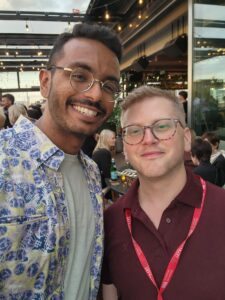 To our surprise, the party was still going strong and we enjoyed a glass of wine on the outdoor patio overlooking downtown Toronto. Linges then whispered that some of the stars of the film were sitting together in a curved booth that shared our same view. In the middle was Sarah Paulson, Naomi Watts, and the one and only Dianne Wiest. I didn’t want to bother them, so I was enjoying their presence from afar, and Linges and I saw Dianne get up and make her way back towards the opening of the party. We assumed that she was heading out, but we were thrilled to see her just the same before I decided to run to the restroom.
At the threshold to the balcony was a slightly curved metal track that allowed the large glass doors to slide open and closed, and just when I was about to cross this to go inside…imagine my surprise to see Dianne Wiest making her way back towards her table outside. Our eyes met and I stepped back to let her pass by me, and she asked me if I could give her a hand to cross the threshold since her dress was long and came to the floor.
“My pleasure,” I said, as I offered her my hand. She took it and crossed back outside where an enthusiastic group of friends was waiting for her return. Dianne, my new best friend, thanked me and gave my hand a squeeze. Our hands were clasped for an extra minute of two as she chatted before she gently let go and nodded in my direction.
Through the tiredness and the sweat from the blistering end-of-summer sun, meeting a true gay icon made my entire trip.
Farewell, Toronto International Film Festival. Until next year!