Celebrated Japanese filmmaker/author Miwa Nishikawa has adapted her own novel, Children Untold, into an extraordinary epic film that takes place before and after the atomic bombing of Hiroshima and Nagasaki and centers on one clever and resilient young girl’s incredible survival journey.
We first meet Kotoko (astonishing newcomer Ami Koyae) in March of 1945 as she’s defying her elders by playing the “music of the enemy” on piano (a French piece) and is labeled “unpatriotic” and a “disloyal dog.” Her teacher, Fumiko (Fumi Nikaido) comes to her rescue. Kotoko is desperate to return to Tokyo to her parents.
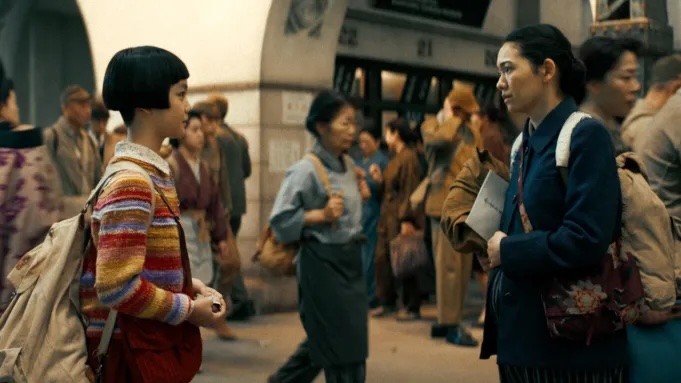
Six months later, post-nuclear-devastation, Kotoko is on a bus with friends and Fumiko, who is now pregnant. Unbeknownst to Kotoko, her parents are missing, her brother is away on duty, and her home has been destroyed. At the train station, Fumiko implores Kotoko to go with her to the orphanage, but a stubborn Kotoko insists on waiting for her parents. Fumiko apprehensively leaves—a decision that will have life-changing consequences.
Kotoko defiantly stumbles her way through the charred ruins, only to find her home has been decimated, but she sees her brother, Ritsuro (a heartbreaking Kaito Sakurai), hiding in the small basement remains of a home, shooting something into his arm. He is stunned to see her and buys her food.
In an amazing moment, while they are on the streets eating, Ritsuro asks to borrow a violin from a beggar and plays a beautiful solo, but as he plays, his grief-stricken look speaks volumes. He is broken. It’s a devastating and revealing moment. A few scenes later Ritsuro is found dead in a river. And Kotoko’s hell truly begins.
But she is savvy.
Our young heroine keenly sees what most young girls must do to survive (basically sell themselves or allow themselves to be raped) and decides to cut her hair, don rags and pretend to be a boy. Kotoko’s odyssey as a male street urchin lands her on a prison island with her new mates (for robbing the GIs food warehouse). Can she survive and will she be found out?
The film juxtaposes Kotoko’s travails with Fumiko’s horrific life where she must also debase herself to feed her new baby. She also continues to search for Kotoko.
In a scroll at the very end of her sweeping saga, Nishikawa notes that there were a recorded 120,000 orphans across Japan at the end of the Asia-Pacific War (although the exact number may never be known) and many were abandoned to violence, hunger and solitude and were unprotected or compensated by the Japanese government. Too many of these children died without ever being able to tell their stories. In Children Untold, she honors them with an absorbing, disturbing and compassionate film about hope, determination and survival.
The film reminded me of Liliana Cavani’s La pelle (The Skin), a searing look at Naples during WWII about how women and children of both sexes were commodities and people did the most heinous things in order to feed themselves.
Norimichi Kasamatsu’s stirring cinematography and Marihiko Hara’s rich score are to be commended as is the entire ensemble, especially the children.
It’s a shame this isn’t Japan’s International Feature Oscar submission, although I have yet to see All of a Sudden…
World Premiering at the Toronto International Film Festival.
In Japanese, with English subtitles