
The massive success of Christopher Nolan’s The Odyssey reminded me of a little-seen 2024 film called The Return. Directed by Uberto Pasolini (the grandnephew of the great Italian filmmaker Luchino Visconti) and starring Ralph Fiennes as Odysseus and Juliette Binoche as Penelope, the film came and went two years ago, earning just over two million dollars at the box office.
Pasolini’s take on Homer’s epic poem is far more intimate than Nolan’s. The cast isn’t massive or full of recognizable faces. It begins with Odysseus washing up on shore, thereby cutting out the Trojan War, the cyclops, the giants, the sirens, or even any mention of the gods. There is only home and what is left of it. It is as earthbound a telling as one could ask for. The Return is also far gnarlier. When Fiennes’ Odysseus washes up on the beach at Ithaca, he not only kisses the ground; he eats it. He is discovered by Eumaeus (Claudio Santamaria) wearing not a single stitch—Fiennes’ cannon and rollers out there for all to see.
Just like Nolan’s take on the classic story, The Return concerns itself with guilt and the cost of war to one’s humanity. But by winnowing the story down to Odysseus’ return home, The Return is a far more haunting affair than Nolan’s Odyssey. Too often in Nolan’s telling, his film feels episodic as it hits each part of Odysseus’ journey back to Ithaca. I can understand why, in a huge motion picture like The Odyssey, Nolan would want to include the cyclops, the giants, the sirens, and Samantha Morton’s show-stopping turn as Circe. The problem is none of these sequences (save Morton’s mini-horror film within a film) lands in a way that feels like something more than a box-checking exercise. It’s all very “this happened then that happened.”
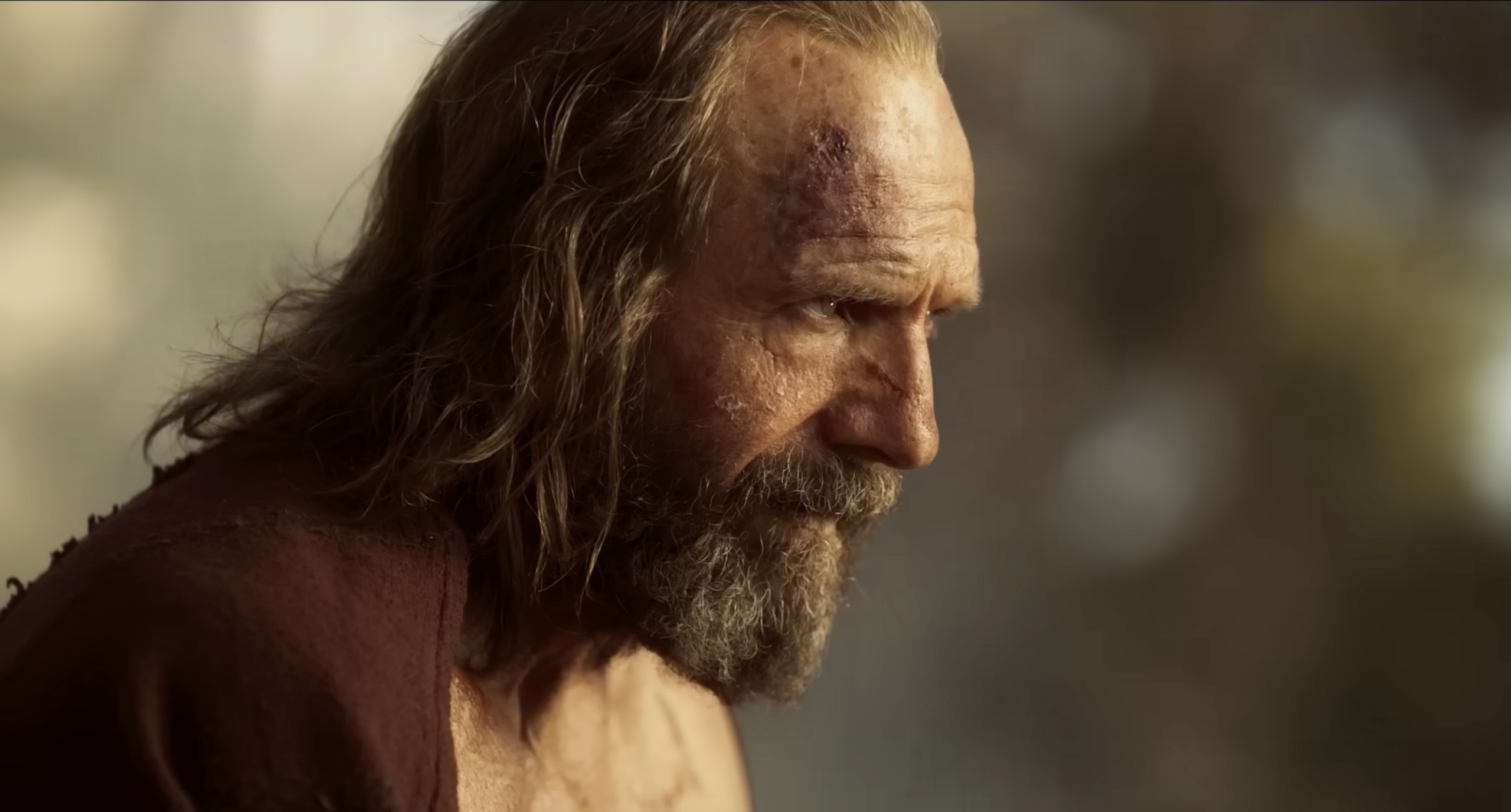
Only in The Odyssey’s late-film flashback to the carnage at Troy does the movie gather up its intended force and focus. As Matt Damon’s Odysseus walks through Troy, almost like a spectator, we see the horror of war reflected on his face. However, in The Return, we get that same sense of guilt and grief just by looking at the face of Fiennes alone. We do not need the horror of war, the Trojan Horse, or even for Fiennes to give us a retelling of any length. The misery of surviving the madness of war rests right upon Fiennes’ grim visage.
For all the casting controversies that preceded Nolan’s Odyssey (The Return uses a diverse cast, too), few pointed at the most concerning choice: Matt Damon as Odysseus. Damon is an outstanding actor who has played a variety of roles with skill, but his Odysseus feels too modern, too inauthentic despite the actor’s best efforts. Fiennes feels like Odysseus from the second he lifts his head off the beach. Weathered, ragged, with the lines of experience surrounding his eyes, Fiennes supplies a core to the character that Damon can’t quite muster. All the moaning and groaning over Lupita Nyong’o and Elliot Page as Sinon completely missed the point. The classics should belong to everyone. The issue isn’t one of appearance, but whether the actor can capably inhabit the role. Nyong’o and Page are not the least bit problematic in The Odyssey; Damon is.
Damon has a youthfulness and optimism (even at 55) that work against his portrayal. He’s hardly bad in the film—his commitment to the role and his talent as an actor don’t allow that—but he’s not right. Fiennes, with his eyes like deep pools of sorrow his scarred skin, and his ripped muscles, bears all the signs of a man who has seen and done too much. Too much to ever feel like he deserves to come home after all these years away. He is not the man who left the island. The man he is now despises what he has become. There is an internal pain in Fiennes that Damon can’t reach.
Binoche as Penelope may not outshine Hathaway in The Odyssey to the same degree that Fiennes overtakes Damon. Still, the great French actress (with very little dialogue) inhabits Penelope fully, and more looks the part. Hathaway is a wonderful actress who, like Damon, plays younger than her years (she’s 44)—not an asset for The Odyssey. As Binoche’s Penélope delays the suitors who want her for only crown and coin, there is an anger in her that is palpable as she creates and destroys the shroud she is weaving on a nightly basis. Anger at her circumstances, at her callow son Telemachus (played by Charlie Hunnam), and most of all, anger at a husband who promised to come back and has perhaps taken too long. When she utters the line, “Has all this waiting been for nothing?” the weight of the words lands like a stone in your stomach.
The Return is most fully about the price of war, not so much the cost paid by those who were vanquished, but by those who did the vanquishing. Speaking of Troy, Fiennes’ Odysseus states, “The city could never be won, only destroyed.” Odysseus was the destroyer, and his soul cannot carry the burden of what he has done.
If there is any purpose to war, it is for the victors to arrive at a place that is better than before. The Return argues that war can’t achieve that purpose. The inhumanity of war can only leave us with less, poetically and actually. No spoils are worth the cost. “For some war becomes home,” Fiennes states. And you believe him. He has no interest in his legacy. He wants what he had before. A life with a beloved wife, a young son, and his hunting dog (the death of Argos is far more affecting here than in Nolan’s film). Odysseus has missed and lost so much during his two decades away from home. He can return, but he cannot regain, and he knows it.
The Return is not a perfect movie. Budgeted at $20M (less than a tenth of Nolan’s film) and running one hour shorter, there are parts of the film that feel a little slight, a little small. The film also doesn’t provide much backstory. If you don’t already know Homer’s tale, you might not connect with the material as easily.
But as the film reaches its climax, as Fiennes bends his bow to his bidding and dispatches the scoundrel suitors before falling into the arms of Binoche, completing the journey from sea to shore, from war to the bosom of Odysseus’ true home of Penelope, there is a lift experienced that was lacking in Nolan’s take. Pasolini’s film breathes more. It doesn’t take on too much. For all it may lack in star power and budgetary largesse, The Return beats The Odyssey by aiming its arrow at the heart instead of spectacle.
Its aim is true.