On this 250th birthday of these “United” States, we will be told how great this country is and has always been. There will be flyovers to note our military might, fireworks to color our night, and a President only too eager to make the anniversary of this country’s founding all about him. He will present himself as the symbol and arbiter of all things patriotic. Flags will wave, eagles will soar, Lee Greenwood will sing that song, and a great many of us will sing along.
But patriotism, as the leaders of the United States have often defined it, has always come with a good deal of gaslighting. Support your country “right or wrong,” we have often been told. Sometimes with an insidious whisper, and at other times, like right now, with a fatuous bellow. A key bullet point on the list of blind obedience is to “support our troops.” No matter the nature of the conflict or the cost of it.
In 1989, just three years after writing and helming the Oscar-winning Vietnam War film Platoon, director Oliver Stone returned to the defining subject of his life and career with Born on the Fourth of July. Based on the autobiography of Marine Ron Kovic, the film focuses primarily on Kovic’s life after the Vietnam War. Stone had been attempting to bring the film to the screen for well over a decade before it was finally released. In 1976, William Friedkin (The French Connection, The Exorcist) was attached to direct with Al Pacino set to play Kovic from Stone’s adapted screenplay. The project languished in development hell, and Friedkin and Pacino left.
What seemed like a death knell was just a delay. Stone burnished his credentials as a screenwriter, earning an Oscar nomination for his adaptation of Midnight Express (1978), as well as scripting Conan the Barbarian (1982), Scarface (1983), and Year of the Dragon (1985). He also wrote and directed the failed 1981 horror film The Hand, starring Michael Caine. In 1986, Stone would break through as a director with both Salvador and Platoon. The former received two Oscar nods: Best Actor (James Woods) and Best Original Screenplay (Stone). The latter became an instant classic, garnering eight Oscar nominations and winning four (including Best Picture and Best Director). Platoon also grossed a then-astonishing $138 million ($426 million when adjusted for inflation). With awards and box office might in hand, Stone returned to Kovic’s story, and this time, not only would the film get made, but he would also direct.
The filmmaker’s dogged pursuit may have led to an arduous journey to fruition, but when the opportunity came, Stone would be ready. Few directors in history have had a ten-year run like Oliver Stone had from 1986 to 1995. Over that decade, an Oliver Stone film was more than a slot on some production studio’s release calendar; it was an event. Salvador, Platoon, Wall Street, Talk Radio, Born on the Fourth of July, The Doors, JFK, Heaven & Earth, Natural Born Killers, and Nixon exhibited a breathtaking array of subjects and directorial prowess from that era, and many of those films came with no small amount of controversy. Oliver Stone made you pay attention whether you liked his films or not.
When Stone set out to finally make Born on the Fourth of July, he was at the peak of his powers. He wasn’t cooking with gas; he was firing with nitroglycerin.
It’s not difficult to understand why Stone would have such an affinity for Kovic’s story. Like Kovic, Stone enlisted in the military during the Vietnam War (the Charlie Sheen character in Platoon is essentially Stone’s avatar). Both men joined the fight based on their strong belief in America and a sense of duty to their country. Both men would also leave Vietnam disillusioned by the conflict. Stone sees a version of himself in Kovic, because he was a version of Kovic. While Stone would come home intact, Kovic would not. A bullet from the rifle of a Viet Cong soldier would sever his spine, leaving him permanently without the use of his legs.
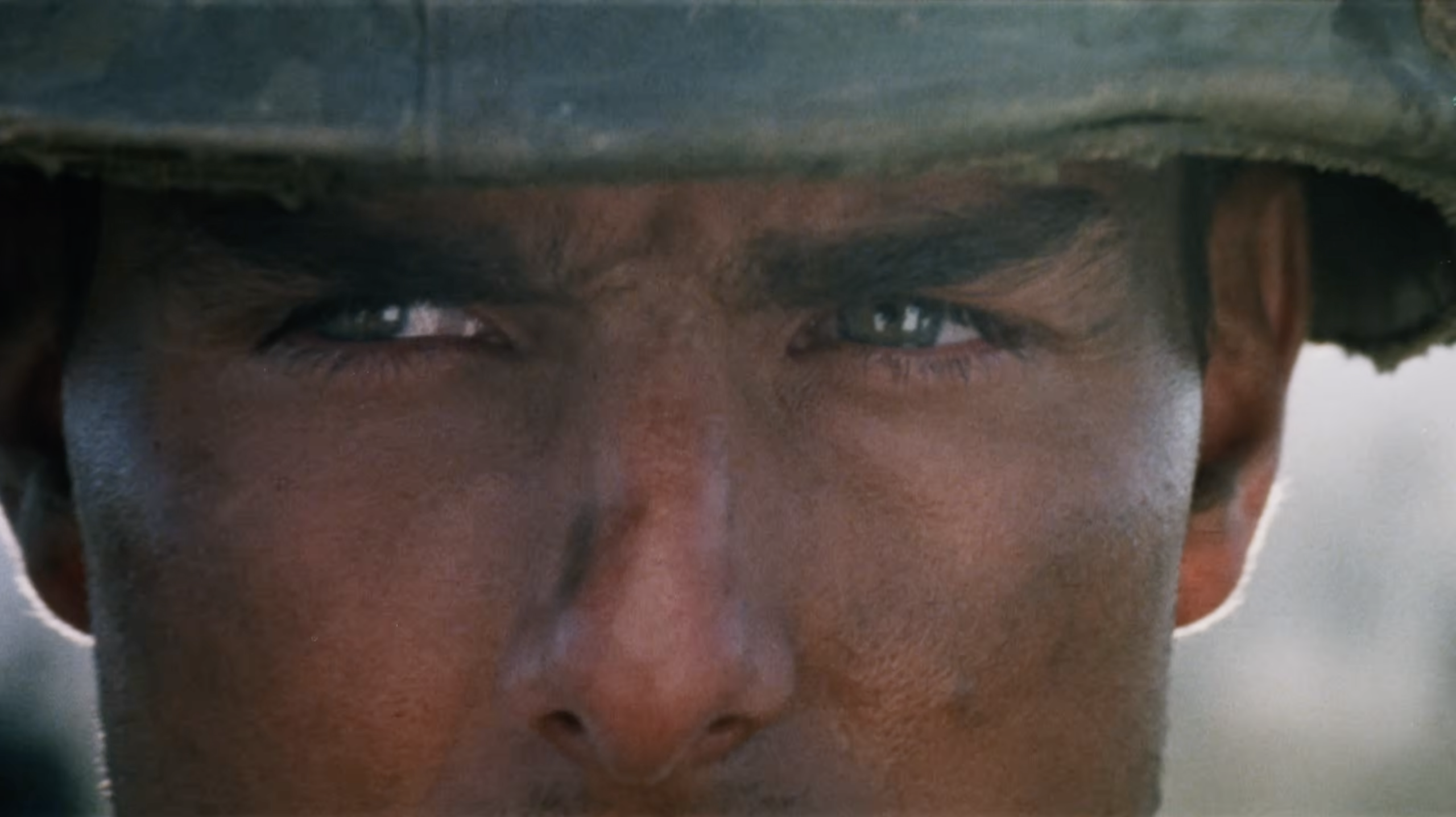
To play Ron Kovic, Stone selected the hottest young movie star in the world: the then 27-year-old Tom Cruise. Cruise was on a four-film winning streak at the box office. Top Gun, The Color of Money, Cocktail, and Rain Man were all massive hits, with The Color of Money and Rain Man winning Oscars and earning Cruise the best reviews of his young career.
Cruise had shown off his underrated chops by holding his own across from legends Dustin Hoffman in Rain Man, and Paul Newman in The Color of Money. As admirable as those two achievements are, nothing could prepare filmgoers for Cruise in Born on the Fourth of July. However daunting it may have been to face up to Hoffman and Newman, in Stone’s film Cruise had to carry all the weight on his own. While the film showcased notable supporting turns from Kyra Sedgwick as Kovic’s high school crush and Willem Dafoe as a fellow paraplegic Vietnam veteran, Cruise is in every scene.
If Cruise didn’t bring the goods, Born on the Fourth of July would have failed. Cruise has had a remarkable career as a movie star, and when asked to deliver in complex material, he has more often than not proven to be outstanding (Magnolia, Jerry Maguire, Eyes Wide Shut). Even so, of all of Cruise’s relentless triumphs, Born on the Fourth of July contains the best two hours and twenty-five minutes of pure acting from the biggest on-screen star of the last fifty years.
The level of commitment that Cruise brought to the set each day is the stuff of Hollywood legend. When Stone suggested that Cruise receive an injection to numb his body from the waist down, the young actor was eager to comply. Stone and Cruise would be thwarted by the film’s far more rational insurers, so Cruise became one with the chair. Even between scenes, Cruise would not leave his wheelchair while on set. He became an expert at rolling, turning, and popping wheelies. He was all in. There is something almost perverse about casting the running man in a film and then taking away his legs, but in doing so, Stone drew depths from Cruise that even the most hardened critics couldn’t deny.
Born on the Fourth of July begins with a group of boys playing army in Massapequa, 1956. The score (by John Williams) is swoony and romantic, set against a backdrop of fireworks, waving flags, the family dog, and the voice of John F. Kennedy saying “Ask not what your country can do for you…” The opening sequence is practically “baseball, hot dogs, apple pie and Chevrolet.” It is a portrait of Americana.
The young Ron Kovic is an overachiever and a true believer. Cruise could probably relate to those attributes. There is a force of will that comes with Tom Cruise. A sense that he is willing to run through walls to win for his movie. When Kovic loses on the wrestling mat, the shock and disappointment in Cruise’s eyes is more than palpable. Both the character and Cruise are humbled before our eyes. Because Cruise plays Kovic, the impact is all the more affecting. Tom Cruise does not lose.
Inspired by a high school event featuring members of the Marine Corps, Kovic is taken by the particularly strident speech of a corps officer (played by Tom Berenger in a brief but meaningful cameo), and he enlists to “serve his country” and fight communism. But did his country serve him? Kovic’s naïveté is painfully present. It’s the naïveté that comes with youth, unquestioning patriotism, and the kind of blind faith that can get you killed, or in Kovic’s case, paralyzed from the waist down. Later in the film, when Kovic says he would give up everything he believes in just to be whole, it’s a heartbreaking shift in perspective.
During the film’s brief but searing war scenes, Kovic’s unit is seen killing villagers, civilians, and children. Kovic accidentally kills a fellow Marine in a case of friendly fire, not long before he is injured. War is hell, they say. So is a bullet to the spine. The trauma Kovic suffers goes beyond the body and deep into the mind. After Kovic comes home, his hometown throws a parade in his honor. As Kovic makes his way down the motorcade in full dress uniform, you see him flinch as fireworks go off. My dad was a Vietnam combat veteran. He told me that when he first came home from the war, he would hit the ground every time a firecracker went off. It is a bizarre and confounding tradition to celebrate veterans by lighting explosives and sending them into the air.
One night, a drunk Kovic comes home to his very conservative Christian parents, railing over his state of being. It’s a wrenching scene full of rage, self-pity, and a consuming sense of doubt over the worth of his life and his once rigid belief in his country. He asks his father, “Who’s going to love me, dad?” He screams at his mother, “Big fucking erect penis!” when she takes offense to the anatomical reference to his lost manhood. He tells both of his parents, “God is as dead as my legs.” Still, Kovic is in “Love it or leave it” mode despite all that he has experienced thanks to a misguided war started by a government with no exit strategy and no clear objective. Born on the Fourth of July may be 37 years old, but it is not lacking in relevance.
As Kovic learns to accept his physical reality, he begins to reject the false reality that had guided his life. He becomes a skeptic about the war, and eventually an activist against it. Change comes slowly for a man like Ron Kovic, and Stone and Cruise make you feel every begrudging step along the route to Kovic’s awakening. The film culminates in Miami, at the 1972 Republican Convention, with the crowd shouting “Four more years!” as Richard Nixon speaks. It’s a reminder that those who lead us aren’t necessarily for us. In this age, Nixon seems practically quaint, but the pattern that Born on the Fourth of July exposes is clear: Those who take us into war will attack the patriotism of those who question the efficacy and rationale of “the mission.”
For all the film’s focus on Kovic’s personal story, its underlying question is “What does it mean to be a patriot?” Kovic is the vessel that carries us from one end of the spectrum to another, more thoughtful and insurgent viewpoint.
Ron Kovic was born on the Fourth of July, 1946. 170 years after the country’s founding. A compromised country that remains more promise than fruition. The Declaration of Independence is an artful, transcendent document, but it is a compromised one. Those who wrote it committed genocide against the indigenous population. They built the economy and the White House by enslaving Africans. Those who followed took advantage of Chinese immigrants to build the railroads. To this day, our agricultural, construction, and service economies rest on the backbones of Latinos. This is a country that stated “All men are created equal,” and has proven time and time again that cheap labor rules the day, even as those who provide it live under constant threat of violence and deportation.
That cheap labor applies to wars, too. During the Vietnam War, an estimated 80% of all enlisted men were made up of the working class, the poor, and minority groups who weren’t “fortunate sons.” They were young men targeted by the government for service because they lacked access to opportunity and power. They were those who would not be missed.
Ron Kovic was not one of those men. Kovic could have gone to college, taken a deferment, and avoided the war. He chose not to, and it cost him dearly. He did not waste his life, though. Despite the trauma of war and painful infirmity, he challenged his government. He stood up for those from less fortunate backgrounds. He defined patriotism through righteous dissent. He became a soldier of conscience.
The film that tells his story does not compromise. It leans into his suffering, and it heralds his hard-won enlightenment. It’s a painful film to watch, akin to getting burnt by a lit cigarette for 145 minutes. But you have to take the pain to understand what it means to be Ron Kovic, to be a patriot, to be Born on the Fourth of July.